listen to the audio of this article
When Rolls-Royce revived its historic Coachbuild division with the one-off Sweptail in 2017, the response from would-be clients was immediate: several patrons approached the brand asking for something equally personal. Three of them, unrelated but united by a shared love of contemporary yacht design, became the genesis of the Boat Tail — unveiled in 2021 as the first car born from Rolls-Royce’s newly formalized Coachbuild program, and, by most accounts, the most expensive new automobile ever built.
Three Cars, Three Stories
Only three Boat Tails exist, and unlike a limited production run, no two are remotely alike. Each was designed around months of dialogue between Rolls-Royce’s Coachbuild team and the individual client — less a car commission than a kind of automotive biography.
The first car, finished in a shimmering oceanic blue lacquer infused with crystal flake, was widely reported in the press at the time to belong to Jay-Z and Beyoncé, both known for hosting elaborate dinner parties — though Rolls-Royce has never officially confirmed the identity of any Boat Tail owner. Its rear hosting suite was stocked with the couple’s reported favorite vintage: Armand de Brignac champagne, chilled to the ideal serving temperature. A later commission took a different emotional register entirely: finished in a cognac-toned paint infused with oyster and rose-gold metallic flake, its rear deck houses a deployable presentation case designed specifically to display the client family’s pearl and gemstone collection — a car built, quite literally, around a family business.
The Hosting Suite
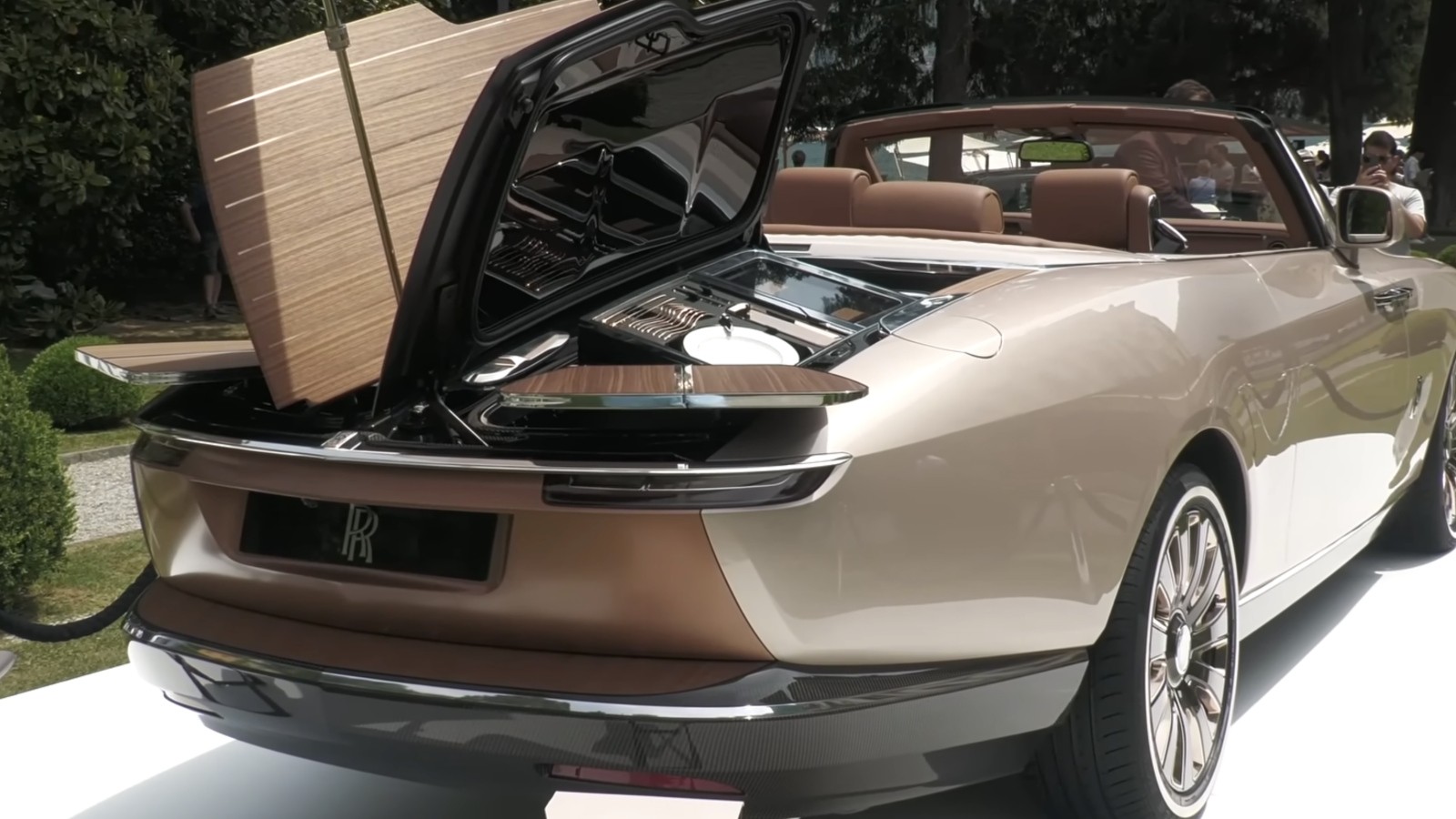
The Boat Tail’s signature feature sits beneath its elongated rear deck. At the press of a button, two lockable panels — hinged at the center and finished in chrome on their undersides — swing open in a sweeping, symmetrical butterfly motion, a gesture Rolls-Royce says was inspired by the cantilevered structures of architect Santiago Calatrava. Rolls-Royce’s Head of Coachbuild Design has called the mechanism itself “an engineering marvel.”
What the panels reveal is less a trunk than a fully staged entertaining suite: a bespoke champagne chest with two chilled bottles, refrigerated storage, and a matched set of crockery and cutlery, all custom-made and, according to Rolls-Royce, entirely without spares — if a piece breaks, the company remakes it from scratch. On either side, rotating cocktail tables finished in matching wood open to reveal a pair of interlocking stools by Italian furniture maker Promemoria, crafted from leather and carbon fiber and designed to fold away when not in use. A parasol, stowed in the center of the deck, extends to shade the whole arrangement. Rolls-Royce built the entire assembly as a kind of contemporary reinterpretation of the wooden rear decks found on the marque’s own 1932 Boat Tail models, several of which one client owned and had lovingly restored.
Design and Materials
Seen from any angle, the Boat Tail reads as a single, uninterrupted surface — Rolls-Royce’s designers deliberately avoided visible panel breaks along its 5.8-metre length, giving the body the seamless quality of a hull rather than a conventional car body. The brand’s familiar Pantheon grille has been softened and effectively deconstructed into the front-end design rather than presented as a standalone element, paired with headlights carrying a strong horizontal daytime-running-light graphic.
Wood plays as prominent a role as paint. Open-pore Caleidolegno veneer — book-matched and perfectly symmetrical, reminiscent of a wooden hull — appears across the rear deck and cabin, while the third commission goes further still, using varnished teak paneling inlaid with mother-of-pearl. Inside, the cabin favors an analog, minimalist dashboard over digital displays, a deliberate choice to preserve what Rolls-Royce calls a timeless aesthetic. The signature Starlight Headliner — thousands of fiber-optic points simulating a night sky — appears here too, alongside an electrochromic privacy glass panel that can tint to separate front and rear occupants. Several cars have also included two-sided bespoke timepieces, one designed for each occupant, that can be worn or mounted in the fascia as a car clock.
What’s Underneath
Mechanically, the Boat Tail is built on Rolls-Royce’s Phantom platform and shares its 6.75-litre twin-turbocharged V12, producing roughly 562 horsepower (419 kW). Rolls-Royce has never published official performance figures for the car — a deliberate omission, the company has said, because the Boat Tail was never conceived as a car to be timed or raced. It’s generally understood to be electronically limited to around 155 mph, the same ceiling shared across most modern Rolls-Royce models, in keeping with the brand’s preference for effortless, unhurried performance over outright numbers.
Price and Legacy
Rolls-Royce has never disclosed official pricing for any Boat Tail, and because each commission includes different materials, objets d’art, and scope of bespoke work, estimates vary considerably. The figure most consistently cited by outlets covering the car’s 2021 debut was around $28 million, though some later reporting on individual examples has placed the price as high as $30 to $38 million depending on specification. Whatever the true number, the Boat Tail is widely regarded as the most expensive street-legal new car ever built, a title it held before Rolls-Royce’s own Droptail series arrived in 2023 with commissions reportedly costing over $30 million apiece.
No further Boat Tails are planned. With all three commissions completed and delivered — one spotted as far afield as Dubai, registered in Ajman — the model remains a closed chapter in Rolls-Royce’s modern Coachbuild story, sitting alongside the Sweptail and Droptail as proof that the marque’s ultimate luxury was never really the car itself. It was always the willingness to build one around a single client’s entire life.