listen to the audio of this article
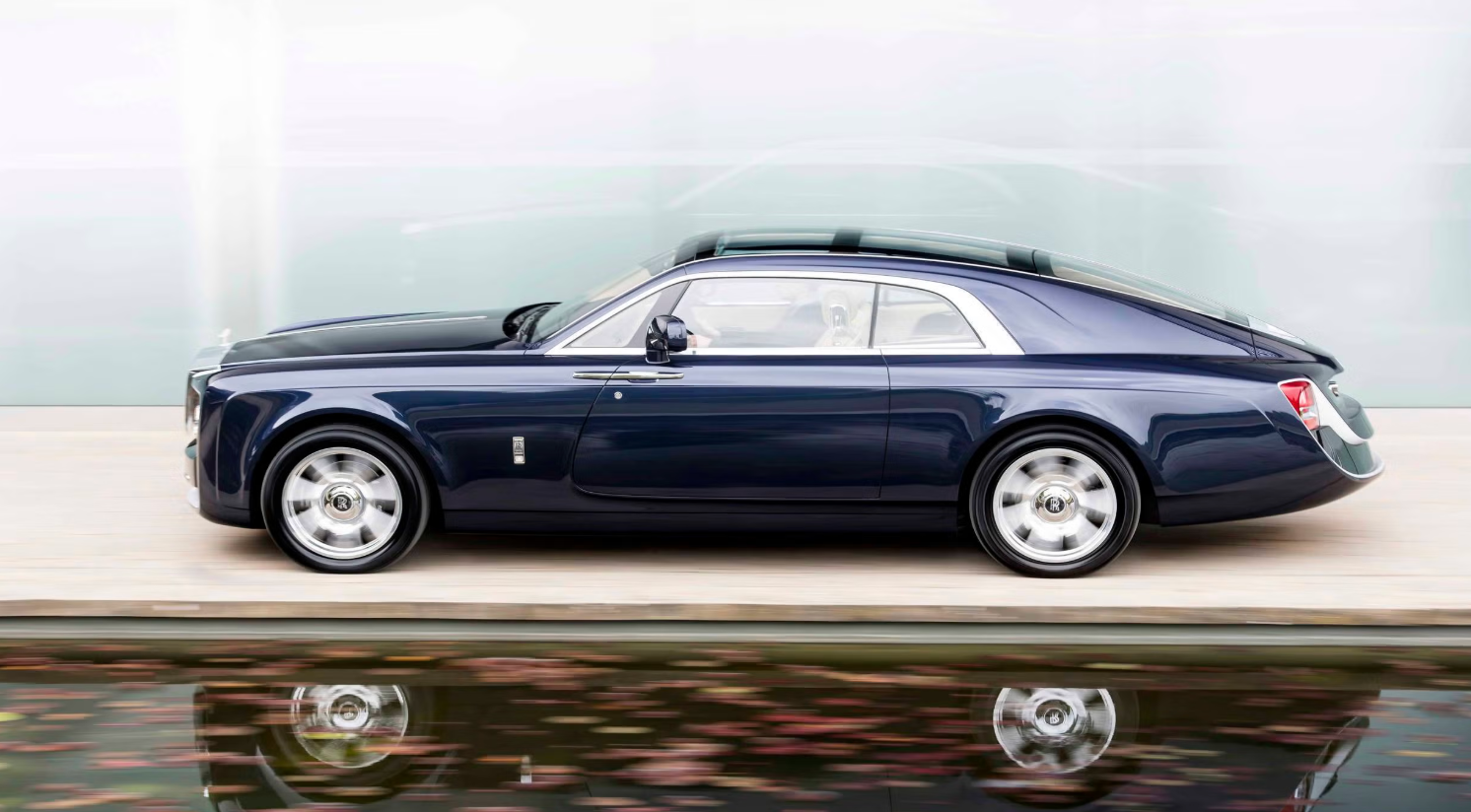
Unveiled in May 2017, the Sweptail remains one of the purest expressions of what happens when a storied automaker builds without a spec sheet, a sales target, or anyone to please but a single owner.
The Sweptail is a two-door coupé assembled at Rolls-Royce’s Goodwood plant in Chichester, West Sussex. Rather than engineering an entirely new platform, the marque built it on the mechanical foundation of the Rolls-Royce Phantom Coupé — a sensible decision that let the design team pour its energy into the bodywork rather than reinventing what sat beneath it.
Under the hood is the familiar 6.75-liter V12, producing 453 horsepower (338 kW) and 531 lb-ft of torque, sent to the rear wheels through a ZF 8-speed automatic transmission. That’s enough to move the roughly 5,645-pound coupé from 0 to 60 mph in about 5.6 seconds and on to a top speed of 155 mph — respectable numbers, though entirely beside the point on a car like this. The Sweptail’s rear-hinged “coach” doors, borrowed from the Phantom Coupé, add a final period-correct touch to a car that otherwise looks like nothing else Rolls-Royce has built in decades.
For a commission this exclusive, the drivetrain really is the least interesting part of the story. What makes the Sweptail unlike anything else on the road is everything layered on top of that Phantom-based mechanical package.
Exterior Highlights and Interior Features
The car’s silhouette is its entire reason for being. A long, tapering rear deck sweeps down toward the tail in one unbroken line — the detail that gives the car its name, and a shape that owes far more to pre-war coachbuilt Rolls-Royces than to anything currently in production. Rolls-Royce’s designers have said the form drew on cars like the 1925 Phantom I Round Door and several 1930s Park Ward and Gurney Nutting coachbuilt Rolls-Royces, filtered through the client’s fondness for classic yachts.
The rear boat-tail section was hand-formed from aluminum to achieve its seamless curvature, and remarkably, the entire exterior uses only five body panels and two A-pillars — an almost absurdly low number for a modern production vehicle, achieved only because there was never any intention of stamping a second one. A curved, panoramic glass hatchback dominates the rear, one of the largest and most structurally complex glass roof sections Rolls-Royce had fitted to any car at the time. Up front, an oversized chrome grille — among the largest ever fitted to a Rolls-Royce, and milled from a single block of aluminum rather than assembled from the usual stainless-steel vanes — sits alongside redesigned LED headlights and large circular lamps. Even the front and rear number plates were treated as part of the car’s sculptural language: hand-formed and polished from solid aluminum ingots rather than simply bolted onto the bodywork.
Step inside and the customization only intensifies. The cabin was built strictly as a two-seater, sacrificing rear seating entirely in favor of space and craftsmanship — the area where rear seats would normally sit is instead an elaborately sculpted shelf in polished Macassar ebony with a backlit lip. The uninterrupted glass roof floods the cabin in natural light, illuminating hand-finished trim throughout, including polished Macassar ebony paired with open-pore Paldao for a deliberate light-and-dark contrast. A dedicated set of bespoke luggage was designed to fit the trunk exactly, nestled among wood cladding and polished aluminum rails, while the exterior’s two-tone blue paintwork carries through into coordinating interior detailing. Rolls-Royce has also described hidden compartments built into the doors, holding custom-fitted attaché cases.
The Feature Everyone Talks About
No writeup of the Sweptail is complete without its signature party trick. Built into the center console is a push-button mechanism that deploys a chilled bottle of the owner’s favored vintage champagne — reportedly a 1970 Dom Pérignon — alongside two crystal flutes, positioned within easy reach of the front seats. The deploying mechanism itself was engineered with milled aluminum gears rather than off-the-shelf plastic components, apparently so that not even the champagne dispenser would compromise the car’s bespoke standards. It’s a small piece of engineering in its own right: a fully functioning champagne bar built directly into the dashboard.
Price and Records
Rolls-Royce has never officially confirmed a sale price for the Sweptail, and estimates have varied depending on the source, typically clustering between $12.8 and $13 million. At its May 2017 debut, most reporting converged on a figure of roughly £10 million (about $12.8 million), which made it the most expensive new car in the world at the time — more than triple the price of a Bugatti Chiron. Rolls-Royce’s chief executive at the time, Torsten Müller-Ötvös, was notably reluctant to confirm that number publicly, neither endorsing nor denying it outright.
The Sweptail held the title of the world’s most expensive new car until 2019, when it was surpassed by the Bugatti La Voiture Noire, reportedly sold for around $18.7 million before tax.
The Sweptail made its public debut in May 2017 at the Concorso d’Eleganza Villa d’Este, the annual celebration of the world’s finest automobiles held on the shores of Lake Como, Italy — a fitting stage for a car built entirely around exclusivity and craftsmanship rather than mass appeal.
The Bottom Line
The Rolls-Royce Sweptail isn’t just an expensive car — it’s a singular object, built once, for one person, with details (a champagne cellar in the console, hand-polished aluminum license plates, custom-fitted luggage, a five-panel body) that exist nowhere else in the automotive world. Its real significance runs deeper than any price tag, though: it marked the revival of Rolls-Royce’s historic Coachbuild division, dormant since the early 20th century, and set the template for the one-off commissions that followed — the Boat Tail in 2021 and the Droptail series beginning in 2023. It remains one of the clearest examples of what happens when a manufacturer builds without limits: not a faster car, or a more powerful one, but simply a more completely personal one.