listen to the audio of this article:
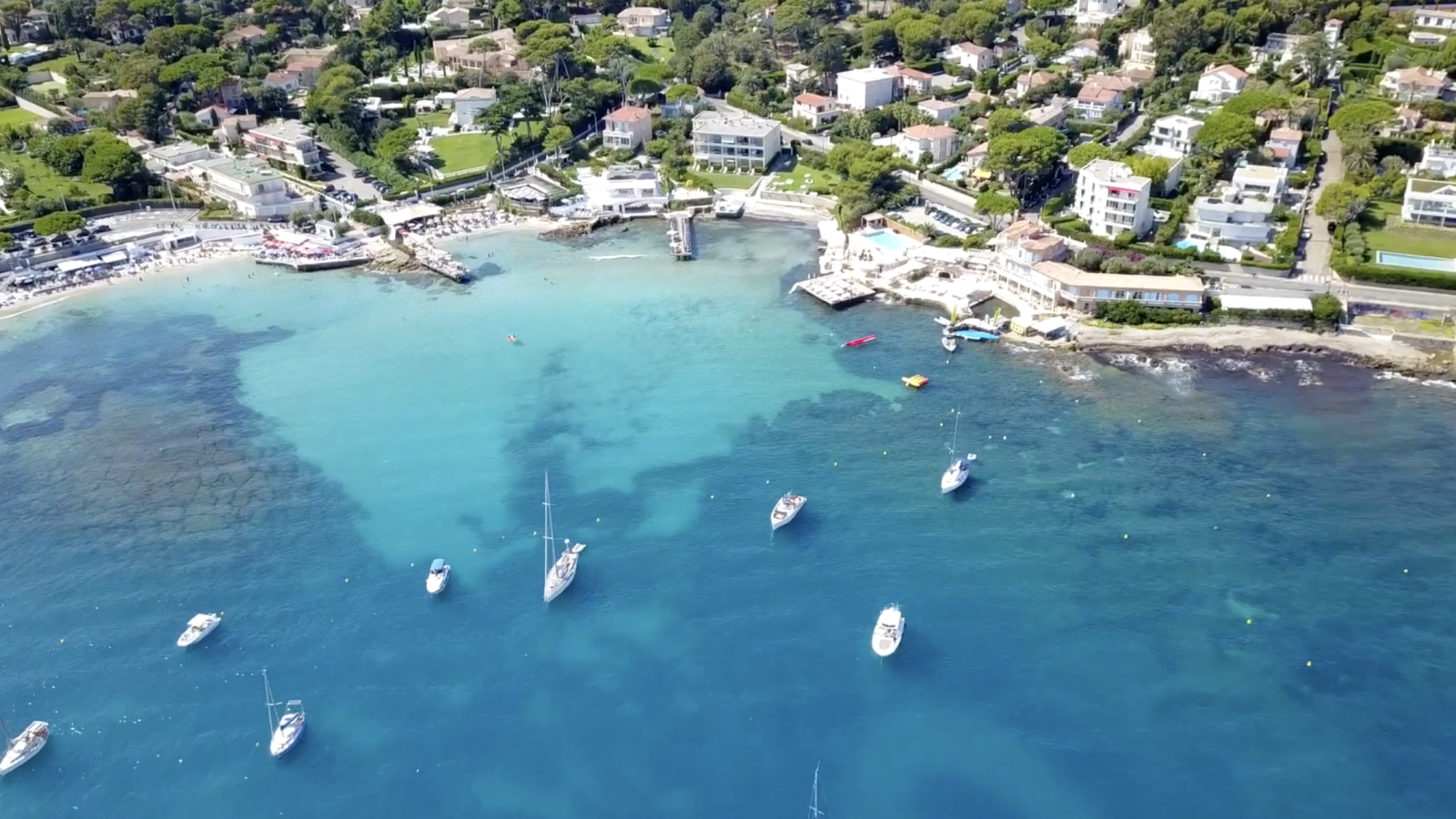
At the southern tip of the Antibes peninsula, where the pine-covered cliffs of the French Riviera meet the Mediterranean, lies a small cove that has become shorthand for extreme wealth itself. Often referred to as the “Bay of Billionaires,” Antibes is one of the most legendary locations on the French Riviera, nestled on the rocky outcrop overlooking the sea between Cannes and Nice. It is a place where superyachts idle offshore, hidden fortunes sit behind gated villas, and a swimming cove barely large enough for a few dozen sunbathers has become one of the most photographed patches of water in Europe.
A Name Born of Silver Light
For all its modern reputation, the bay’s actual name has nothing to do with billionaires at all. The “Billionaires’ Bay,” whose real name is Anse de l’Argent-Faux, sits at the foot of Villa Eilenroc, and was initially accessible only by boat before a small pedestrian path opened it up in 2011. The poetic original name — roughly, “cove of fake silver” — comes from the water itself: in good weather, the sea produces silvery reflections at the spot. The nineteenth-century poet Paul Arène once described the wider cape in similarly luminous terms, evoking rocky creeks so thick with fish that the seabed itself seemed paved in silver.
The “billionaires” nickname is a much more recent invention, born of the bay’s heavy traffic of prestigious yachts and the fact that the cove remained inaccessible by land for so long that reaching it was, for decades, the exclusive privilege of yacht owners arriving by sea. That exclusivity — geographic before it was ever financial — is really the origin story of the nickname.
The Hotel That Started It All
The bay’s transformation into a byword for glamour is inseparable from one building: the Hôtel du Cap-Eden-Roc, perched nearby on the same stretch of coastline. Opened in 1870 as a private mansion called Villa Soleil, the property became a hotel in 1889 after Italian hotelier Antoine Sella purchased it, and an additional Eden-Roc pavilion was added in 1914, roughly 400 yards from the main building.
By the 1920s, the hotel had become ground zero for the Jazz Age’s transatlantic elite, sitting at the crossroads of the Modernist movement and drawing writers such as Ernest Hemingway and F. Scott Fitzgerald, along with artists ranging from Marc Chagall to Pablo Picasso. Fitzgerald did more than simply stay there — the hotel was immortalized as the fictional “Hôtel des Étrangers” in his final novel, Tender Is the Night, whose opening lines describing a “large, proud, rose-coloured hotel” on the Riviera shore were understood by contemporaries to be describing the Hôtel du Cap in only the thinnest of disguises.
The Villas Behind the Trees
What truly earns Cap d’Antibes its nickname, though, isn’t the hotel — it’s the string of private estates hidden in the pine forest around Billionaires’ Bay. These properties have passed through an extraordinary sequence of owners spanning European aristocracy, shipping fortunes, and post-Soviet wealth.
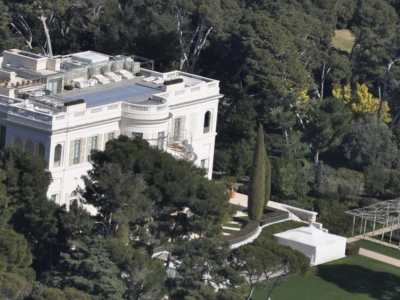
Villa Eilenroc, at whose foot the bay itself sits, is one of the cape’s most storied estates. Constructed in 1927 by designer Armand Albert Rateau for Sir William Pomeroy Burton, president of Associated Newspapers, the villa was acquired in 1938 by the Duke of Windsor, the former King Edward VIII. Later owners included Greek shipping magnate Stavros Niarchos, and in 2004 Russian billionaire Roman Abramovich purchased the château, set within an eight-hectare park designed by landscape architect Peter Wirtz.
Just along the coast, Château de la Croë carries its own tangled history of Russian ownership. Abramovich’s connection to the area predates his purchase of Eilenroc: he had spent time as a guest at the nearby Château de la Garoupe in the late 1990s, while still on good terms with its then-owner, the Russian oligarch Boris Berezovsky, before later acquiring his own separate estate on the cape.
And Château de la Garoupe itself — built in 1907 for a British aristocrat, later owned by Berezovsky, seized by the French state in a money-laundering case, and eventually sold in 2023 to WhatsApp co-founder Jan Koum for roughly 65 million euros — is arguably the cape’s most emblematic property: a single estate whose ownership history traces the arc of twentieth- and twenty-first-century wealth, from British lords to Soviet-era oligarchs to Silicon Valley billionaires.
Walking the Coastline
Remarkably, given the concentration of private wealth, much of Cap d’Antibes remains open to ordinary visitors — on foot. Until 2011, only those with private boats could reach the Bay of Billionaires; now, a small pathway allows visitors to access the beach on foot. That pathway is part of a larger network: the Sentier du Littoral, or coastal walk, runs along the rocky shoreline between Plage de la Garoupe and the Baie des Milliardaires, cutting through the forested heart of the cape’s most exclusive real estate. The full trail stretches roughly five kilometers, passing some of the most exclusive stretches of coastline on the Riviera.
Visitors making the walk today can glimpse, at a respectful distance, the staircases and façades of estates like Château de la Garoupe, while the bay itself remains prized for reasons that have nothing to do with money at all. The cove curves around rocky coastline and hidden inlets where the water shifts between deep blue and turquoise, bordered by steep cliffs and lush vegetation that give it a secluded atmosphere despite sitting close to Antibes and Juan-les-Pins. Visitors describe it as a secluded paradise well suited to swimming and diving, with crystal-clear water ideal for snorkeling, though the rocky terrain calls for sturdy shoes and the site offers no amenities.
A Cape Shaped by a Century of Money and Myth
What makes Cap d’Antibes and its Bay of Billionaires unusual isn’t simply the concentration of wealth — plenty of coastlines can claim that. It’s the layering of eras. A cove named for the color of sunlit water became, through decades of yacht traffic and inaccessibility, a shorthand for the ultra-rich. A hotel built as a modest writers’ retreat became the backdrop for one of American literature’s defining novels of decadence and decline. And a handful of private estates scattered through the pine forest have, one after another, changed hands between English lords, deposed royalty, Greek shipping magnates, Russian oligarchs, and American tech billionaires — each owner adding another layer to a peninsula that has spent more than a century quietly accumulating both history and fortune.
For now, the bay remains what it has always been: a small, silver-lit cove that ordinary visitors can walk to for free, even as the villas surrounding it continue to trade hands for sums that would have been unimaginable to the poets and painters who first made Cap d’Antibes famous.