There is a particular kind of hotel that doesn’t need to advertise, on the rocky southern tip of Cap d’Antibes, the Hôtel du Cap-Eden-Roc has spent more than 150 years perfecting that posture — and in doing so, became arguably the single most mythologized hotel on the planet.
From Writers’ Retreat to Riviera Institution
The hotel’s origins have nothing to do with luxury at all. F. Scott Fitzgerald immortalized it in his 1934 novel Tender Is the Night, describing “the large, proud, rose-colored hotel” that “has become a summer resort of notable, fashionable people.” But decades before Fitzgerald ever set foot on the property, it began life as something far humbler. The hotel began in 1869 as a writers’ sanctuary commissioned by Hippolyte de Villemessant, founder of Le Figaro, built on a limestone promontory above the sea. By the time hotelier Antoine Sella acquired it in 1887, its identity as a refuge for the distinguished and the restless was already established.
Sella’s family would go on to shape the hotel for generations, expanding it into the sprawling Riviera institution it remains today. The property eventually grew to encompass not just the original clifftop mansion but a separate seaside pavilion built specifically to house its most famous feature.
The Pool Blasted Into the Rock
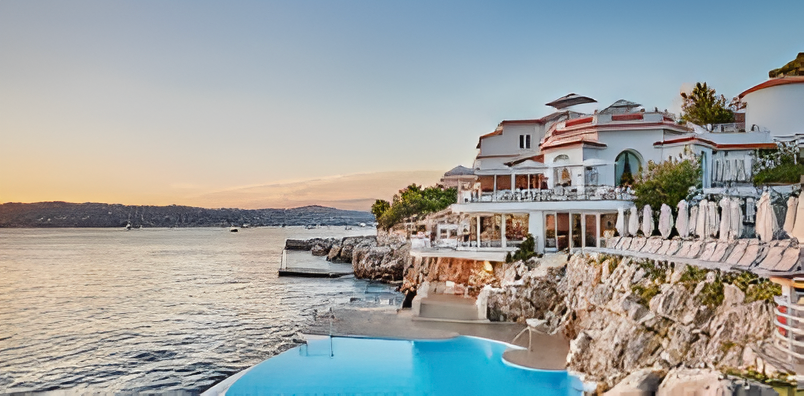
If one image defines the Hôtel du Cap-Eden-Roc more than any other, it’s the pool. An almost 200-meter-long avenue leads from the main house down to the swimming pool, which was blasted into the rock after World War I and now seems to float above the sea. Separate from the main hotel building, the seaside pavilion backs directly onto the rocks, housing the flagship Eden-Roc Restaurant alongside the salt-water swimming pool carved from the rock face.
The pool has become one of photography’s most reproduced images of postwar glamour. Photographer Slim Aarons’ images from the hotel — showing bathers by the pool in the 1970s — became iconic depictions of the sun-kissed home away from home for titans of literature, film, art, music, politics, and high society, from Cole Porter and Fitzgerald to the Duke of Windsor and Wallis Simpson. To this day, the chicest way to arrive is by sea on a private tender, stepping directly from a yacht’s teak speedboat deck into the retro sea pool carved from basalt rock.
A Guestbook Like No Other
Few hotels anywhere can claim a guest history as dense with legend. The guestbook ranges from F. Scott Fitzgerald and Coco Chanel to Clint Eastwood, Jacques Chirac, and Madonna, along with family dynasties including the Kennedys, Kardashians, and Hadids. Its guests over the decades have included Marlene Dietrich, Alain Delon, and Elizabeth Taylor — who reportedly brought every one of her husbands there — along with Chagall, Picasso, and Matisse in the art world, John Lennon and Yoko Ono and Ella Fitzgerald in music, and Churchill, De Gaulle, and the Kennedys in politics. Orson Welles came, and Elizabeth Taylor and Richard Burton arrived together, honeymooning there on separate occasions during their two marriages to each other.
Some of the encounters have become part of Riviera folklore in their own right. In the 1960s, whenever Cary Grant spent his vacations at the hotel, Grace Kelly would swing by from Monaco to visit him. The hotel’s Mediterranean gardens even hosted their share of eccentric mischief: Pablo Picasso and Gary Cooper apparently once set up a shooting gallery in the grounds.
Not every brush with fame was so charming for the hotel’s management. One especially notorious episode came when Madonna spent a night there in 1992: paparazzi gathered on a fleet of boats in the Mediterranean, while outside the gates hundreds of fans spent the night screaming her name, forcing the gate to be locked at all times. To this day, the hotel maintains a strict perimeter against the press during high season. Photographers who arrive by sea must keep a distance of 300 meters, marked by a yellow buoy they cannot cross.
The Cash-Only Years
For most of its modern history, the hotel was as famous for how it refused to be paid as for who stayed there. For the longest time, the Hôtel du Cap-Eden-Roc was famous for a very specific quirk: it didn’t take credit cards. Up until 2006, guests had to settle their bill — which could easily run into the tens of thousands of euros — in cash or by wire transfer. It was, in its own way, a badge of honor for the elite: if you had to ask about the payment method, you probably didn’t belong there.
The hotel accepted only cash payments up until 2006, resisted installing televisions in rooms until 2012, and was never shy about banishing well-heeled guests who were rude to staff. The eventual modernization was not small: a $67 million renovation eventually brought televisions and minibars into the rooms for the first time and finally introduced credit card payments, ending the cash-only policy. Even now, remnants of the old resistance to change linger in small, deliberate details. The room keys remain solid, heavy, ornate objects rather than cards, even as amenities behind closed doors have been quietly updated with well-appointed minibars, modern marble bathrooms, and, eventually, wifi.
A Fixture of the Cannes Film Festival
No calendar date matters more to the hotel than the Cannes Film Festival, held every May a short drive away. During the festival, the hotel becomes a refuge to the stars, and in summer more broadly it becomes the object of desire for countless paparazzi. The annual amfAR Gala, one of the festival’s signature charity events, is held at the hotel, with celebrities packing its halls, and its Le Grill restaurant remains one of the season’s essential gathering spots.
The hotel’s role during Cannes extends well beyond glamour photography. Its terraces and beach cabanas function during the festival as an informal industry exchange — the place where the line between a lunch and a business meeting dissolved long ago, and where much of the serious business of the film world quietly gets done.
An Institution That Guards Its Own Character
Even as the hotel has modernized in fits and starts, its custodians have been notably protective of its physical character. When a small garden recently needed to be shifted thirty feet to extend a deck by the pool, every single rock was numbered on a scale diagram and put back in precisely the same place. The result is a property that today, according to the Michelin Guide, retains much of its historical atmosphere even as its rooms and suites have been kept up to date, their look still familiar to guests who might have stayed there a century ago.
That balance — genuine modernization paired with an almost stubborn refusal to let its essential identity slip — may be the real secret to the hotel’s endurance. More than 150 years after opening as a Belle Époque retreat, the property still carries the markings of a grande-dame hotel: a guest list that reads like a who’s who of Western tastemakers, marble lobbies, and classic decor throughout its rooms, suites, and villas.
The Legend Persists
Today, the Hôtel du Cap-Eden-Roc operates seasonally, typically opening in spring and closing again by autumn, and commands some of the highest room rates on the entire French Riviera, particularly during the Cannes Film Festival window. But its real currency has never been simply the price of a room. It is the accumulated weight of a century and a half of writers, artists, exiled royals, film stars, and industrialists who have all, at one point, walked down that long avenue toward a pool cut into solid rock — and found, whatever the era, that the hotel had not particularly changed its mind about who it wanted to be.