The $245 million asking price briefly slapped on Bel-Air’s Chartwell Estate in 2018 made global headlines as the highest listing price in U.S. history, but the more interesting story of 875 Nimes Road is what happened to the price — and the house — afterward. Behind the limestone facade of this French Neoclassical mansion sits a story of family rejection, Hollywood typecasting, a billionaire’s obsession with privacy, and a final sale price far below anything the listing agents advertised.
A Mansion Nobody Wanted to Live In
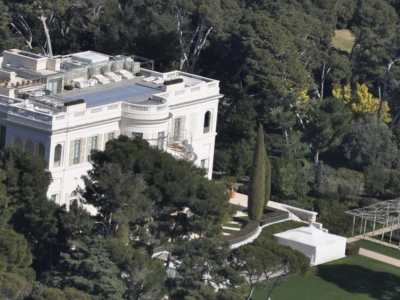
The story of Chartwell begins in the early 1930s with Lynn Atkinson, an engineer and public-works contractor whose firm is widely reported to have taken part in construction of the Hoover Dam (then still known as Boulder Dam) during the same period. Atkinson commissioned architect Sumner Spaulding to design an authentic French château on a hilltop parcel in Bel-Air, sparing no expense on a symmetrical limestone exterior modeled on 18th-century European estates. The house was completed around 1933, reportedly at a cost of roughly $2 million.
The twist: Atkinson’s wife reportedly took one look at the finished mansion and found it pretentious and ostentatious — and the couple never moved in. Atkinson instead sold the property in the mid-1940s to Chicago hotelier Arnold Kirkeby, a bond dealer and hotel investor who had recently acquired the Beverly Wilshire Hotel and whose family owned Chartwell for decades. It was during the Kirkeby era that the house achieved its most unlikely fame: its limestone facade and iron gates were filmed for the opening credits of the 1960s sitcom The Beverly Hillbillies, making it one of the most recognizable house exteriors on American television even though almost no interior scenes were ever filmed there. Reruns still occasionally show the Clampett family mistaking the palatial gates for a prison on account of its sheer scale.
Perenchio’s own path to Chartwell was as colorful as the house itself. Before running Univision, he had built a first fortune as a talent agent and boxing promoter — most famously staging the 1971 Muhammad Ali–Joe Frazier
“Fight of the Century” — and later as a television producer, partnering with Norman Lear and Alan “Bud” Yorkin on Tandem Productions, the company behind a run of hit sitcoms including All in the Family, Sanford and Son, and Maude.
The Reclusive Billionaire and the Underground Compound
The property found its true architect of transformation in 1986, when it was purchased for roughly $14 million by A. Jerrold “Jerry” Perenchio, the fiercely private billionaire best known as chairman and CEO of Univision from 1992 to 2007 (and, earlier, as a talent manager and television producer behind hits like All in the Family and Sanford and Son alongside Norman Lear). Perenchio did not just want a home; he wanted an impenetrable, ultra-luxurious sanctuary hidden from the public eye. He tore down the wrought-iron street gates that had made the house a tourist gawking spot, walled off the property from Bel Air Road entirely, and relocated the functional entrance to a quieter street at the rear of the property — 875 Nimes Road, the address by which the estate is known today.
Perenchio spent five years gutting and rebuilding the interior — reportedly keeping little more than the original exterior walls — and gradually bought up three contiguous parcels of neighboring land, expanding the compound to roughly 10 acres (about 452,000 square feet). In 2016, he added a fourth notable parcel: the former Bel-Air home of Ronald and Nancy Reagan, purchased for about $15 million and folded into the estate. To maintain absolute privacy across this expanded footprint, he undertook several engineering projects that pushed underground:
- The Secret Tunnel: Multiple accounts of the property describe a tunnel reportedly connecting the main château’s basement to the 75-foot swimming pool and pool house, allowing movement around the grounds unseen — though, as with much about this intensely private estate, the tunnel’s existence rests on secondhand reporting rather than public documentation.
- The Subterranean Gallery: An underground parking structure holding up to 40 vehicles was built beneath the manicured motor court, keeping any car collection out of view from the street or gardens.
- The Wine Cellar: A temperature-controlled, 12,000-bottle wine cellar was carved into the basement of the main house.
To furnish the interior, Perenchio hired the celebrated French decorator Henri Samuel, whose past clients had included the Rothschild family and fashion houses such as Valentino. Samuel’s mission was to make the 25,000-square-foot mansion feel like an authentic centuries-old European palace rather than a 20th-century Los Angeles house — importing 18th-century French paneling, antique fireplaces, and rare period furniture. (Some accounts also credit the estate’s extensive gardens, water features, and redwood grove partly to Samuel and partly to landscape designer François Goffinet.) A separate five-bedroom guest house on the property, converted from one of the neighboring parcels Perenchio acquired, was originally designed decades earlier by architect Wallace Neff.
The result was visually staggering but famously formal. Beyond the interiors, Perenchio indulged a personal fascination with Northern California’s redwood forests by shipping in dozens of mature redwood trees to create a private grove on the property — an unusual landscaping flourish for a Mediterranean-climate hillside in Los Angeles — along with a working vegetable garden, koi ponds, cascading fountains, and bridle paths threading through the grounds. Despite hosting glamorous charity events during Perenchio’s decades of ownership, those close to the estate often described it as feeling more like a heavily guarded, silent museum than a lived-in family home.
After the Billionaire: A Record Sale, Well Below the Ask
Perenchio died in May 2017 at age 86, leaving Chartwell to his estate. What followed was a dramatic public unwinding of the secrecy he had spent three decades building: the property was first shopped privately for $350 million, then formally listed on the open market in 2018 for $245 million — briefly the most expensive home listing in the United States — before being cut to $195 million in mid-2019. It finally sold in December 2019 to media executive Lachlan Murdoch for approximately $150 million, a price that, while a small fraction of the original ask, still stood at the time as the most expensive residential sale in California history.
In other words, the mansion built to be seen by no one ended its most famous chapter as one of the most closely covered real estate stories in the country — its floor plans, price cuts, and hidden tunnels dissected by outlets from The Wall Street Journal to CNBC before a single buyer ever set foot inside as owner.
Chartwell’s saga is also a useful data point on how ambitiously Bel-Air’s nine-figure listings can overshoot their eventual sale prices. The neighborhood has produced some of the highest verified residential sales in American history — the Chartwell sale itself briefly held the California record — but asking prices at this rarefied tier routinely run tens or even hundreds of millions above what a property ultimately fetches, since so few comparable buyers exist for any single trophy estate. Chartwell’s drop from a privately shopped $350 million down to a closed sale of roughly $150 million is one of the starkest examples of that gap on record, and a reminder that the listing price attached to any single Bel-Air megamansion is best read as a marketing figure rather than a reliable estimate of its eventual worth.