Gaggenau has quietly become one of the most talked-about names in luxury home appliances. Gaggenau Hausgeräte traces its roots back to 1683, making it one of the oldest continuously operating businesses in the world, though it didn’t become a kitchen appliance company until the 20th century—its earlier centuries were spent as an ironworks, then a bicycle and enamel-signage manufacturer, before Georg von Blanquet steered the company toward built-in ovens in 1956. Today, that long and winding history has translated into a lineup that dominates conversations among architects, high-end kitchen designers, and serious home cooks alike.
The standout product story right now is the Expressive series, the brand’s newest design language and, notably, its first entirely new oven cavity design in nearly two decades. The Gaggenau Expressive series spans the oven, combi-steam oven, fully automatic espresso machine, combi-microwave oven, vacuuming drawer, and culinary warming drawer—and, as of a recent expansion, refrigeration too, through the Vario Cooling Expressive series. Inspired by Bauhaus principles and minimalist modern architecture, the whole collection is built around the idea of “two frames, one circle, a piece of art”: an outer frame that borders the kitchen cabinetry, and an inner frame that cradles a passepartout of Gaggenau stainless steel behind smoked glass. Every appliance in the line shares the same materials, proportions, and spacing, so that whatever combination a homeowner installs—stacked, side by side, mixed and matched—it reads as one unified composition rather than a collection of separate boxes.
Within ovens specifically, the Expressive series oven introduces convection plus, a new heating system aimed at professional results with minimal noise, and Gaggenau also created what it calls the first oven to hide its broiling element behind the enamel, delivering searing performance without the visual clutter of an exposed element. A new “floating control ring” sits directly on the glass door, merging a physical dial with a digital display hidden behind the glass—according to Gaggenau’s own interface designers, it was meant to give a screen-based interaction something tangible to hold onto.
The Expressive series has extended into refrigeration too, through the Vario Cooling Expressive series. These fridge-freezer combinations, refrigerators, freezers, and wine climate cabinets share the same dark brushed stainless steel interior and warm-white, glare-free adaptive lighting found across the rest of the range, along with solid anthracite aluminum shelving and door bins that can be aligned across separate units to create one seamless-looking cooling wall when installed side by side.
The EB 333 Oven: The Aspirational Flagship
For sheer prestige, nothing tops the EB 333, the 90-centimeter, hand-built oven that has served as Gaggenau’s flagship and emblem for close to four decades, tracing back to the original EB 300 launched in 1986. It’s described by the brand as an aspiration for the professional chef at home—and the numbers back up why it generates buzz well beyond its actual sales volume: Gaggenau produces only about 10 units of the EB 333 a day at its Lipsheim, France factory, with a single sheet of 3mm stainless steel hand-shaped into each door. That’s less a mass-market product than a genuine limited-production statement piece, closer in spirit to a piece of furniture than a kitchen appliance, and part of why it carries an outsized reputation relative to how few actually leave the factory each year.
Ovens, Steam, and Cooling Round Out the Lineup
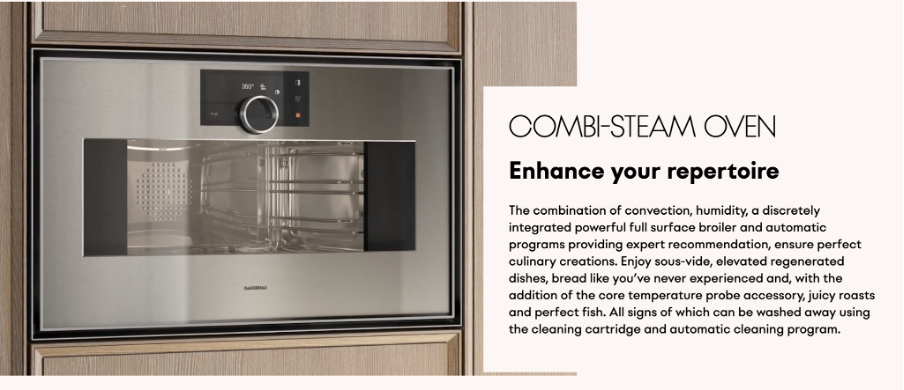
Beyond the flagship pieces, Gaggenau’s broader oven range remains a core draw. Every wall oven is handcrafted at the Gaggenau factory in Lipsheim, France, with options for 25 languages, 17 cooking modes, and the ability to save 50 individual recipes—features that show up consistently across the brand’s own retailer materials for both the 400 and 200 series lines. The brand’s steam technology is also a signature: Gaggenau introduced steam cooking into the private kitchen roughly a quarter-century ago, and has continually refined it since. Its latest combi-steam ovens offer a 50-liter cavity, automatic programs, a three-point core temperature probe, and a fully automatic cleaning system, alongside five humidity levels and precise electronic temperature control.
On the cooling side, the brand’s fully integrated, modular Vario cooling family includes refrigerators, freezers, fridge-freezer combinations, and wine climate cabinets that can be paired together for a cohesive, architecturally consistent display—shelving, lighting, and materials matched across units so a side-by-side refrigerator and freezer can look like a single built-in wall of cooling rather than two separate appliances bolted together.
Cooktops round out the popular categories, with modular 400 and 200 series cooktops that let homeowners build a customized cooking surface piece by piece—mixing induction, gas, glass ceramic, or specialty modules like a Teppan Yaki plate or wok burner into a single countertop layout. Gas cooktops in these ranges span roughly 12 to 36 inches wide, in configurations from a single wok burner up through two-burner and five-burner layouts, with the largest five-burner 400 series option putting out close to 18,000 watts across a wok ring and four additional burners.
Gaggenau’s price list shows some of these pieces retailing for well over $20,000—the EB 333 alone lists at close to that figure before any accessories are added—and even individual accessories aren’t cheap: a cast-aluminum Gastronorm roaster pan runs nearly $900, and even a set of replacement control knobs for the EB 333 lists for around $300. That price point cements Gaggenau’s position at the very top of the luxury appliance tier, well above mainstream competitors, and it’s part of why the brand’s appliances function almost as much as design statements and status objects as they do as functional kitchen tools—the price of admission is, quite deliberately, part of the pitch.
Why the Expressive Series Matters
It’s worth dwelling on just how rare it is for Gaggenau to introduce an entirely new cavity design. The company’s design language tends to move slowly and deliberately—the EB 333’s overall silhouette, for instance, has barely changed since 1986, evolving through careful refinement rather than reinvention. Against that backdrop, the Expressive series represents a genuinely significant moment: the first ground-up rethink of what a Gaggenau oven cavity looks like in close to twenty years, developed alongside a completely new refrigeration line built to match it stylistically. That kind of coordinated, multi-category rollout—ovens, steam ovens, coffee machines, drawers, and refrigeration all sharing one visual language simultaneously—is unusual even for a brand that has always emphasized modular, mix-and-match kitchens.
The design details reinforce that ambition. The passepartout concept, borrowed from framing terminology, treats the stainless steel and smoked glass surrounding each appliance’s controls as a kind of mat board around the artwork—deliberately drawing a parallel between a Gaggenau appliance and a piece of curated art rather than a purely functional object. Gaggenau’s own designers have talked about wanting every milled chamfer and every gram of metal to communicate the craftsmanship behind the piece, which is very much in keeping with a brand whose flagship oven is still measured in units per day rather than units per hour.
A Kitchen Built Around One Philosophy
Taken together, the picture that emerges is a brand that has resisted almost every pressure toward mass production that has reshaped the rest of the appliance industry. Where most manufacturers have spent decades chasing manufacturing efficiency, Gaggenau has doubled down on hand assembly, limited daily output for its flagship pieces, and a design philosophy that treats a kitchen wall of ovens, steam ovens, and refrigeration as a single architectural composition rather than a shopping list of separate purchases. Whether that’s viewed as admirable craftsmanship or expensive theater probably depends on the audience—but for the architects, designers, and serious home cooks the brand has built its reputation on, that distinction is precisely the point.