The luxury real estate landscape in Shanghai has reached a historic crescendo. Domestically crowned as Greentown Chaoming Dongfang (绿城潮鸣东方) and celebrated internationally as Greentown Symphony Shanghai, this ultra-luxury residential development represents the absolute pinnacle of contemporary urban living in China’s most competitive housing market.
Developed to commemorate Greentown China’s 30th anniversary, the landmark property rewrote the records for high-end Chinese real estate by generating 6.988 billion RMB (roughly $1.03 billion USD at prevailing exchange rates) in sales in a single day, with all 120 units selling out instantly upon launch—a figure repeatedly confirmed across Chinese financial and property media as a genuine national record for single-day residential sales.
Prime Location: The Heart of the West Bund
Situated on the north bank of the Huangpu River, Symphony Shanghai occupies an elite plot in the Xuhui Riverside (West Bund) area—notably, on land that had previously been associated with Xiaomi’s planned Shanghai headquarters before the site changed hands. Located within a few hundred meters of the waterfront and the district’s growing cluster of museums and cultural institutions, the development sits at the junction of the West Bund’s art precinct, its digital-industry corridor, and a direct tunnel connection to Lujiazui’s financial core across the river. Greentown paid 4.805 billion RMB for the site in an August 2024 land auction, at a floor price of roughly 131,000 RMB per square meter—at the time, the most expensive land parcel, by unit price, ever transacted in Shanghai.
Architectural Mastery by gad
The architectural design was led by gad, the China-based studio known for a substantial body of work across the country and for pairing sustainable design principles with locally rooted practice. Greentown assembled a broader international team around gad’s core design: landscape architecture by JTL, and interiors for the show flats split between Hong Kong’s CCD—known for restrained, hospitality-grade luxury interiors—and CSS (召禾), a studio recognized for a more naturalistic, eclectic sensibility rooted in local cultural context.
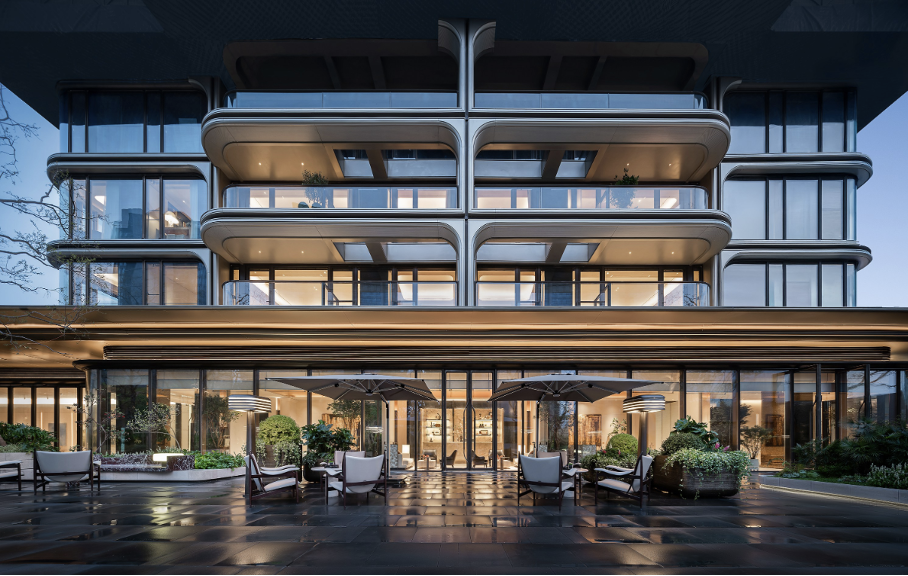
The development consists of three high-rise residential towers, each reported at 21 stories plus a rooftop level—consistent with the roughly 80-meter height cited in some coverage, though exact tower heights vary slightly by source. The facade favors continuous glass panels and curved, flowing corner geometry, deliberately echoing the movement of the river itself; project materials describe the design language as “fluid geometry” intended to soften the traditionally rigid edges of tower architecture and to visually connect the building to the West Bund’s industrial waterfront heritage. A distinctive 270-degree curved glass corner treatment on select units has been highlighted in Chinese coverage as one of the project’s signature architectural moments, maximizing both light and skyline views for residents.
“Curated Living” and Public Art
Symphony Shanghai treats its public plazas and entry sequence as a curated art experience rather than simple circulation space, with an extended, monumentally scaled entryway framed by stone architecture leading residents from the street into the development’s interior grounds.
As part of the project’s art program, Greentown commissioned French sculptor Sylvestre Gauvrit—working with Australian public-art fabricator UAP—to create two major bronze artworks for the development’s riverfront precinct, part of a broader thematic concept described as “Flowing Feast, Heartbeat Echoes.” The best-documented of the two pieces is titled Magic Birds: a gleaming, aerodynamic bronze form suggested to be a pair of wings caught mid-flight, conceived around the idea of “racing tides of life” as a metaphor for Shanghai’s constant motion and reinvention. Its surface is designed to shift in appearance as light moves across it throughout the day, alternately reading as grounded material and something closer to weightless motion. (Note: some secondary sources have referred to the sculpture by the title Princesse des Airs, but that name belongs to an unrelated, previously exhibited Gauvrit work sold through a different gallery—it is not part of this commission.)
Premium Specifications and Interior Scale
The development caters exclusively to high-net-worth buyers, with reported ceiling heights in the range of 3.5 to 3.6 meters—notably higher than most comparable projects along the same stretch of riverfront, several of which cap out around 3.5 meters. Standard residential units span roughly 285 to 320 square meters, with some listings citing units up to 330 square meters, arranged as large-format, four-bedroom river-view flats. Reported penthouse and top-floor duplex configurations extend considerably beyond the standard footprint, offering substantially larger, more customizable floorplans, though the precise 465–585 square meter range specific to those units could not be independently corroborated here and should be treated as reported rather than confirmed.
Elite Amenities: Dual-Ground Architecture
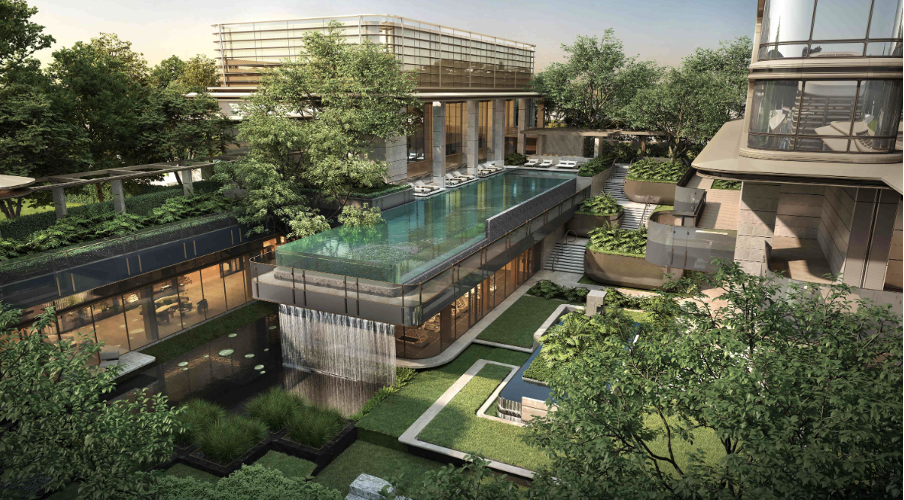
Faced with a compact urban plot, the design team excavated the center of the development to create a dual-ground-level configuration, revealing a sunken courtyard of approximately 3,000 square meters at the heart of the property—confirmed across multiple Chinese-language project descriptions as a central social and landscape feature, envisioned as a future clubhouse-style gathering space for residents.
Wellness amenities within the compound include what Greentown’s own marketing describes as an oversized, boundary-less “floating” swimming pool—a signature feature repeatedly highlighted in project coverage, though the specific claims of a 40-meter length, treetop-height cantilever, and a 12-meter landscape wall could not be independently confirmed and are presented here as reported rather than verified figures. Additional amenities described in Greentown’s materials include an indoor swimming pool, a subterranean fitness facility, a poolside social bar, an arts-themed children’s play area, and a fully integrated smart-home ecosystem across all units.
The Price of Perfection
As one of the most expensive and closely watched residential launches in modern Chinese real estate history, Symphony Shanghai set a new benchmark for Shanghai’s inner-ring luxury segment, with an average price of roughly 195,000 RMB per square meter across the launch. Reported per-unit prices ranged from a low of about 150,300 RMB per square meter up to a high of 265,200 RMB per square meter for the top penthouse unit, translating into total unit prices from roughly the tens of millions of RMB up to a confirmed high of 154 million RMB for the single most expensive residence sold—figures that are consistent with, and help substantiate, the broad entry-to-penthouse pricing range described in the original reporting on this launch. Buyers were also required to demonstrate at least 30 million RMB in verified assets to qualify to purchase, a notably high bar even by the standards of Shanghai’s luxury market.
The launch’s success has not been an isolated event: Greentown has since followed it with a second “Chaoming” branded project on the Shanghai Bund, which itself sold 44 units for 1.485 billion RMB on its own opening day—evidence that Symphony Shanghai’s record-setting debut reflects a genuine, sustained surge in demand for trophy-grade real estate in Shanghai’s core, rather than a one-off anomaly.
Greentown’s Broader Position
Greentown China, founded in Hangzhou in 1995 under chairman Song Weiping, has built its reputation over three decades on a particular strain of high-end residential development, blending Chinese cultural motifs with contemporary architecture and, in recent years, an increasingly international roster of collaborators. The company’s broader 2025–2026 sales performance underscores just how significant Symphony Shanghai’s single-day result really was in context: Greentown’s total contracted sales across its entire national portfolio ran to tens of billions of RMB over multi-month periods even in strong years, meaning a single Shanghai development generating close to 7 billion RMB in one day represents an extraordinary concentration of demand into one launch event rather than a typical incremental contribution to overall sales.
That context also helps explain why Greentown chose to mark its 30th anniversary with this specific project rather than a flagship launch in its home market of Hangzhou. Shanghai’s West Bund has, over roughly the past decade, transformed from a former industrial and logistics corridor into one of the city’s most concentrated cultural districts, anchored by a cluster of contemporary art museums, galleries, and increasingly by exactly the kind of technology-sector office development that once occupied the Symphony Shanghai site itself. Positioning a 30th-anniversary flagship on land with that specific pedigree—previously linked to a major technology company’s headquarters ambitions, now reimagined as ultra-luxury housing—was very much a deliberate statement about the trajectory of the neighborhood, and by extension the confidence Greentown was placing in continued high-net-worth demand for exactly this kind of address.
A Market Still Setting New Benchmarks
Data from the first months of 2025 reinforced that Symphony Shanghai’s launch was part of a broader pattern rather than an isolated spike: transaction volumes for Shanghai homes priced above 50 million RMB reportedly rose several-fold year over year in the opening months of that year, with multiple other ultra-luxury projects across the city—not just Greentown’s—posting standout results in the same window. Analysts covering the market have attributed the trend partly to global economic uncertainty pushing high-net-worth capital toward what’s often described as a “safe harbor” in prime, supply-constrained real estate in China’s core cities, and partly to a genuine, multi-year uptick in the sophistication and ambition of the luxury product itself, as developers like Greentown increasingly bring in international architects, landscape designers, and artists to differentiate flagship projects from the broader new-build market.
That same reporting includes a cautionary note worth preserving here: while genuinely prime addresses like Symphony Shanghai’s West Bund site have shown remarkably resilient demand, commentators have also flagged a risk of price softening for so-called “faux-luxury” developments further from the city’s core, suggesting the ultra-high-end market is bifurcating between a small number of truly irreplaceable locations and a much larger tier of developments trading more heavily on marketing than on genuine scarcity. Symphony Shanghai’s combination of a record-setting land price, an internationally assembled design team, and a waterfront site with genuine cultural and locational pedigree places it firmly in the former category—one reason its results have continued to be cited as a reference point across the industry well after its opening day.