The Sand Castle at 1900 Spindrift Drive is an irreplaceable, ultra-luxury oceanfront compound in La Jolla, California, currently priced at $87.5 million—down from an original 2024 asking price of $108 million, after two rounds of price cuts brought it first to $92.5 million and then to its current figure. The property was originally built in 2005 by San Diego hotelier Doug Manchester. Billionaire Darwin Deason bought the home in 2009, later acquired the adjacent parcel, and spent roughly six years and an estimated $60 million combining the two lots into the estate that stands today, with construction wrapping in 2015. Deason, the Affiliated Computer Services founder who sold that company to Xerox for $6.4 billion in 2010, died in December 2025 at age 85, and the estate remains part of his family’s holdings.
Nestled along San Diego County’s most exclusive coastline, the compound spans nearly 13,000 square feet and seamlessly bridges the timeless elegance of the French Riviera with modern engineering. Because modern environmental regulations make building directly on the California tide line functionally impossible today, this historic anomaly stands as a landmark that can never be replicated—its seawall and beach access were grandfathered in under rules that predate the California Coastal Commission’s current restrictions on shoreline armoring.
Design & Architecture
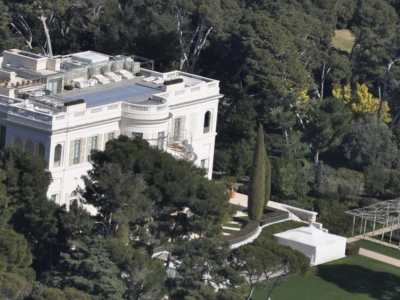
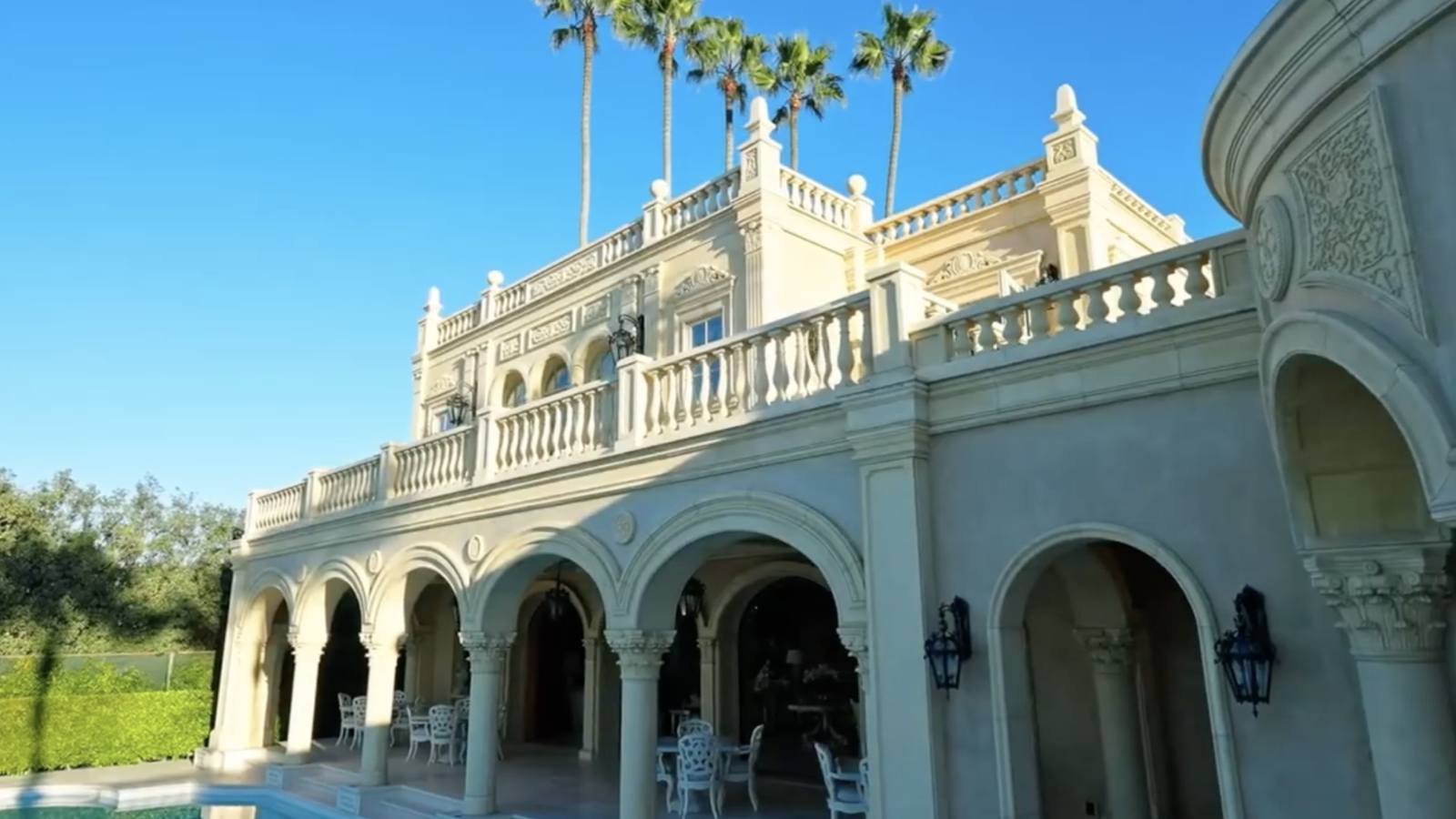
Reimagined by interior designer Timothy Corrigan, the estate draws its inspiration from the grand manors of the French Riviera and the Palace of Versailles—the separate guest house, in particular, was designed to evoke Versailles’ Petit Trianon. The property features a roughly 9,565-square-foot, seven-bedroom main house and a 3,416-square-foot, three-bedroom guest residence, combining for approximately 13,000 square feet, 10 bedrooms in total, and 17 bathrooms (14 full and 3 half, per the property’s MLS listing). Inside, the design combines historic grandeur with a soft, sea-and-sky color palette. The opulent finishes showcase hand-laid New Ravenna mosaics, imported antique fireplaces from France, custom-made furniture built to fit each specific room, walnut millwork, onyx marble surfaces, and even an 18th-century mermaid sculpture—details meant to feel closer to a private museum than a beach house.
One especially personal touch: a nautical-themed bar designed to resemble the bar aboard Deason’s own yacht, Apogee, where he spent much of his time cruising the Mediterranean and Caribbean. “I take pride in the entire property, but another part I am especially proud of is the nautical-themed bar, which resembles the bar on my yacht,” Deason said of the home before his death.
A True Private Beach
What elevates this property into a true one-of-one legacy estate is its rare, private shoreline. Protected by a roughly 162-foot pre-Coastal-Commission seawall, the estate features one of California’s only true on-property private beaches, reached via a private elevator that descends to a beach platform raised about 10 feet above the waterline. To create the ultimate coastal retreat, the beachfront was famously built using imported white sand from the renowned Augusta National Golf Club in Georgia—reportedly at a cost of around $40,000—because, as Deason once put it, he wasn’t a fan of the “coarse” texture of local California sand. A customized beachfront kitchen and the whimsical, boat-shaped bar complement the sand, turning the private coastline into an unmatched venue for upscale entertaining.
A Self-Contained Private Resort
The estate functions as a self-contained private resort, shielded from public view by multistory security hedges. The outdoor space is anchored by a Thassos-marble-tiled saltwater pool and spa, flanked by separate men’s and women’s relaxation cabanas. Inside the compound, residents have access to a fitness center and a dedicated health spa, reachable in part by a private elevator. Sprawling terraces and expansive glass walls frame uninterrupted, panoramic views of the Pacific Ocean and the dramatic La Jolla coastline to the north, west, and south.
Who Built It: Darwin Deason’s Journey to the Sand Castle
The man behind the Sand Castle’s transformation had a story almost as dramatic as the estate itself. Darwin Deason was born in 1940 on a farm in Rogers, Arkansas, during the tail end of the Great Depression, and by his own account left home the day after high school graduation with $50 borrowed from his father and an old Pontiac. He worked as a mail clerk at an oil company, moved into data processing, and eventually became CEO of a Dallas firm called MTech at just 29 years old. When that company was sold out from under him in 1988, Deason started over, founding Affiliated Computer Services the same year. He built ACS into a Fortune 500 business-process-outsourcing giant with roughly 85,000 employees before selling it to Xerox in 2010 for $6.4 billion—a deal that made him one of Xerox’s largest individual shareholders and, later, a key player in blocking a proposed Fujifilm-Xerox merger in 2018.
By the time he purchased the original La Jolla property in 2009, Deason was already a billionaire many times over, splitting his time between a primary residence in Dallas, a lake house near Cedar Creek Lake, a property in Cabo San Lucas, and long stretches aboard Apogee in the Mediterranean and Caribbean. The Sand Castle was reportedly one of his least-used properties in his final years, prompting the decision to list it. He died in December 2025, and the estate has remained on the market under the stewardship of his family in the months since.
La Jolla’s Broader Luxury Boom
The Sand Castle’s saga is unfolding against the backdrop of a genuinely booming, if selective, luxury market in coastal San Diego County. La Jolla has increasingly become a magnet for ultra-wealthy retirees, life-science entrepreneurs, and tech investors drawn by the area’s weather, schools, and relative privacy compared to more paparazzi-heavy enclaves like Malibu or Beverly Hills. Median home prices in the neighborhood have climbed into the multi-million-dollar range even for ordinary properties, and by some measures the area has posted double-digit percentage growth in just the past year alone.
Still, La Jolla remains, in relative terms, something of a bargain compared with the truly stratospheric prices commanded in Los Angeles’ Bel Air, Beverly Hills, and Holmby Hills neighborhoods, where nine-figure sales have become almost routine over the past several years. San Diego County’s own record for a single-family home sale has hovered in the $44 to $50 million range in recent years, set by waterfront trophy properties in nearby Del Mar—meaning that even at its now-discounted $87.5 million ask, the Sand Castle would still nearly double the county’s existing benchmark if it sells anywhere close to that figure. That gap between the asking price and the local comparables is precisely why the listing has drawn so much attention: there’s genuinely nothing else nearby to measure it against.
A Market Still Testing Its Ceiling
The Sand Castle’s long and winding path to its current price says almost as much about the state of the ultra-luxury market as the house itself does. When it first listed at $108 million in October 2024, agents Brett Dickinson and Ross Clark of Compass noted that a sale anywhere near that number would obliterate San Diego County’s real estate records outright—the county’s previous high-water mark for a single-home sale sat around $44 to $50 million, set by a Del Mar waterfront property. More than a year later, after 478 days on the market without a buyer, the price dropped by $15.5 million to $92.5 million in February 2026. It has since been cut again to its current $87.5 million.
That trajectory isn’t unique to this property. Even with San Diego’s luxury market showing real strength—by some counts, 17 La Jolla homes sold for $10 million or more in 2025 alone—ultra-high-end listings above $5 million in the area have reportedly seen a sales failure rate approaching 40 percent over recent months, with dozens of similarly priced listings expiring unsold. Brokers close to the deal have described a “shadow inventory” of several other ultra-high-end La Jolla homes waiting in the wings, along with a smaller pool of buyers realistically able to transact at this level. Total investment in the Sand Castle—roughly $26 million to acquire the two underlying parcels, plus another $60 million in construction—put its all-in cost at around $86 million even before a sale price was ever set, meaning today’s $87.5 million ask represents barely any built-in profit margin at all relative to what Deason actually spent creating it.
Whatever it ultimately sells for, the Sand Castle’s combination of a genuinely irreplaceable private beach, a fully bespoke interior by a designer of Timothy Corrigan’s caliber, and a late owner’s very personal, yacht-inspired touches make it one of the more singular offerings anywhere in the country’s ultra-prime housing market—a property whose value, unlike almost anything else at this price point, is tied less to comparable sales than to the simple fact that California will never again permit anyone to build another one.