Perched on a gated hilltop promontory in Los Angeles, 10721 Stradella Court stands as a pinnacle of modern residential architecture. The ultra-luxury mega-mansion captured global headlines following its off-market sale for $112 million in the fall of 2024 — among the priciest residential transactions in Los Angeles history. The seller, tech entrepreneur George Ruan, co-founder of the online coupon platform Honey, completed a meticulous, multi-year transformation of the estate before passing the keys to an undisclosed buyer.
Representing a flawless integration of raw structural power and serene interior minimalism, this 21,000-square-foot compound — with 9 bedrooms and 11 bathrooms in the main residence, plus a separate one-bedroom guest house — redefines the boundaries of Southern California luxury living.
A Troubled Origin Story
Long before it became a symbol of quiet ultra-luxury, the Stradella Court property had a far more notorious history. The land was originally acquired in February 2016 for $14.6 million by Woodbridge Group of Companies, the real estate empire controlled by Robert Shapiro. At the time, Woodbridge tapped the South African design firm SAOTA to draft renderings for an ambitious spec home, internally named “Skygarden,” and quickly listed the unbuilt project for $100 million through a Shapiro-affiliated brokerage.
That plan collapsed when federal investigators uncovered that Woodbridge was actually the vehicle for a $1.3 billion Ponzi scheme, one of the largest investment fraud cases in U.S. history, which ultimately defrauded more than 7,000 investors — many of them elderly retirees relying on their retirement savings. Shapiro pleaded guilty to fraud and tax evasion charges and was sentenced to 25 years in federal prison. As part of the resulting asset liquidation, the unfinished Stradella Court property was placed into a court-ordered trust and ultimately sold in 2020 for $60 million to an anonymous buyer operating through an entity called Sky Garden 2020 LLC — later revealed to be George Ruan, the Honey co-founder whose company had been acquired by PayPal for $4 billion earlier that same year.
Ruan spent the following years completing an extensive, multi-million-dollar renovation of the still-unfinished structure. He first tested the market in 2022, listing the estate for $150 million through agent Aaron Kirman at Compass — more than double what he’d paid for it. That price ultimately proved too ambitious; when the sale finally closed in the fall of 2024, it settled at $112 million, brokered by Aaron Kirman, Bryce Lowe, and Kirby Gillon, who by then had moved their practice to Christie’s International Real Estate Southern California. Even at a steep discount to its original ask, the sale ranked among the largest residential transactions in Los Angeles that year, closing despite a broader slowdown in the city’s luxury market driven by Measure ULA, the so-called “mansion tax” on high-value property sales.
An Elite Architectural Collaboration
The visual identity of 10721 Stradella Court is the result of an international design partnership. The estate was envisioned by the world-renowned South African design firm SAOTA, celebrated for their dramatic, site-specific modernist structures. To bring the ambitious concept to life, SAOTA collaborated with premier Los Angeles architecture studio Woods + Dangaran, who served as executive architects and helped shepherd the design from the Shapiro era through Ruan’s eventual completion of the home.
The home’s exterior draws inspiration from brutalist and modernist aesthetics, utilizing massive, finished concrete blocks to construct soaring, monumental shapes. These heavy concrete volumes open up to expansive glass walls, creating a structure that feels grounded yet completely open to its surroundings — a striking contrast to the home’s later, softer interior finish.
Seamless Japandi Interior Design
While the exterior projects a commanding, structural presence, the interiors whisper absolute tranquility. Staged and curated with a heavy Japandi influence — the hybrid blend of Japanese artistic minimalism and rustic Scandinavian warmth — the living spaces focus on organic details, earthy textures, and a soft, cohesive color palette that stands in deliberate contrast to the raw concrete shell surrounding it.
The Culinary Suite: The chef’s kitchen serves as a functional centerpiece, complete with premium Gaggenau and Miele appliances, custom millwork, and heavily veined, honed quartzite countertops.
The Primary Oasis: Designed to replicate a world-class resort, the primary bedroom suite features dramatic floor-to-ceiling glass walls that slide away to reveal a private terrace. The suite includes dual walk-in dressing rooms flanked with rich marble accents and an opulent bathroom centered around a deep soaking tub.
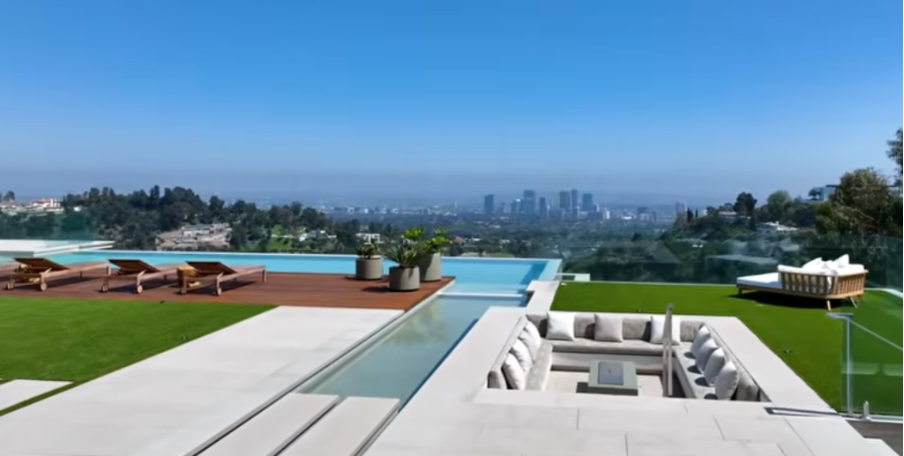
Unrivaled Horizons: Positioned on a rare promontory lot, the estate boasts 360-degree panoramic views. Looking out from the main living rooms, the view sweeps across the surrounding canyon and reservoir landscape, the glowing Los Angeles skyline, the rolling hills, and all the way out to the Pacific Ocean and Catalina Island on a clear day.
A Compound Built for Leisure and Discretion
Sprawling over a 1.15-acre lot, 10721 Stradella Court is configured as a fully self-contained sanctuary optimized for upscale entertainment and absolute privacy.
The Main Grounds & Pool Deck: The main outdoor terrace blends internal living spaces with nature via deep, sheltered patio overhangs. At its edge sits a large infinity pool that seemingly drops off into the canyon below. The poolside area features integrated sunken fire pits and private cabanas, alongside additional entertaining and outdoor living space.
The Wellness Pavilion: Detached from the main residence is a private, one-bedroom guest pavilion. Far more than a standard guest house, this wing functions as a private health resort, featuring its own independent swimming pool and a fully equipped fitness and spa area — described by the home’s original listing materials as one of the most impressive residential gym-and-spa combinations built into any private estate in the region.
Stealth Staff Infrastructure: To maintain a high-end estate seamlessly, discretion is vital. The property features an independent staff wing containing three separate staff quarters. This utility space includes its own prep kitchen and private laundry facilities, keeping daily operations entirely separate from the homeowner’s primary living areas.
Landmark Status in Bel Air’s Real Estate History
The property’s history is inextricably linked to some of the most consequential moments in recent Los Angeles luxury real estate. Few homes anywhere carry an origin story quite like Stradella Court’s: conceived under a fraudster’s real estate empire, rescued and rebuilt by a tech entrepreneur, and ultimately sold for nearly eight times what Woodbridge originally paid for the bare land back in 2016.
The sale also arrives against a broader backdrop of record-chasing Bel Air real estate. Just two years earlier, in 2022, “The One” — the infamous 21-bedroom, 49-bathroom spec mansion built by developer-turned-filmmaker Nile Niami — had been auctioned off for $141 million after its initial $295 million asking price collapsed under the weight of lawsuits and construction delays. While Stradella Court’s $112 million sale didn’t eclipse that figure outright, it stands as one of the most significant completed, off-market residential transactions the neighborhood has seen, closing quietly and without the years of public drama that defined its more infamous predecessor.
A New Era for a Once-Troubled Address
Today, 10721 Stradella Court stands as a testament to architectural resilience — a property that survived the collapse of a $1.3 billion fraud, years of incomplete construction, and multiple failed listing attempts before ultimately finding both a devoted owner in George Ruan and, eventually, a buyer willing to pay $112 million for the finished result. Its journey from an abandoned Ponzi-scheme asset to one of the most architecturally significant residential sales in Los Angeles history makes it a uniquely compelling case study in how a property’s fortunes — and reputation — can be entirely rebuilt.