listen to the audio of this article
Tucked into a sliver of Knightsbridge between Hyde Park and the roar of London traffic sits a building that has become shorthand for a certain kind of wealth: opaque, global, and almost unimaginably deep. One Hyde Park isn’t just an apartment block. It’s a symbol — of London as a parking lot for international capital, of architecture as armor, and of a real estate market that operates by rules most people will never encounter.
One Hyde Park sits at 100 Knightsbridge, directly across from the park that gives it its name, in the heart of one of London’s wealthiest postcodes. The development comprises 86 apartments and duplexes, including four penthouses, along with three retail units at ground level. It was designed as four glass and stone pavilions rising above a continuous ground-floor retail arcade, and the architecture is the work of Richard Rogers’ firm, Rogers Stirk Harbour + Partners — the same practice behind the Pompidou Centre and the Lloyd’s building.
The complex’s ground-floor retail tenants include Rolex, McLaren Automotive, and Abu Dhabi Islamic Bank, giving the street frontage the feel of a private members’ shopping arcade rather than an ordinary residential lobby — which, in a sense, is exactly the point.
One Hyde Park was developed by British brothers Christian and Nick Candy alongside Qatari businessman Sheikh Hamad bin Jassim bin Jaber Al-Thani, the former prime minister of Qatar. The Candy brothers had already built a reputation in London for ultra-high-end residential projects, but One Hyde Park, completed in the early 2010s, became their defining statement: a building engineered from the ground up to be the most expensive residential address on the planet.
Money and Reputation
The building’s central mythology is its price tag. Flats here have long traded in the tens of millions of pounds, and the numbers have only climbed. One apartment in the block was listed for sale in early 2026 at 175 million pounds. Even by the standards of prime central London, that is an extraordinary figure for a single residential unit.
Ownership at One Hyde Park has always been wrapped in secrecy. Many flats are held through offshore companies and trusts rather than in individuals’ names, and for years reporters have struggled to pin down who actually lives there — if anyone does. A widely cited 2011 finding showed that only a small fraction of sold apartments were registered for council tax with Westminster City Council, fueling the perception that many units function less as homes than as vaults: places to store money in bricks and glass rather than to live in day to day.
That reputation — deserved or not — has made One Hyde Park a recurring reference point in debates about London housing, foreign investment, and the use of anonymous shell companies to buy UK property, discussions that gained fresh urgency after the introduction of the UK’s register of overseas entities.
Amenities
Part of what residents are paying for is a level of physical security more associated with a private compound than an apartment building. The complex is reported to include bulletproof glass, panic rooms, and a bunker-like basement, alongside a private tunnel connecting to the Mandarin Oriental hotel next door — allowing residents to reach a five-star hotel’s services without setting foot on the street.
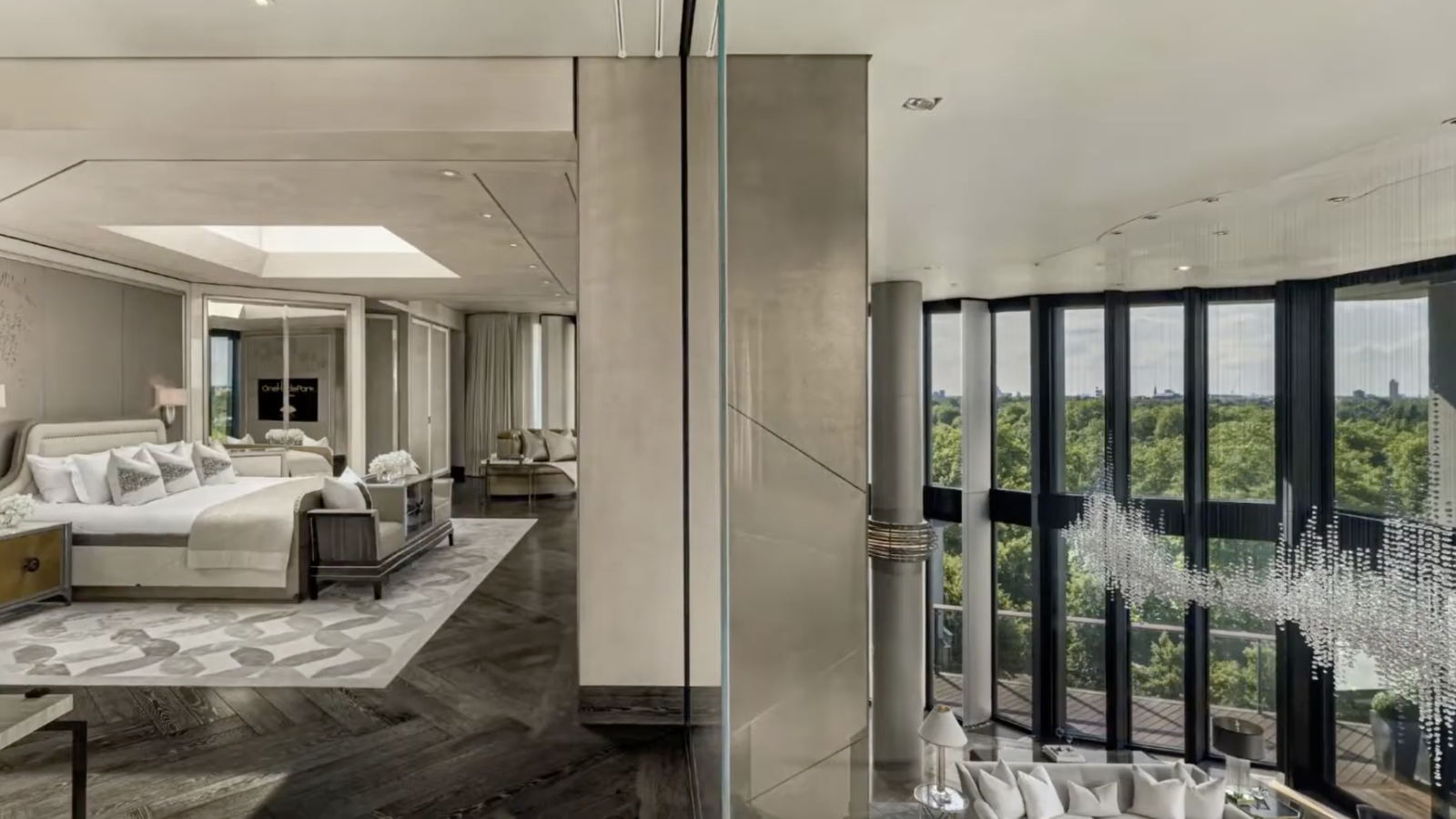
Inside, the building offers the amenities expected of nine-figure real estate: a 21-metre swimming pool, spa and gym facilities, a private cinema, a business suite, wine cellars for individual apartments, and a dedicated concierge and butler staff modeled on hotel service standards. The scale of service is deliberately designed to make owning a flat here feel less like homeownership and more like membership in an extremely small, extremely expensive club.
One Hyde Park endures as a cultural reference point because it distills, almost too neatly, the anxieties of the modern housing conversation: a landmark address next to a public park, largely emptied of ordinary residential life, held by capital that moves faster and more quietly than any government can easily track. Supporters point to the jobs, investment, and architectural ambition the project represents. Critics see it as an extreme example of housing as an asset class, disconnected from the city around it.
Whichever view one takes, the building remains what it was built to be: a statement in glass and stone that money, at a certain altitude, doesn’t just buy a home — it buys security, and a view of Hyde Park that almost no one will ever actually see from the inside.