listen to the audio of this article:
944 Airole Way — known to the world as “The One” — sits at the crossroads of architectural ambition and financial excess. Perched on a promontory in the exclusive hills of Bel-Air, this 105,000-square-foot residence is technically a compound: a main house plus three smaller structures, built in the modernist style. It is one of the largest privately built homes ever attempted in an American city, and its story — spanning a decade of construction, a bankruptcy, a receivership, and a record-setting auction — has become a case study in the perils of speculative ultra-luxury development.
The estate sits on a 3.8-acre hilltop lot that Nile Niami purchased in 2012 for $28 million, not the five acres often cited elsewhere. From that perch, the property has a 360-degree view of the Pacific Ocean, downtown Los Angeles, and the San Gabriel Mountains. The original 10,000-square-foot house on the lot was demolished to make way for construction. Tucked at the end of a private road above Bel-Air, the site offers the kind of seclusion the ultra-wealthy expect, with the city spread out far below.
Architecture and Engineering
Designed by architect Paul McClean, The One took roughly a decade to build: construction began around 2014, and the online auction listing in early 2022 described the project as having taken close to ten years to reach that point. McClean’s signature dissolution of indoor and outdoor space is scaled here to an unusual degree. Reporting on the property has repeatedly described a sweeping infinity pool wrapping the residence — one account puts it at roughly 400 feet long — creating the sense that the glass-and-marble structure floats above the hillside. Because of height limits and grading constraints on a steep hillside lot, a substantial share of the square footage was built into and below the terrain, a common technique on Bel-Air’s hillside parcels.
Aesthetics: Minimalist Grandeur
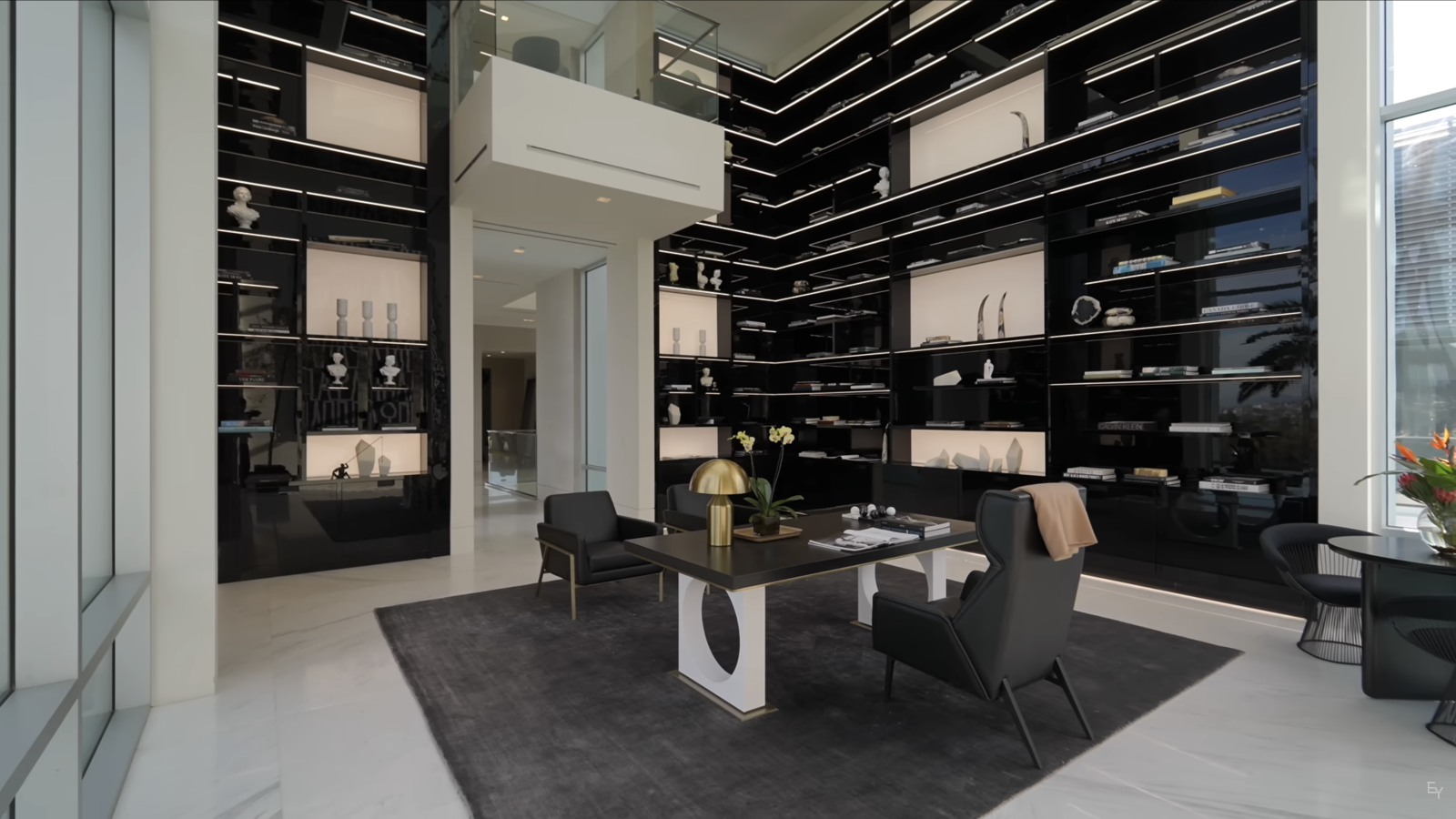
The interiors favor a restrained, monochromatic material palette — white marble, dark steel, poured concrete — over ornament. Floor-to-ceiling glass walls open the interior to the California air, and open-air courtyards were designed to bring daylight into the lower, partly subterranean levels. One much-discussed and later scaled-back feature was a wall of live jellyfish tanks, which came to symbolize the project’s excess as much as any single room in the house.
Amenities: A Self-Contained Universe
The finished amenity list is extensive, though exact figures vary slightly across reporting. The home has 21 bedrooms and 42 bathrooms, several swimming pools (accounts range from three to five), a 10,000-square-foot rooftop sky deck, a private nightclub, a beauty salon and wellness spa, and a movie theater — reported variously as a 40-seat and a 50-seat theater depending on the source. There’s also a four-lane bowling alley, a subterranean garage doubling as an auto gallery with vehicle turntables, and a putting green. Niami, a former film producer, described his ambition plainly: he wanted not just a big house but “a city within a house.”
Financial Saga
The financial story is where the original telling of this house goes most wrong, and where the real drama lives. Niami’s asking price climbed to a much-publicized $500 million at its peak, a figure that would have shattered every residential real estate record in the country. But the project was financed almost entirely on debt. By 2018, Niami had taken an $82.5 million loan from Don Hankey, a billionaire lender who built his fortune in subprime auto financing, and construction dragged on for years past its original schedule. By September 2021, the property had defaulted on more than $165 million in debt and was placed into receivership by the Los Angeles County Superior Court, a stunning reversal for a house Niami had called his “life mission.”
Niami tried unconventional escape routes, including an attempt to launch a cryptocurrency, “The One Coin,” backed by the property — an effort that went nowhere. The house was pulled from a Los Angeles County foreclosure auction in late 2021 after Niami’s development company, Crestlloyd, filed for Chapter 11 bankruptcy, with a bankruptcy judge overseeing the case instead. By that point, Crestlloyd’s own bankruptcy filings valued the property at around $325 million against roughly $180 million in debt — a fraction of the original fantasy figure but still enormous.
The house was ultimately marketed through Concierge Auctions with a $295 million starting bid in early 2022. It sold for far less: $126 million at auction, or roughly $141 million once commissions were factored in, in March 2022. The winning bidder was later identified as Richard Saghian, the billionaire founder of Fashion Nova. Even at that steep discount, it was reportedly the highest price ever paid for a home at auction in the U.S., though it fell short of the outright record for a home sale, held at the time by Ken Griffin’s $238 million New York penthouse purchase. And the sale still came in well below what was owed: the Los Angeles Times reported the price fell well short of the roughly $190 million in debt the property carried, leaving Niami’s creditors, including Hankey, absorbing significant losses.
Cultural Legacy: A Symbol, Not a Sole Cause
The idea that The One single-handedly triggered a new anti-mansionization law is an oversimplification worth correcting. Los Angeles had been wrestling with “mansionization” — oversized homes built to the edge of their lots — since well before The One broke ground: the City Council adopted temporary mansionization restrictions across twenty neighborhoods, including Bel Air, years earlier, aimed at curbing demolitions and out-of-scale construction. Councilman Paul Koretz, who pushed those restrictions, said at the time that the goal was to slow the spread of “boxy, lot line-to-lot line McMansions” nationwide, not to respond to any single property.
What is fair to say is that The One became the most visible symbol of that era’s excess — one of dozens of spec mansions that rose in Bel Air and Beverly Hills after 2014, when developer Bruce Makowsky’s $70 million spec-mansion sale kicked off a building boom of infinity pools, auto galleries, and party rooms across the Los Angeles hills. As tighter hillside and size regulations were phased in during the years The One was under construction, the property came to be marketed as the first and likely last residence of its scale that could ever be built in Los Angeles under the city’s current rules. In that sense, The One isn’t the cause of the law so much as its most famous casualty and its most enduring illustration — a benchmark against which the city’s later, stricter limits on hillside megahomes are still measured.
The house has also become a recurring reference point in Los Angeles’s broader, ongoing debate over how to regulate housing at the extreme high end: it has been cited in recent coverage of the city’s “mansion tax” (Measure ULA), which imposes a transfer tax on high-value property sales and has itself become a flashpoint in arguments over how such policies affect both mega-mansions and ordinary apartment construction.
A Monument to Its Era
In the end, 944 Airole Way stands as a monument to a particular moment in American real estate — the mid-2010s spec-mansion boom, when developers bet that scale and spectacle alone could manufacture nine-figure value. Nile Niami’s vision produced something genuinely singular: a compound with a bowling alley, a nightclub, and an auto gallery cut into a Bel-Air hillside. But the debt behind it proved far less patient than the architecture. Sold for roughly a quarter of its original asking price, The One remains both an engineering feat and a cautionary tale — the biggest house of its kind that Los Angeles is ever likely to see again, not because a single law was written to stop it, but because the market, the lenders, and eventually the city all decided, in their own ways, that “biggest” had stopped being the point.