Understated luxury is returning to wardrobes with cleaner lines and richer fabrics. The new codes favor proportion over logos.
In the pantheon of fashion history, few names carry the weight of innovation, whimsy, and sheer artistic audacity as Schiaparelli. While Coco Chanel gave women the little black dress and timeless elegance, her great rival Elsa Schiaparelli offered something altogether different: a world where clothing became art, where a lobster could grace a gown, where shocking pink was not just a color but a statement, and where the boundaries between the wardrobe and the surrealist imagination dissolved entirely. Today, under the leadership of Texan-born creative director Daniel Roseberry, the house of Schiaparelli has risen from decades of dormancy to become one of the most talked-about and influential forces in contemporary fashion, proving that Elsa’s spirit of fearless creativity is as relevant as ever.
The Visionary Founder: Elsa Schiaparelli
Elsa Luisa Maria Schiaparelli was born into an aristocratic Italian family in Rome in 1890, the daughter of a Neapolitan aristocrat mother and a father, Celestino Schiaparelli, who was an accomplished scholar and served as Dean of the University of Rome. Her uncle was the renowned astronomer Giovanni Schiaparelli, who identified the so-called Martian canals, and the young Elsa often studied the heavens through his telescope—an early exposure to the wonders of the universe that would later inform her imaginative approach to design. From an early age, she displayed a rebellious and creative spirit. She penned a volume of poems titled Arethusa, based on ancient Greek myth, the content of which so alarmed her conservative parents that they sent her to a convent boarding school in Switzerland. Within the school’s confines, Schiaparelli rebelled against its strict authority by going on a hunger strike, leaving her parents with no alternative but to bring her home.
Schiaparelli’s dissatisfaction with a cloistered, refined lifestyle led her to seek adventure in the wider world. After a brief, unhappy marriage to William de Wendt de Kerlor—a Franco-Swiss self-styled count and psychic medium sometimes described as a persuasive but inconstant theosophist—and a period living in New York’s Greenwich Village, she eventually found herself in Paris, where her fashion career would begin. With encouragement from the legendary couturier Paul Poiret, who had revolutionized women’s fashion by abolishing the corset, Schiaparelli began making her own clothes. Despite having no formal training in pattern making or clothing construction, she possessed an intuitive genius for draping fabric directly on the body, relying on impulse and serendipitous inspiration.
The breakthrough came in 1927 with a hand-knitted black-and-white sweater featuring a trompe-l’œil design of a bow tied at the neck. As current creative director Daniel Roseberry observes of this iconic piece, “Everything kind of came from this. It speaks so much to her modern perspective on the woman’s wardrobe.” This single garment, with its optical illusion and artistic sensibility, immediately caught the attention of the fashion world and led Schiaparelli to found her own house that same year, 1927, initially operating from a small Paris atelier. It wasn’t until 1935 that the maison relocated to the address it still occupies today: 21 Place Vendôme, inside the Hôtel de Fontpertuis, a five-floor space combining a boutique and workshop that would come to define her golden era.
The Surrealist Era: Collaborations and Iconic Designs
The 1930s marked Schiaparelli’s golden age, as she became a central figure in the era of Dadaism and Surrealism. Her contemporaries were the giants of the avant-garde: Salvador Dalí, Jean Cocteau, Man Ray, and Alberto Giacometti. Schiaparelli was unique among fashion designers in that she treated clothing as a medium for artistic expression, collaborating with these artists to create garments that were as much works of art as they were fashion.
Her first collaboration with Salvador Dalí was a compact powder case shaped like a rotary telephone dial, a whimsical object that perfectly captured the Surrealist love of unexpected juxtapositions. This partnership would go on to produce some of the most famous garments in fashion history. Perhaps the most legendary is the “Lobster Dress,” created in 1937 as part of an 18-gown wedding trousseau for Wallis Simpson ahead of her marriage to the Duke of Windsor. The dress, featuring a giant lobster painted by Dalí, was celebrated in an eight-page spread in American Vogue after society photographer Cecil Beaton captured Simpson wearing it, and it remains one of the most recognizable pieces of 20th-century fashion.
Schiaparelli’s designs were full of Surrealist motifs: the human body, insects, trompe-l’œil illusions, and unexpected materials. Her 1938 collections featured shocking plastic bug ornaments resting on delicate pink silk collars, a jarring juxtaposition that was quintessentially Schiaparelli. She also became renowned for her unconventional buttons, which could resemble candlesticks, playing card emblems, ships, crowns, mirrors, crickets, silver tambourines, or silk-covered carrots and cauliflowers.
Schiaparelli was also among the designers who pioneered the wrap dress concept and was one of the first to use visible zippers as a design element rather than hiding them, while her 1930 divided skirt—a forerunner of shorts—shocked the tennis world when worn by Spanish player Lili de Alvarez at Wimbledon.
Perhaps her most enduring contribution to the fashion lexicon is the color “shocking pink,” a vibrant, almost electric fuchsia that she launched simultaneously with her “Shocking” perfume in 1937. The perfume bottle itself was a work of art, shaped like a dressmaker’s bust inspired by the curves of Mae West, for whom Schiaparelli had designed outfits, and encircled by a measuring tape sealed with a medallion. The fragrance was an instant bestseller and remained so for years.
The House Closes and the Phoenix Rises
The Second World War brought a darker tone to Schiaparelli’s work. With the fall of Paris, Schiaparelli sailed to New York, where she remained for much of the war. When she returned to Paris, she found that fashions had changed dramatically. Christian Dior’s “New Look,” with its emphasis on hyper-feminine silhouettes and a rejection of pre-war fashion, had captured the public’s imagination. The house of Schiaparelli struggled in the post-war austerity, and in December 1954, she closed her couture house—the same year that her great rival Coco Chanel returned to the business.
For decades, the house of Schiaparelli lay dormant, continuing only as a perfume company. But in 2007, Diego Della Valle, chairman of the Tod’s Group, purchased the Schiaparelli trademarks and began the slow process of revival. The house celebrated its return to 21 Place Vendôme in May 2012, and in 2013, Christian Lacroix created a one-off haute couture collection dedicated to Elsa Schiaparelli. In the years that followed, the house was officially awarded the Haute Couture label by the French authorities, marking its formal return to the highest echelons of fashion.
The Daniel Roseberry Era: A New Surrealism
The turning point came in April 2019 with the appointment of Daniel Roseberry as creative director. A Texas native who studied at New York’s Fashion Institute of Technology and spent roughly a decade under the obsessively constructed wing of Thom Browne, Roseberry became the first American to lead a French couture house. His appointment raised eyebrows in Paris but turned out to be one of fashion’s most brilliant plot twists.
Roseberry’s approach was not to create literal recreations of Schiaparelli’s historical pieces but to channel her “spirit”—her love of tension, the unexpected, and the shocking. He describes his design process as intuitive: “The more you design, the more normal it becomes to examine previous seasons to assess what worked and what didn’t.” His inspirations often start close to home, with the oversized plant sculptures from his Fall/Winter 2023 couture collection inspired by the plants in his own living room.
Under Roseberry, Schiaparelli has become synonymous with hyper-realistic, avant-garde designs that are meticulously crafted. The house’s signature “Schiap jacket,” typically a highly silhouetted, sharp-shouldered piece that is often heavily embroidered, has become a defining element of the brand’s identity. Roseberry points to the Surrealist Matador jacket from the Fall 2021 couture collection as the first jacket that truly “announced itself.”
Roseberry’s runway shows have become must-see events, creating seismic cultural moments. The Spring 2023 couture collection, inspired by Dante’s Inferno, featured gowns with strikingly lifelike 3D embroidery of a wolf, a leopard, and a lion’s head. While sparking debate, the hyper-realistic pieces, constructed from resin, foam, and silk, cemented the house’s reputation for blurring the lines between fashion and sculpture. One show even featured a robot baby, constructed from hundreds of thousands of components, as a nod to the increasingly polarized digital age.
The Agony and the Ecstasy: Spring 2026 Couture
Perhaps Roseberry’s most ambitious and personal collection to date was the Spring 2026 haute couture show, “The Agony and the Ecstasy.” Inspired by a trip to the Sistine Chapel, the collection was driven by emotion rather than form, exploring how it feels to create rather than simply how couture should look. Roseberry stated, “I stopped thinking for the first time in years of how something should look, but instead about how I feel when creating it.” This shift in perspective became the collection’s emotional core, with “agony” and “ecstasy” expressed through silhouettes that fuse beauty with menace and romance with tension.
The collection was a euphoric traipse through a birds-of-paradise-filled forest. It included extraordinary feathered masterpieces: Look 26, a double-decker flared gown with a radiant blue bustier, contained an astounding 65,000 kingfisher silk feathers in 27 unique shades of blue and took over 8,000 hours to make. Look 28 featured a structured green dress resembling a fanned peacock, covered in thousands of absinthe-green crystal-dipped feathers. Roseberry also explored aquatic themes, with Look 19 featuring a richly embroidered bustier gown covered in 690 natural shells, each containing a pearl, a piece that took over 4,000 hours to embroider.
The collection was widely hailed as a masterpiece, with one fashion critic describing it as “as close to a perfect collection as I have seen” and “the crowning moment in his seven-year tenure at Schiaparelli.”
Couture and Ready-to-Wear: The Schiaparelli Vocabulary
Roseberry has perfected the ready-to-wear format, producing pieces that are as desirable as they are artistic. The goal, he explains, is “to create extraordinary, everyday pieces.” From day-to-day staples like blazers and slacks to striking evening wear, the collection is infused with Schiaparelli’s iconography—the measuring tape, the keyhole, the anatomy motif—in a way that feels intriguing and accessible. This blend of the avant-garde with the functional is what sets Schiaparelli’s ready-to-wear apart from its luxury collections. As Roseberry notes, “Most luxury brands are pretty boring by the end of the day. Sure, there’s a lot of power, but not a lot of creativity. So, building a brand on the concept of creativity feels like a radical idea.”
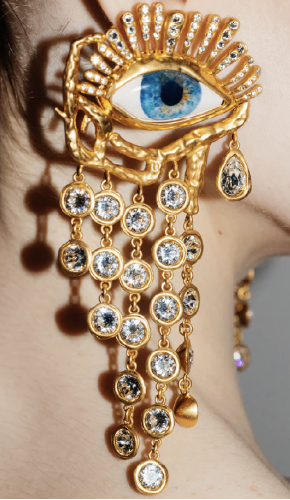
The brand’s accessories have become particularly iconic. From the instantly recognizable Face bag to new keyhole pumps and the “Secret” padlocked handbag, these pieces are designed to be conversation starters, often eliciting the question, “Where did you get that?”—a hallmark of Schiaparelli’s bold approach. Roseberry has also brought his own innovations to the brand’s jewelry, creating gold-plated shell earrings with blush-pink porcelain interiors, tentacle-shaped gold earrings, and silicone pieces recalling sea anemones.
The Cultural Phenomenon
Schiaparelli’s red-carpet moments have become legendary. Lady Gaga wore a Schiaparelli Haute Couture gown to sing the American national anthem at President Joe Biden’s inauguration in 2021, a gold-plated brass dove brooch symbolizing peace pinned to her chest. Bella Hadid’s gilded rib breastplate and Natasha Poonawalla’s gold-armored bustier at the 2022 Met Gala have become iconic images. As Roseberry notes, “Our most iconic moments weren’t just about the person but about the moment itself.” The house has also dressed Beyoncé and Alia Bhatt, who wore a blush-pink corseted number to the 2026 Cannes Film Festival.
Yet Roseberry remains clear-eyed about the ephemeral nature of such moments. “When you’ve broken the internet, like we have a few times—whether it’s with Bella Hadid’s ‘lungs’ or the animals or Beyoncé—you also realize those moments last for maybe two days,” he says. “Even if you feel like you’ve won, you really haven’t. I’m trying to create collections that will live beyond a week of social media attention.”
Schiaparelli: Fashion Becomes Art at the V&A
The house’s enduring legacy and present relevance were celebrated in 2026 with a major exhibition at the Victoria & Albert Museum in London, titled “Schiaparelli: Fashion Becomes Art.” The exhibition spanned Elsa Schiaparelli’s original pieces through Roseberry’s ongoing tenure, highlighting the thread of artistic innovation that connects the house’s past and present. Roseberry himself played tour guide for the exhibition, underscoring how he used Schiaparelli’s work to blend the past and present, pointing to the embroidered “Apollo” dress from Spring 2022 couture as “the first time something from the archives really pulled us in.”
The Radical Idea of Creativity
Schiaparelli’s story is one of resilience, reinvention, and an unwavering commitment to the radical idea that creativity itself is the most valuable currency in fashion. From Elsa’s first trompe-l’œil sweater to Roseberry’s latex and silicone sculptural masterpieces, the house has consistently challenged what clothing can be and what it can mean. It is a house built on the belief that fashion is not merely about covering the body but about expressing the imagination, provoking thought, and creating wonder.
As Elsa Schiaparelli herself demonstrated, and as Daniel Roseberry continues to prove, the house of Schiaparelli is a place where fashion truly becomes art. It offers not just clothes but a vision of the world that is more fantastical, more daring, and more alive. In a fashion landscape often dominated by commercial considerations, Schiaparelli stands as a reminder that the wildest dreams can become the most powerful realities.