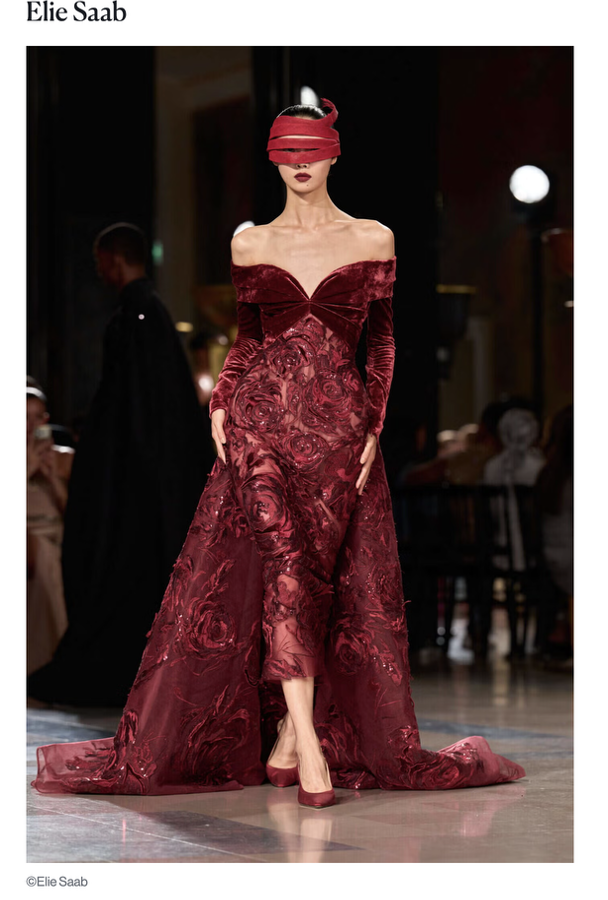
The Elie Saab Fall/Winter 2026-2027 Haute Couture collection cast a spell over Paris Fashion Week with its presentation titled “The Ball of Untamed Dreams”. Stepping away from his familiar soft pastel palettes, the Lebanese couturier pivoted toward a theatrical, deeply romantic aesthetic steeped in mystery and surrealism. At the heart of this collection sits a spectacular, deep burgundy gown that effortlessly bridges the boundary between regal opulence and Salvador Dalí-inspired art.
The Architecture of the Gown
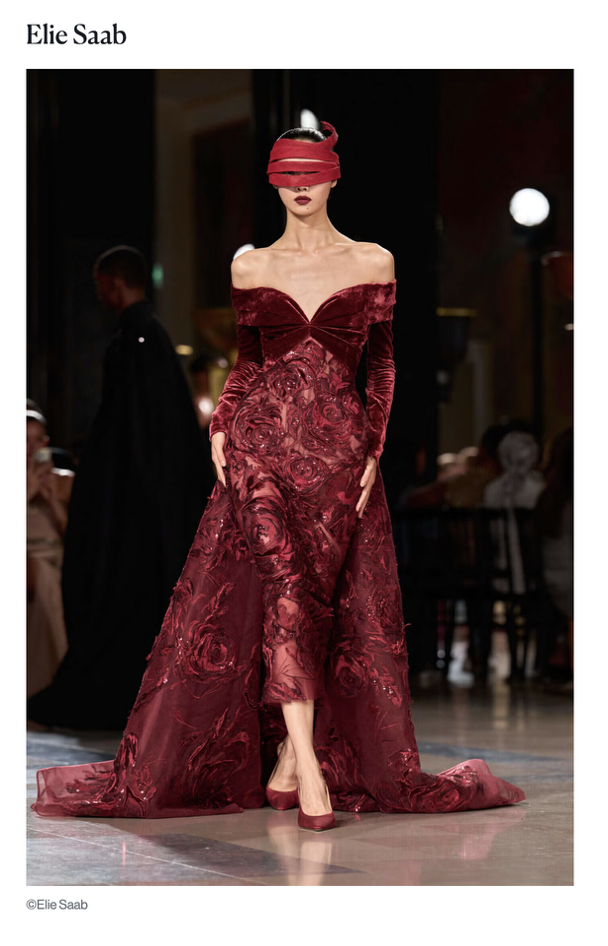
The gown begins with a heavily structured, corseted bodice crafted from sumptuous, deep Bordeaux silk velvet — a wine-dark hue so saturated it reads almost black under low light before catching a flash of true red. Cut into an off-the-shoulder silhouette, the velvet wraps tightly around the bust and cascades into long, clinging sleeves, exposing the collarbone and shoulders in a gesture that softens the corset’s severity with a moment of unexpected vulnerability. It is a structural choice that reads as both armor and undress at once: the boning holds the body upright and formal, while the dropped neckline lets something looser and more human slip through.
As the eye travels down, the solid weight of the velvet gives way to an entirely different register. The bodice’s density dissolves into a skirt built from intricately embroidered tulle — sheer, airy, and almost weightless by comparison to the velvet above it. Rather than a printed motif, the florals here are constructed, dimensional, and raised directly off the fabric: tonal sequined rosettes, worked thread by thread, bloom across the tulle in clusters that vary in scale, some no larger than a coin, others swelling into oversized, sculptural blooms. This is where the collection’s central reference makes itself known. The entire Fall/Winter 2026–2027 collection built its floral vocabulary around Salvador Dalí’s Meditative Rose — the surrealist’s 1958 painting of a single, impossibly large rose suspended in an empty sky above a solitary figure. Across the show, that image was translated with varying degrees of restraint, from a single embroidered black rose climbing a vine on an otherwise minimalist ivory gown, to this closing look, where the rose motif is at its most maximalist: not one bloom, but an entire garden of them, dense and light-catching, covering nearly every visible inch of tulle.
To complete the dramatic silhouette, Elie Saab layered a floor-sweeping velvet overskirt on top of the embroidered tulle — matching the bodice in fabric and color, and matching the skirt beneath it in its own covering of raised sequined rosettes. It falls in sharp, tailored folds to form an imposing, sweeping train, and its presence does real structural work: it is the counterweight that keeps the sheer tulle from reading as merely delicate. Without it, the dress might feel like lingerie dressed up for the runway. With it, the sheerness becomes something glimpsed rather than exposed — a controlled reveal, layered under real weight and real drama, so that transparency and grandeur end up reinforcing each other rather than competing.
A Touch of Surrealism
What elevates this look from traditional eveningwear into high-concept spectacle is entirely in the styling. The model walked masked by a structured velvet visor — not a delicate lace eye mask or a decorative half-veil, but a solid, architectural blindfold in the same fabric as the gown itself, fully obscuring her sight. She was, in the language used to describe the show, an elegant sleepwalker: a figure moving through the space with the unhurried, untroubled gait of someone dreaming rather than performing. That framing matters, because it reorients the entire look away from a masquerade-ball flirtation with mystery and toward something closer to genuine disorientation — a woman moving confidently through a space she cannot see, trusting the architecture of the gown itself to hold her upright and carry her forward.
This closing look didn’t arrive in isolation. It was the final and most intense chapter of a show explicitly built around dreaming, titled “The Ball of Untamed Dreams.” The collection’s mood board reportedly drew on a specific cast of old-Hollywood and theatrical references: Richard Burton wrapped in sweeping capes, Elizabeth Taylor beneath a feathered halo, and Mia Farrow rendered fragile under a butterfly mask — a lineage of glamour that is theatrical, faintly gothic, and never entirely at ease. The show progressed from restraint toward excess. Early on, a draped, pleated ivory gown carried only a single black rose climbing a vine on the bustier — a moment of near-minimalism that let the Dalí reference breathe. From there, the collection built toward a black-to-Bordeaux ombré velvet gown, first printed and then embroidered over with matching gradient beadwork, evoking the particular heaviness of a dream that lingers stubbornly after waking. The closing gown described here is the culmination of that arc: the point at which restraint is fully abandoned in favor of saturation, weight, and total sensory covering.
Other looks in the same collection reinforced the throughline without repeating it. A fishtail gown in striking magenta silk, nicknamed for its rose motif, offered a sleeker, more body-conscious take on the same florals. A champagne bridal gown closed the show more conventionally, its sculpted, molten-iridescent bodice layered with gold embroidery and crystal work standing in deliberate contrast to the darker, more surreal gowns that preceded it — a return to light after a sustained passage through shadow. Against that arc, the Bordeaux velvet gown with its blindfolded model reads as the collection’s emotional low point and stylistic high point simultaneously: the darkest color, the heaviest fabric, the most literal embrace of disorientation as a design principle, positioned deliberately just before the show’s return to bridal brightness.
It’s worth noting what this look is not. It is not a case of surrealism layered thinly over a conventional gown for shock value — the transparency, the visor, and the rose embroidery all function together, structurally and thematically, rather than as isolated flourishes. The velvet overskirt isn’t just decorative drama; it’s load-bearing, both literally (in how it grounds the sheer tulle) and conceptually (in how it signals gravity and consequence against the airiness of the embroidered underlayer). Nor is the blindfold a coy nod to mystery in the manner of a lace masquerade mask — it fully removes the model’s sight, turning the runway walk itself into a small feat of trust and choreography, and reframing the entire garment as something experienced rather than merely displayed.
By merging deep, moody color with genuinely meticulous textile construction — hand-worked sequined rosettes, tonal ombré beading, structural velvet engineering — Elie Saab made a case that couture’s romantic foundations don’t have to be abandoned to introduce tension and theatrical ambiguity. Instead, romance is deepened by shadow. The rose, historically couture’s most familiar and least risky floral reference, becomes genuinely strange again when rendered at this scale, in this density, on a woman who cannot see it herself. That’s the real achievement of the look: not the invention of a new symbol, but the defamiliarization of an old one, pushed just far enough into excess and obstruction that it stops reading as pretty and starts reading as uncanny.
Commercially, it’s worth noting the collection’s push toward the surreal never actually broke from wearability — every gown, however dark or masked, remained fundamentally a red-carpet-ready silhouette underneath its conceptual staging. That tension between avant-garde presentation and thoroughly commercial construction is arguably the most Elie Saab thing about the entire show: the house’s identity has always rested on romantic, body-flattering eveningwear, and even its most theatrical experiment stops short of abandoning that core. The blindfold comes off; the gown remains sellable. That may be the most surreal detail of all — a fashion house staging a genuine dream sequence, and still landing every look squarely within the bounds of what its clientele would actually wear.