There are few jewelry designs that capture the imagination quite like Boucheron’s Point d’Interrogation. Since its debut in 1879, this singular necklace has transcended its status as an accessory to become a legend — a piece that didn’t just adorn the neck but dared to redefine what jewelry could be. Its story, much like a great epic, is one of rebellion, reinvention, and a relentless pursuit of the extraordinary.
For the eagle-eyed connoisseur, every new iteration of the Question Mark necklace seems to raise the stakes. How does one top — or simply continue — the sensation of a design that broke every rule of 19th-century jewelry, earning the Grand Prix at the 1889 Paris Universal Exposition? It’s a design so central to the house’s identity that Boucheron’s own materials describe it as one of the pieces that solidified the maison’s reputation for combining technical daring with genuine emotional expression. For creative director Claire Choisne, each reinterpretation functions as both tribute and event — whether that means resurrecting archival motifs like peacock feathers and ivy, or spending years perfecting a mechanically complex, fully reversible necklace.
An Act of Liberation
The original Point d’Interrogation began, fittingly, as a drawing rather than a finished jewel. In 1879, founder Frédéric Boucheron commissioned French painter Paul Legrand to sketch a necklace unlike anything else being made at the time: clasp-free, asymmetrical, and built around an ivy motif that curled down the body in a single unbroken line. That sketch became the blueprint for one of the first claspless necklaces in the history of high jewelry — a design a woman could slip on herself, in one fluid motion, without a lady’s maid to help fasten it.
This was not a small detail. In an era when women’s high jewelry was typically heavy, rigid, and required assistance to put on, a necklace that a woman could wear entirely on her own terms was a genuine social statement disguised as a technical one. The mechanism that made it possible — a hidden leaf-spring system built from a multitude of small, interlocking parts — was developed exclusively within Boucheron’s own workshops. It remains, even by the account of the house itself, nearly invisible to the eye: a piece of engineering quietly doing the work beneath an ornament that reads, from a distance, as pure fluid line. The necklace takes its name, the Question Mark, from the sinuous asymmetrical curve this mechanism allowed — a shape that broke decisively from the rigid symmetry that had defined jewelry design up to that point.
A decade after that first sketch, the Point d’Interrogation was awarded the Grand Prix at the 1889 Exposition Universelle in Paris, cementing its place not just as a beautiful object but as a genuine turning point in the technical history of jewelry-making.
source : Boucheron website
The Peacock Feather and Its Royal Buyer
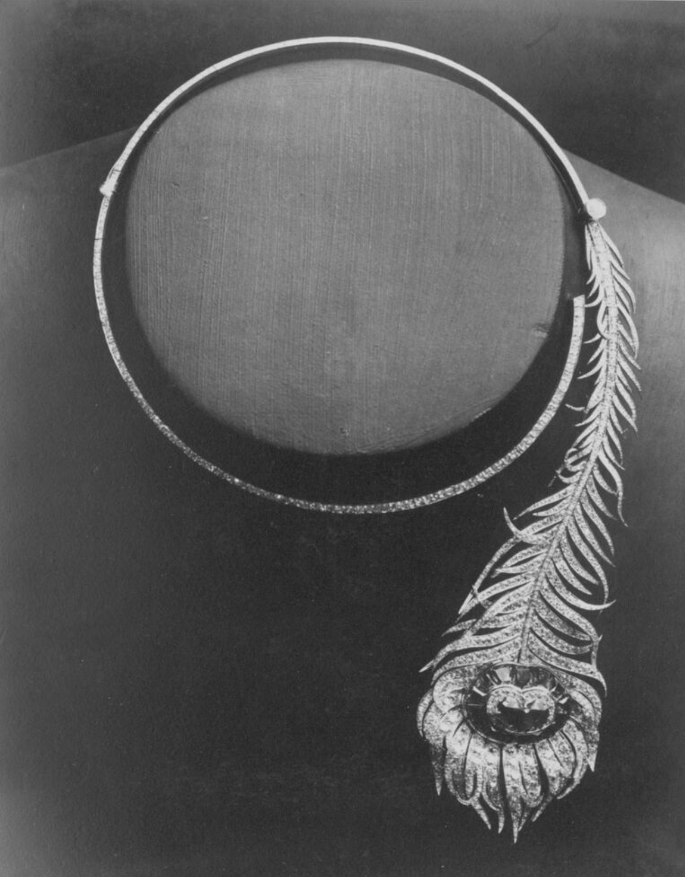
If the ivy version established the concept, it was the peacock-feather rendition that turned the Question Mark into a piece of legend. Frédéric Boucheron had long been drawn to the peacock feather as a motif — it had already appeared in his brooches and hair ornaments in the 1860s — and in the early 1880s he adapted it into the Question Mark’s asymmetrical form, producing versions in 1882 and 1883. It was the second of these, made in 1883, that found its way to one of the era’s most storied clients: Grand Duke Alexei of Russia, a loyal Boucheron customer, purchased the piece — a necklace set with an impressive sapphire, emeralds, and diamonds, with a detachable feather that could double as a brooch or hair ornament — for 14,000 francs, a fortune at the time and an unmistakable signal of the piece’s status among European nobility.
That single sale set the tone for the necklace’s early clientele. Boucheron’s own archives note that the workshops produced only around thirty examples of the Question Mark necklace in this initial period, and that scarcity, combined with the design’s novelty, quickly won the house an international following — from the Russian imperial family to the great American industrial dynasties of the Gilded Age, families for whom a Boucheron Question Mark necklace functioned as both jewelry and a kind of currency of taste.
From Archive to Atelier: The Modern Reinterpretations
More than 140 years after that first Legrand sketch, the Question Mark remains one of the clearest expressions of what Boucheron considers its house style: technical innovation in service of emotional expression, and a persistent focus on how jewelry moves with — rather than restrains — the women who wear it.
The clearest recent example of that philosophy is the reversible Question Mark necklace Boucheron unveiled in 2024, the product of several years of development inside the maison’s workshops. The design takes its cue from a specific archival piece: an 1884 Question Mark necklace custom-made for the American businessman Cornelius Vanderbilt. Boucheron’s contemporary reworking preserves the original’s clean, asymmetrical lines but adds an entirely new tailor-made mechanism that allows the entire necklace to flip. One face blazes with color — rubellites, tanzanites, or green tourmalines, depending on the version — while the reverse offers something quieter: custom-cut rock crystal set with pavé diamonds. It’s a neat encapsulation of the piece’s dual nature, veering between maximalist spectacle and restrained, architectural minimalism depending on which side faces outward.
That same anniversary campaign brought several other reinterpretations to life, each rooted in a specific piece of archival history rather than invented from scratch. The Lierre de Paris Question Mark Necklace revives Legrand’s original 1879 ivy sketch, rendered in emeralds and rhodium-plated gold, using an antique trembleur technique that makes each leaf appear to tremble with the wearer’s movement — a detail Boucheron’s workshops first developed for 19th-century pieces and have kept in active use ever since. The Plume de Paon Question Mark Necklace returns to the peacock-feather motif that made the design famous in the first place. The Laurier Question Mark Necklace, meanwhile, pays tribute to an 1880 laurel-themed rendition of the necklace, updated with rubellites dangling from the leaves like ripe fruit. And the Question Mark Eternity Necklace takes the opposite approach entirely, stripping the design down to curved simplicity, with a detachable center stone that lets it convert between a full necklace and a streamlined choker.
What It Costs to Own a Piece of the Legend
Pricing for the Question Mark’s various modern descendants varies enormously depending on materials, scale, and specific model — there is no single figure that captures the range. A smaller Plume de Paon pendant in rose gold can start in the neighborhood of $15,000, while a fuller diamond-and-rock-crystal medallion version has been priced well above $100,000, and a yellow-gold necklace set with a large rose-cut diamond has climbed past $190,000. As with all true high jewelry, the most extraordinary pieces — one-of-a-kind creations using rare colored gemstones, or the fully reversible archival reinterpretations — exist in a realm where prices are simply made available upon request, and where a final figure can run well into six figures or beyond, depending on the rarity of the stones involved and the complexity of the mechanism.
A Question That Keeps Answering Itself
The backstory, in the end, is often as captivating as the jewels themselves. Every new Boucheron campaign built around the Question Mark leans into that history rather than away from it — pairing each reinterpretation with the specific archival sketch, client, or decade that inspired it, so that buying a modern piece means, in some sense, buying a footnote to a very particular 19th-century story. That’s a deliberate choice on the maison’s part: rather than treating the original 1879 design as a closed chapter, Boucheron keeps returning to it as raw material, mining specific sketches, specific clients, and specific technical problems from its own 140-year-old archive and asking its current artisans to solve them again, this time with contemporary materials and contemporary mechanisms.
Not every reinterpretation demands years of planning — some borrow more loosely from the archive, adapting a motif without reproducing an entire historical commission. But the standard across all of them stays consistent: technical ambition matched to genuine historical grounding. For a house whose founding gesture was freeing women from needing help to get dressed, that consistency feels appropriate. The Point d’Interrogation was never simply a beautiful shape; it was a solved problem, wearing a beautiful shape as its outward form. Nearly a century and a half later, Boucheron’s workshops are still finding new problems inside the same silhouette — and for those who can afford the result, owning one is less a simple purchase than a way of wearing a specific, well-documented piece of jewelry history around your neck.