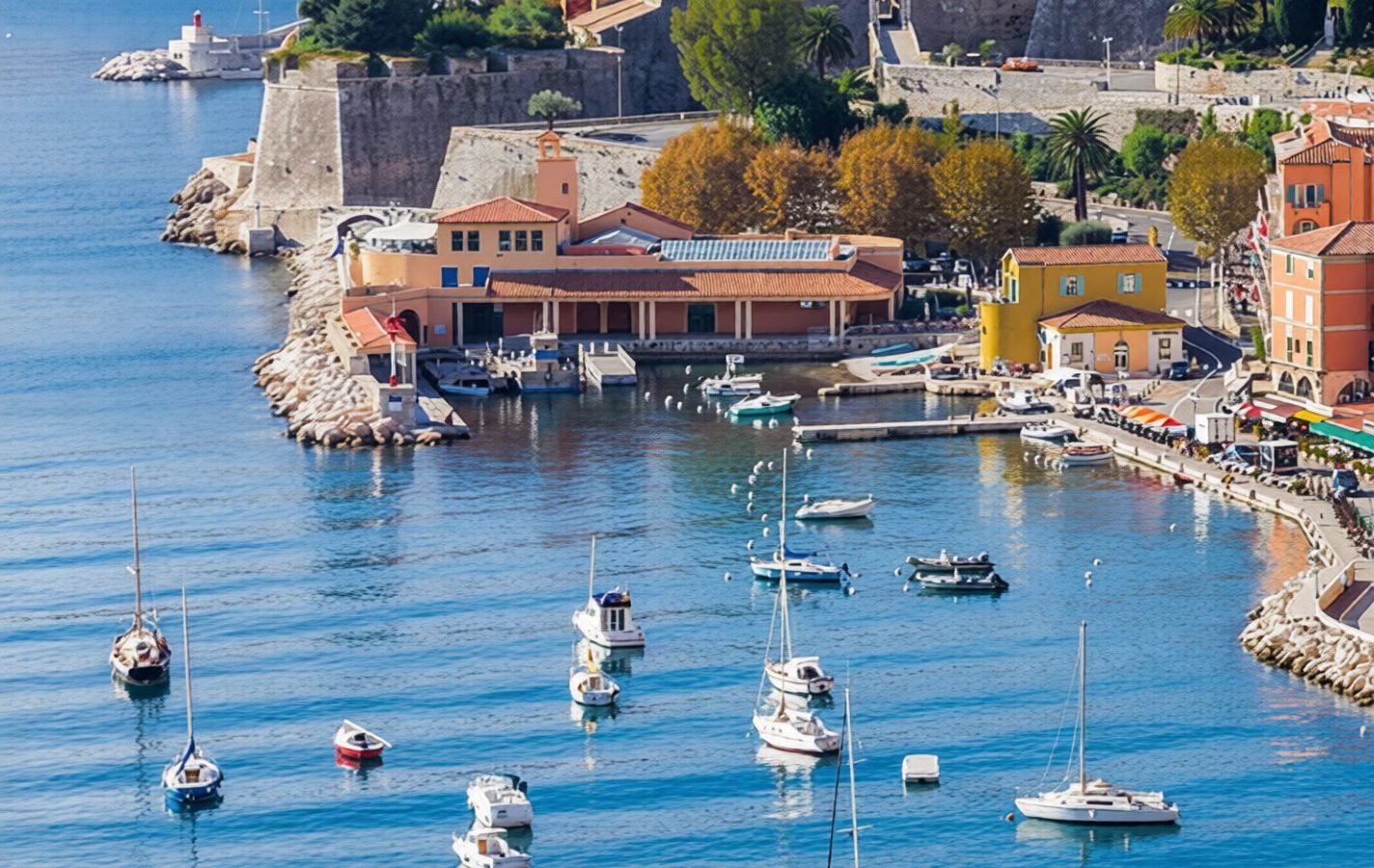
Ask most travelers to name the highlights of the Côte d’Azur and you’ll get the predictable roll call: Nice’s Promenade des Anglais, Monaco’s casino steps, the hilltop lanes of Èze. Villefranche-sur-Mer rarely makes the opening lineup, which is precisely why the people who do know it tend to guard the secret a little jealously. Wedged into one of the deepest natural harbors in the Mediterranean, just a few minutes east of Nice and a few minutes west of Saint-Jean-Cap-Ferrat, this pastel-colored fishing town has spent the better part of a millennium being exactly what the Riviera used to be before the Riviera became a brand.
A Harbor Built for Empires, Not Just Yachts
The town’s name gives away its origins: Villefranche translates roughly to “free town,” a nod to its centuries-long status as a duty-free port. That designation dates back to the late 13th century, when Charles II of Anjou — Count of Provence and King of Naples — granted the settlement its tax-exempt privileges to encourage trade along a coastline that had spent the preceding centuries fending off Saracen raiders and serving as a hideout from pirates. For roughly five hundred years afterward, Villefranche belonged to the Duchy of Savoy, functioning as the Duchy’s only real access point to the sea even as the seat of power sat inland in Turin. It wasn’t until 1860, when Nice and its surrounding territory were formally annexed by France following a treaty with the Kingdom of Sardinia, that Villefranche became French in more than just geography.
That long Italian chapter is still legible in the town today. Locals and longtime visitors alike will tell you Villefranche feels more like Liguria than Provence — pastel orange and ochre buildings stacked up narrow, sun-bleached lanes, linguine turning up on menus as often as bouillabaisse, and a general looseness to the place that owes more to Italian village life than to French formality.
The real draw, though, has always been the bay itself. At depths reaching close to 100 meters in places, the Rade de Villefranche is one of the deepest natural anchorages on the Mediterranean coast, deep enough that aircraft carriers and naval fleets have used it for generations — the U.S. Sixth Fleet anchored here for years during the Cold War. Today that same depth draws a different kind of vessel: superyachts glide in for the season and drop anchor within view of the old town, sharing the water with the cruise ships that call at Villefranche roughly 250,000 passengers strong each year between April and October. It’s worth timing a visit around that rhythm; arrive on a quiet weekday morning and the harbor feels almost private, while a Tuesday in July with three ships in port tells a very different story.
The Old Town: A Maze Worth Getting Lost In
Villefranche’s vieille ville rewards aimlessness more than any itinerary could. The streets fold in on themselves in a genuine labyrinth of covered passages, stone stairways, and sherbet-toned facades, and the best strategy is simply to wander until you stumble onto something worth stopping for. Rue Obscure, the town’s most curious street, is a case in point: a vaulted stone corridor that runs beneath the buildings above it, it began centuries ago as an open route along the ramparts used to move soldiers and supplies. Once the town’s Citadel was completed in the 16th century, the passage lost its military purpose and the town simply grew over it, floor by floor, until it was fully enclosed by the 18th century — leaving behind a cool, dim tunnel that still cuts through the old town today.
That Citadel — the Citadelle Saint-Elme, completed in 1554 — remains the town’s most imposing landmark, its thick fortified walls and cannon-lined ramparts offering some of the best panoramic views of the harbor and coastline available anywhere in Villefranche. Inside its grounds now sit several small museums, but the real appeal is simply walking the ramparts themselves at golden hour, when the bay below turns the color of the buildings that surround it.
Down at the waterfront sits the town’s other essential stop: the Chapelle Saint-Pierre, a modest 14th-century fishermen’s chapel that Jean Cocteau took on as a personal project in the 1950s, covering its interior in his signature linework frescoes depicting scenes from the life of Saint Peter and the town’s fishing heritage. It’s a small building — the visit takes fifteen minutes, tops — but Cocteau’s touch turned an unremarkable chapel into one of the more unexpected art pilgrimages on the coast.
Beach Time, the Villefranche Way
For a town this small, Villefranche punches above its weight on the beach front. Plage des Marinieres, stretching out beneath the Citadel, is the main event: a shallow, gently sloping beach that makes it one of the more family-friendly stretches of sand on this part of the coast, with clear water and easy access from the train station. The sand here leans gravelly rather than powder-soft — standard for this stretch of the Riviera — but it’s clean, uncrowded relative to Nice, and close enough to town that a swim and a proper lunch can happen within the same hour.
Where to Base Yourself
Villefranche makes an excellent home base precisely because of what surrounds it. Nice’s old town and airport sit roughly fifteen minutes away by car or train, making arrival painless. Saint-Jean-Cap-Ferrat, with its own storied string of belle-époque villas, is a short walk or a five-minute drive along the coast. Monaco, Èze’s clifftop medieval village, and the winding Grande and Moyenne Corniches — the coastal roads immortalized in a half-century of car chases and postcards — are all comfortably within a half-day’s reach. Villefranche’s own train station puts the entire coast between Menton and Cannes within striking distance without ever needing to move the car.
The Case for Villefranche
The Riviera has no shortage of towns competing for the title of most photogenic, and Villefranche doesn’t always win that argument outright against rivals like Menton or Èze. What it offers instead is something harder to manufacture: a working town that has managed to hold onto its own rhythm despite eight centuries of empires, navies, and now cruise ships passing through its harbor. The yachts still anchor in the bay, the fishing boats still go out in the morning, and the old town still feels, at the right hour, like a place that exists for the people who live there rather than the people passing through. That balance — glamorous enough to matter, unpretentious enough to still feel real — is exactly what keeps drawing people back, and precisely why it’s worth reaching before everyone else finally catches on.