listen to the audio of this article
Some cars are remembered for winning races. Others are remembered for the record they set at auction. The Mercedes-Benz 300 SLR Uhlenhaut Coupé manages to do both, despite never once competing. Built in 1955 as a pair of closed-roof prototypes derived from the championship-winning 300 SLR racer, it became, decades later, the most expensive car ever sold. Its story blends engineering brilliance, personal legend, tragedy, and an almost unimaginable price tag.
Two Cars, One Purpose
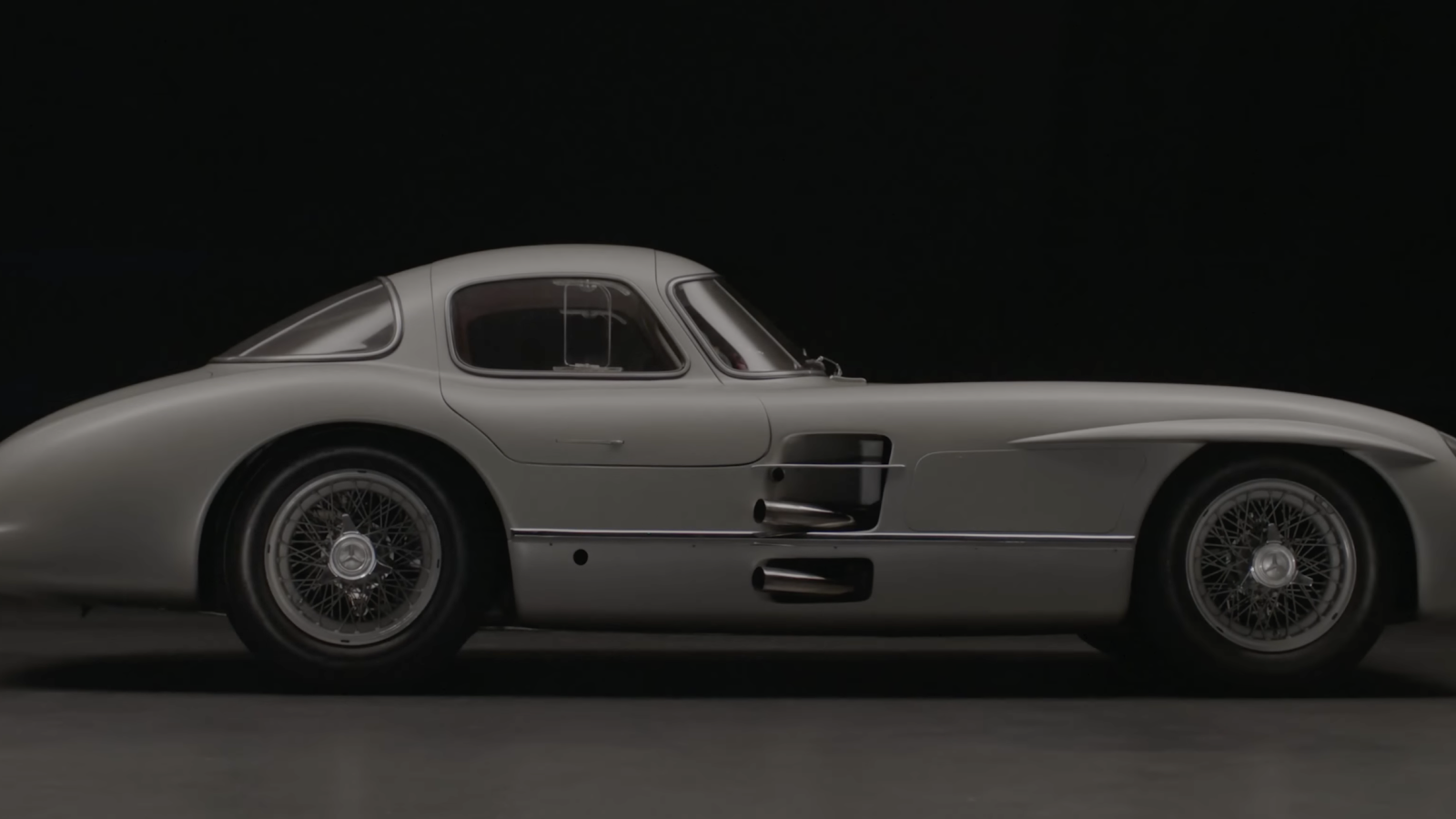
By 1955, Mercedes-Benz’s 300 SLR (W196 S) sports racer had already proven itself the class of the field, sweeping the World Sportscar Championship with drivers like Juan Manuel Fangio and Stirling Moss behind the wheel. Alongside the open racing cars, the factory built two coupé versions with fixed, gullwing-style roofs. These were not intended as showroom products or even as a third body style for competition, but as engineering demonstrators built to show what the marque’s racing technology could achieve when wrapped in a closed body suited to very high-speed, long-distance travel.
Only two were ever made. One would eventually become a personal car for the engineer whose name it now carries; the other stayed largely in the background at the factory, later becoming a museum piece. Together, they represent one of the smallest production runs of any Mercedes-Benz model in history.
The Man Behind the Name
The coupés take their name from Rudolf Uhlenhaut, the engineer most responsible for their existence. Born in London in 1906 to a German father and English mother, Uhlenhaut joined Daimler-Benz in the early 1930s and went on to lead the technical development of the pre-war “Silver Arrows” Grand Prix cars, and later the postwar W196 Formula One car and its 300 SLR sports-racing sibling.
Uhlenhaut was unusual among engineers of his era in that he was also a genuinely fast driver, reportedly capable of lapping the Nürburgring at speeds that rivaled the works drivers he employed. That hands-on feel for chassis behavior and performance is often credited as a defining trait of his engineering philosophy, and it made him a natural choice to shape a road-going interpretation of the team’s racing hardware. One of the two coupés is widely said to have served as his personal transport, giving rise to the nickname by which both cars are known today.
Engineering Beneath the Skin
Mechanically, the Uhlenhaut Coupé was essentially a 300 SLR racer wearing a fixed roof. It used the same 3.0-liter straight-eight engine as the open racing cars, producing over 300 horsepower through mechanical fuel injection and desmodromic valve control, a system that closed the valves mechanically rather than relying on springs, allowing for higher, more reliable revs. This gave the coupé a top speed reported at around 290 km/h (roughly 180 mph), making it, at the time, the fastest car capable of being driven on public roads.
The car rode on a lightweight tubular spaceframe chassis with a body fashioned largely from magnesium alloy, keeping weight extremely low for the performance on offer. Inboard drum brakes reduced unsprung mass at each corner, and the transaxle gearbox arrangement, with the transmission mounted toward the rear, helped balance the car’s weight distribution between front and rear axles. Period road testing by Autocar magazine in 1956 reportedly recorded a 0-60 mph time under seven seconds, a figure that would remain competitive with performance cars built many years later.
Perhaps the most famous anecdote associated with the car’s capabilities involves Uhlenhaut himself allegedly driving from Munich to Stuttgart, a journey of roughly 220 kilometers, in a little over an hour on the autobahn, a pace that would be difficult to match even in today’s traffic conditions.
A Car That Never Raced
Despite being built from racing stock, neither Uhlenhaut Coupé ever competed. The plan had reportedly been to enter the closed cars in long-distance road races such as the Carrera Panamericana in Mexico, where a fixed roof and high top speed would have been advantageous. In the aftermath of an accident, Mercedes-Benz withdrew its remaining cars from that year’s Le Mans and, before the season was out, pulled out of motorsport entirely for decades. Plans to race the Uhlenhaut Coupés evaporated. The two cars that had been built to show off Mercedes’ engineering on the world’s toughest roads were left instead to sit largely unseen, testbeds for a program that had already ended.
From the Factory Vault to the Auction Block
For nearly seventy years, Mercedes-Benz retained ownership of both coupés. One remained on public display at the Mercedes-Benz Museum in Stuttgart; the other was kept out of public view. That changed in May 2022, when Mercedes-Benz announced it would sell one of the two cars through a private sale arranged with the auction house RM Sotheby’s, held at the museum itself.
The sale was notably discreet. Bidding was limited to a small number of invited collectors, and the buyer’s identity was represented by British car specialist Simon Kidston rather than disclosed publicly. When the hammer fell, the winning bid came to approximately €135 million, or roughly $143 million at the time, instantly making it the most expensive car ever sold and surpassing the previous record, held by a 1962 Ferrari 250 GTO, by a wide margin.
Mercedes-Benz’s chairman, Ola Källenius, explained afterward that proceeds from the sale would help fund a global scholarship program, intended to support future engineers and continue the kind of innovation that Uhlenhaut himself had once represented. The second coupé remains with the factory, still on display as one of the centerpieces of the Mercedes-Benz Museum’s collection.
A Legend Secured
The Uhlenhaut Coupé occupies an unusual place in automotive history: a car defined as much by what it never did as by what it achieved. It never raced, never carried a driver to victory, and was built in a run of just two. Yet its engineering, drawn directly from one of the most dominant racing programs of the 1950s, its connection to one of the era’s most gifted engineers, and the tragic backdrop of the Le Mans disaster that kept it off the track all combine to give it a mystique that few cars can match.
That mystique was ultimately confirmed in the clearest way markets can express it: in price. Nearly seventy years after it was built, the Uhlenhaut Coupé became the most valuable car in the world, a fitting, if unexpected, final chapter for a machine originally built simply to prove what was possible.