listen to the audio of this article
Subtlety has never been Ferrari’s strong suit when it matters most, and the 12Cilindri (pronounced as ‘dodici cilindri’) proves the point before a single spec sheet is consulted. The name translates, plainly, to “twelve cylinders,” a description so literal it borders on defiant. In an era when nearly every performance manufacturer, Ferrari included, has begun hedging its most powerful models with electric motors and turbochargers, the 12Cilindri arrived in May 2024 as a pointed exception: a front-engine V12 grand tourer with no hybrid assistance whatsoever, built for a clientele Ferrari describes simply as connoisseurs of the naturally aspirated engine.
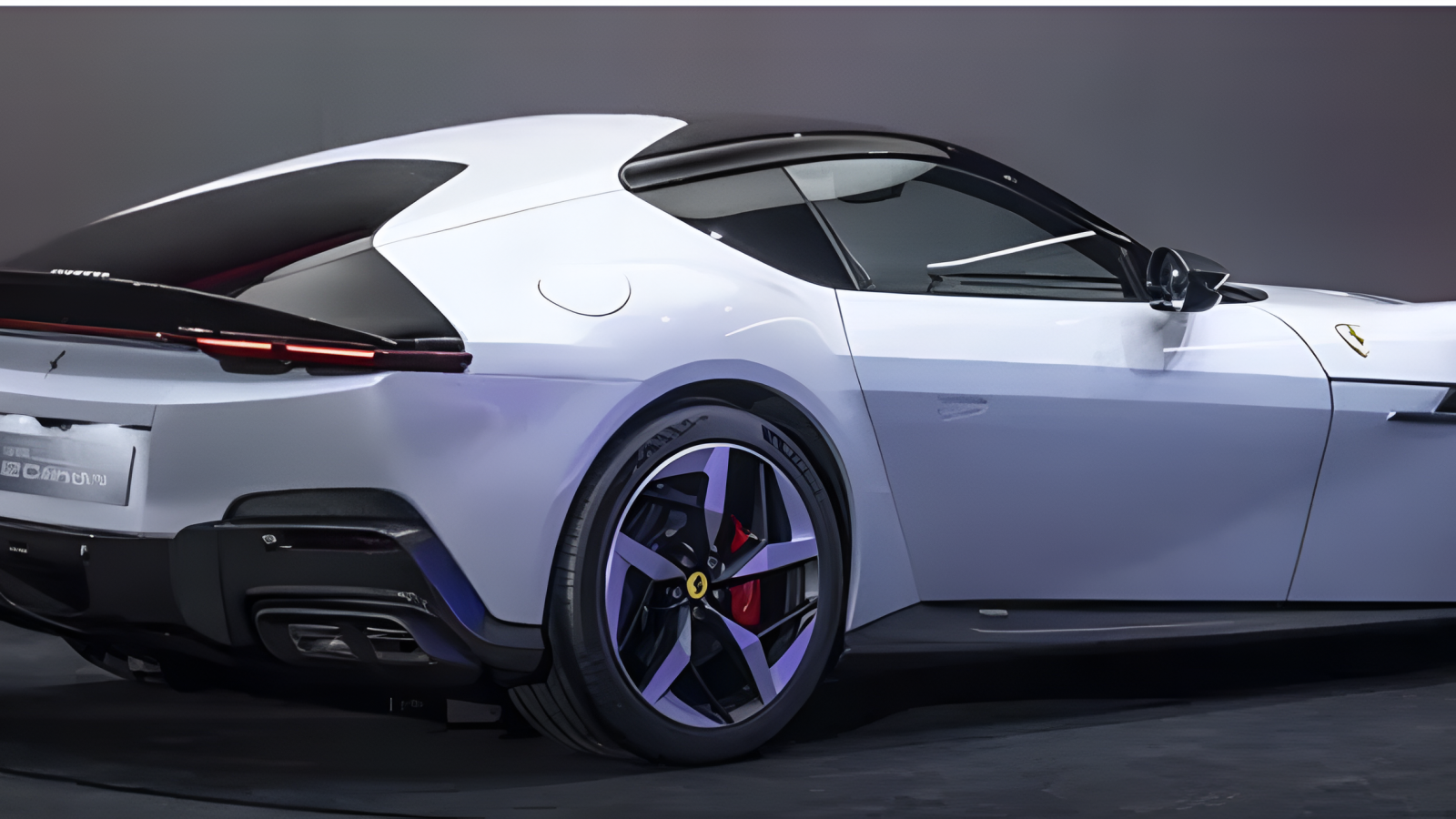
It succeeds the 812 Superfast and 812 GTS, continuing a lineage of front-mid-engine V12 Ferraris that stretches back to the marque’s earliest road cars of the late 1940s. But where the 812 leaned into raw aggression, the 12Cilindri’s design, penned in-house under Flavio Manzoni, reaches further back for its inspiration — to the Ferrari Daytona of the late 1960s and the grand tourers of the 1950s and ’60s more broadly, an era when a Ferrari’s job was as much about covering continents in style as setting lap records.
The Engine Is the Entire Argument
Beneath that long, sculpted bonnet sits a 6.5-liter naturally aspirated V12, the F140 HD, representing the latest evolution of an architecture that has powered Ferrari’s flagship models for years, including the 812 Competizione, the Purosangue, and the limited-run Daytona SP3. In the 12Cilindri, it produces 819 horsepower at a screaming 9,250 rpm, with peak torque of 500 lb-ft arriving at 7,250 rpm and the redline extending to 9,500 rpm — figures that would be remarkable for a turbocharged engine and border on absurd for one that draws breath entirely on its own.
Ferrari’s engineers borrowed lessons from the company’s Formula 1 program in refining the unit’s direct fuel injection and its 48 valves, actuated by sliding finger cam followers rather than conventional rocker arms, in pursuit of quicker response at the top of the rev range. The result is an engine that does not merely produce power but performs it, building toward its redline with the kind of theatrical intensity that turbocharged and hybridized engines, whatever their outright numbers, rarely manage to replicate. Ferrari has been candid that this may be among the last purely naturally aspirated V12s the company builds without some form of electrification; the 12Cilindri, in that light, reads less like a new model than a farewell tour conducted at 9,500 rpm.
Numbers That Still Startle
Power reaches the road through an eight-speed dual-clutch transmission and, for the moment, exclusively the rear wheels. Ferrari quotes a 0-to-62-mph time of 2.9 seconds and a top speed beyond 211 mph, figures that place the 12Cilindri among the fastest cars the company currently builds despite the complete absence of electric assistance. Dry weight comes in at 1,560 kilograms, distributed 48.4 percent front and 51.6 percent rear, a balance Ferrari achieves in part by mounting the engine behind the front axle line — the “front mid-engine” layout that has defined the marque’s grand tourers for decades.
The chassis carries forward Ferrari’s eighth-generation Side Slip Control system, tuned to make the car’s considerable power accessible across a wider range of driver skill than the raw output figures might suggest, alongside magnetorheological dampers capable of adjusting damping force within milliseconds. An active rear spoiler, tilting up to ten degrees at speeds above 37 mph, generates roughly 50 kilograms of downforce and doubles as an aerodynamic brake under hard deceleration — a modest concession to the electronic sophistication that governs even Ferrari’s most analog-feeling cars.
A Cabin Built Around Two Cockpits
Inside, the 12Cilindri adopts what Ferrari calls a dual-cockpit architecture, a design language that treats driver and passenger as two distinct zones rather than a single shared space — a philosophy borrowed loosely from the marque’s earlier grand tourers, where the passenger was as much a participant in the journey as the driver was in the performance. Leather trim, tightly tailored surfaces, and a Burmester audio system round out an interior that leans toward timeless, restrained luxury rather than the more overtly technical cabins found in Ferrari’s mid-engine models.
For clients seeking an even purer connection to the car, Ferrari also offers the 12Cilindri Manuale, a version paired with a traditional manual gearbox rather than the standard dual-clutch unit — a vanishingly rare option in the modern supercar landscape, and one that sold out its full allocation of 1,499 units well ahead of most competing models even entering production.
The Spider: An Open-Top Argument for the Same Engine
The 12Cilindri Spider, revealed alongside the coupe and following it to market by several months, trades the fixed roof for a retractable hardtop, engineered to fold away without compromising the car’s structural rigidity or its performance figures in any meaningful way. Ferrari’s structural reinforcements keep the Spider’s weight penalty modest, and the car retains the coupe’s full 819-horsepower output along with nearly identical acceleration figures — a rare case of a convertible variant sacrificing almost nothing beyond a modest price premium, estimated at roughly $50,000 over the coupe.
Visually, the Spider distinguishes itself with a reworked rear deck to accommodate the folding roof mechanism, but the silhouette otherwise tracks closely with the coupe’s Daytona-inspired lines. For a car built explicitly to celebrate the sound of a naturally aspirated V12 revving toward 9,500 rpm, the open-top format is, in some ways, the more honest expression of the 12Cilindri’s entire premise — there is no glass, no roof panel, and no insulation standing between the driver and the engine’s case for its own existence.
Design as Homage, Not Nostalgia
Manzoni’s team was careful to describe the 12Cilindri’s styling as an homage rather than a retro exercise, and the distinction holds up on close inspection. The long, low bonnet and fastback proportions recall the Daytona unmistakably, but the surfacing throughout is unmistakably contemporary — sharp creases along the flanks, a floating rear wing integrated rather than bolted on, and headlights reduced to a thin horizontal signature that owes more to Ferrari’s current design language than to anything from the 1960s. The effect is a car that reads as familiar without ever tipping into pastiche, a balance Ferrari has not always struck successfully with its more overtly retrospective specials.
That design earned the 12Cilindri a Car Design Award in 2025, a recognition Ferrari has not been shy about publicizing, and one that speaks to the tightrope the car walks: honoring five decades of front-engine V12 heritage while still looking, unmistakably, like the newest thing in the lineup. Few manufacturers attempt that particular balancing act with a flagship model; fewer still manage it without the result feeling like a costume.
Positioned Against Its Rivals, and Against Time
Ferrari positions the 12Cilindri directly against the Aston Martin DBS and the Bentley Continental GT Speed, both of which now lean on turbocharging and, in Bentley’s case, hybrid assistance to reach comparable performance figures. None of them can currently match the 12Cilindri’s naturally aspirated architecture, which increasingly functions as the car’s core differentiator rather than a footnote. Priced from the low $400,000s for the coupe, the 12Cilindri sits well above the Amalfi in Ferrari’s hierarchy, trading everyday usability for a driving experience built almost entirely around a single, increasingly rare mechanical proposition.
Whether the 12Cilindri proves to be the final unhybridized V12 Ferrari ever builds remains an open question the company has not fully answered, but the car carries itself, deliberately, like an ending worth marking properly. It is not trying to be the most technologically advanced car Ferrari makes, nor the quickest around a track. Its entire case rests on a sound and a sensation that electrification, however capable, has yet to replicate — and for the clients willing to pay for that argument, the 12Cilindri and its Spider counterpart may be remembered less as a model than as a moment.