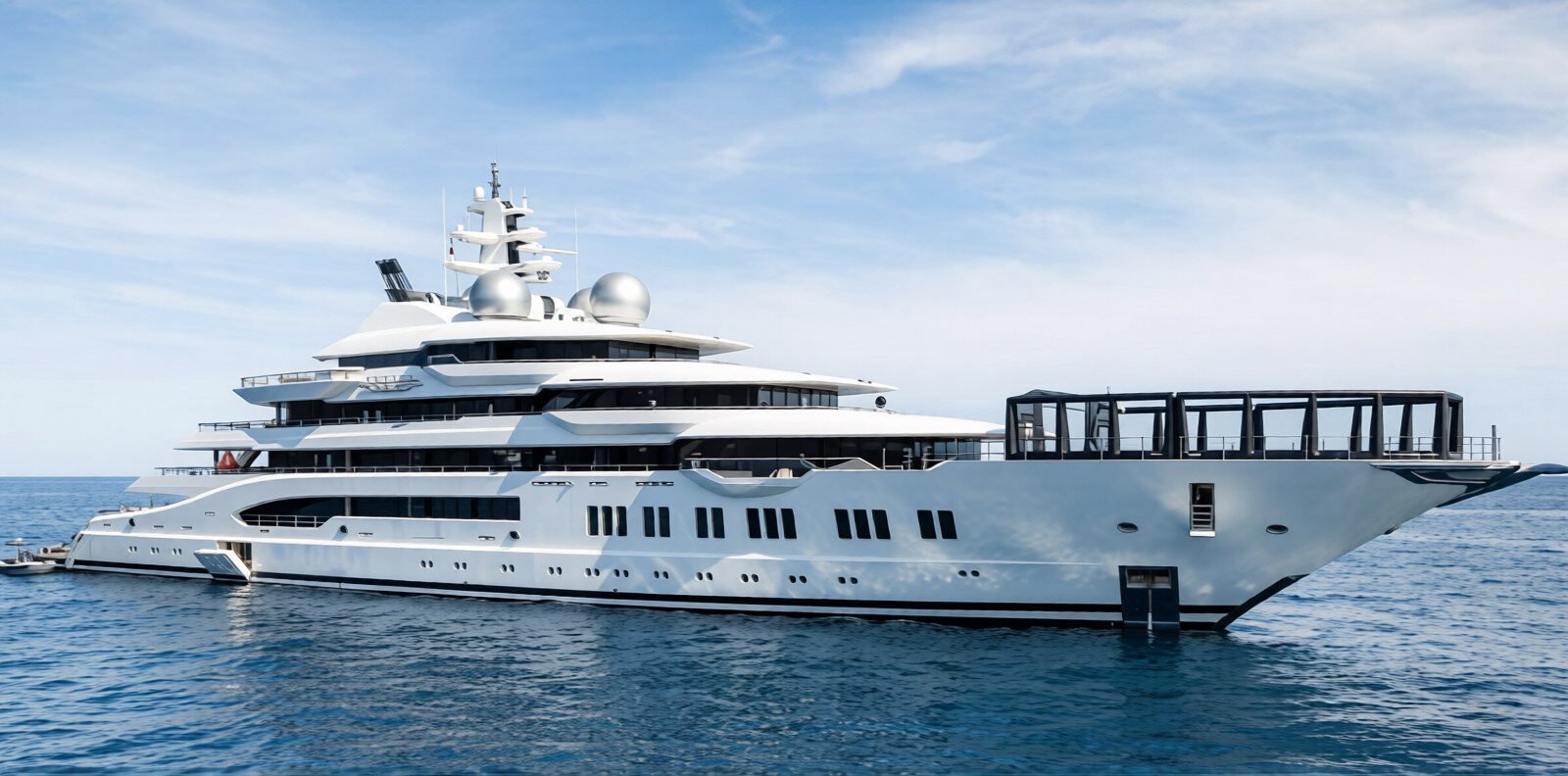
Few vessels afloat carry a story as strange as the Amadea’s. On paper, she is simply one of the world’s great superyachts — a 348-foot masterpiece of German engineering with six decks, a helipad, an infinity pool, and a hand-painted grand piano. In practice, she has spent much of the last four years as a piece of evidence in an international sanctions case, a government-run guest ship costing American taxpayers millions of dollars a month, and finally, an auction lot. Her journey from private playground to courtroom exhibit to billionaire’s trophy again is one of the more remarkable sagas in modern maritime history.
A Masterwork of Design
The Amadea was built by Lürssen, the storied German shipyard responsible for some of the largest and most technically ambitious private yachts ever constructed. At roughly 106 meters (348 feet) in length, she sits comfortably among the largest superyachts in the world, distinguished not just by her size but by the craftsmanship packed into every deck.
Inside, the yacht reflects the no-expense-spared philosophy that defines the top tier of yacht design. She features six decks connected by a pair of gold-finished elevators, a ten-meter infinity pool positioned for sweeping ocean views, and a helicopter landing pad for guests who prefer to skip the marina altogether. Perhaps her most eccentric flourish is a hand-painted Pleyel grand piano — the same French piano maker once favored by Chopin — installed as a centerpiece rather than a mere instrument. The interior blends classic yacht elegance with contemporary materials, the kind of understated maximalism that signals extreme wealth without shouting it.
Yachts of this caliber typically carry accommodations for a dozen or more guests across multiple suites, along with a large crew — often 30 or more — needed to run the engineering, hospitality, and security operations of a vessel this size. When the U.S. government took custody of her, the ongoing costs of simply keeping her seaworthy gave the public a rare look at what it actually costs to operate a yacht like this: reported monthly expenses included roughly $360,000 for crew wages, $165,000 for maintenance, food, and waste removal, and $75,000 for fuel, on top of $1.7 million in annual insurance and a one-time $5.6 million dry-docking bill.
From Russian Oligarch to Fijian Seizure
The turning point came just after Russia’s full-scale invasion of Ukraine in February 2022. As Western governments moved to freeze the assets of Kremlin-linked oligarchs, the Amadea suddenly set out on an 18-day voyage from Mexico toward the Pacific, eventually reaching Fiji. Flying a Cayman Islands flag and carrying only crew — no owner or guests aboard — the yacht’s movements looked to investigators less like a pleasure cruise and more like an evasion attempt. U.S. officials later said they had uncovered internal communications referencing Kerimov and his family, along with a message hinting that the yacht’s real destination was Russia, even though its official manifest claimed she was bound for the Philippines.
In May 2022, acting on a request from the FBI, Fijian authorities executed a seizure warrant on the Amadea. The move triggered an immediate legal fight in Fiji’s courts, but the country’s Court of Appeal ultimately sided with the United States, clearing the way for the yacht to be handed over. A month later, in June 2022, the Amadea arrived in San Diego Bay, where she would remain under U.S. government control for years.
Although the seizure happened quickly, formally stripping the yacht of its ownership took far longer. It wasn’t until October 2023 — some sixteen months after she docked in San Diego — that the Department of Justice filed a civil forfeiture case seeking to permanently confiscate the vessel. With the ownership dispute resolved in the government’s favor, the Amadea was cleared for private sale. Bidders reportedly needed to show proof of at least $500 million in available funds and put down a $10 million escrow deposit just to participate. In September 2025, the yacht was sold at a private auction to Abbas Sajwani, a young Dubai-based real estate developer, in a deal reported to be worth roughly $250 million.
A New Chapter
Today, the Amadea sails again as a private yacht rather than a piece of forfeited property. She has since been spotted anchored off Monaco during Grand Prix season, once again playing host to the kind of glamorous gatherings she was built for. Yet her four years in legal limbo left a lasting mark on the industry.