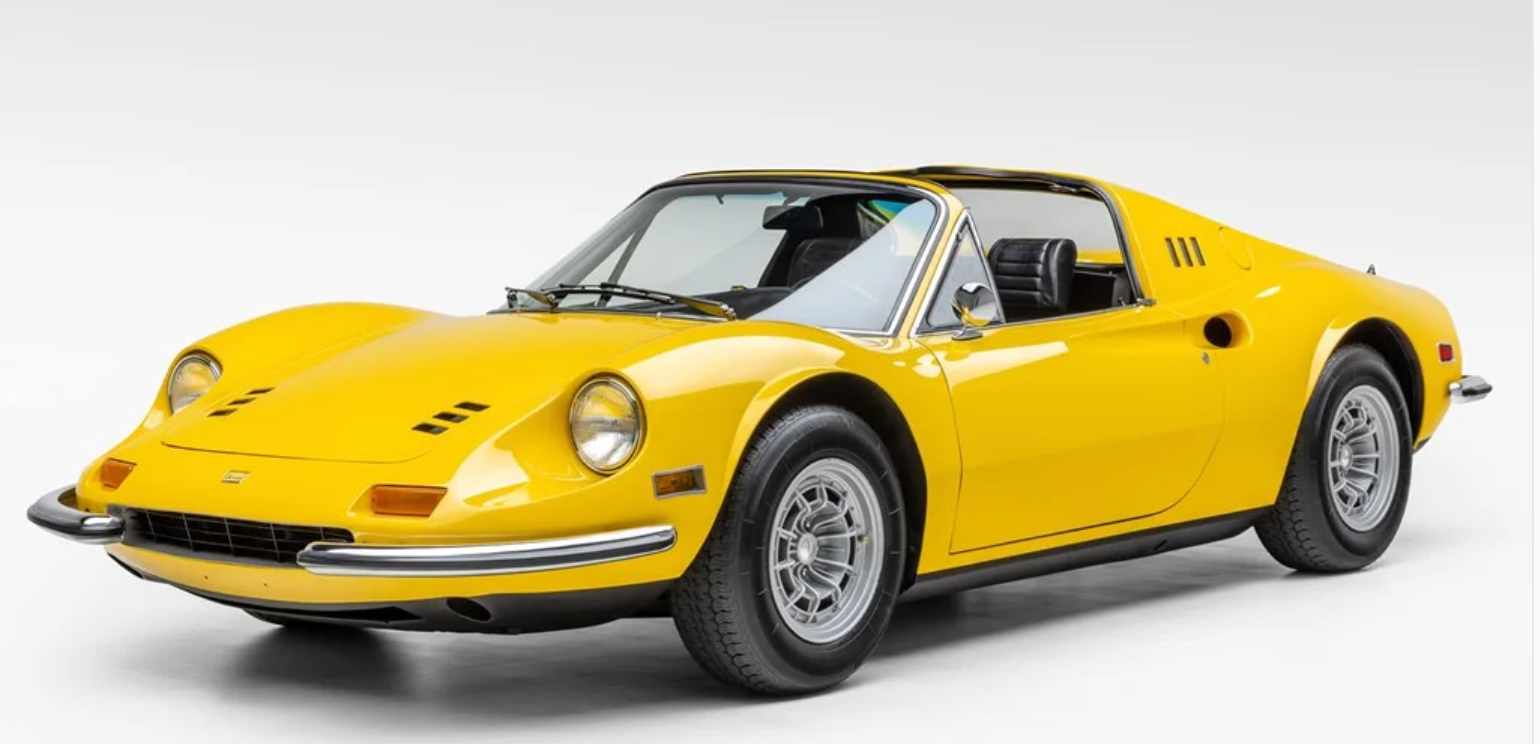
For a car that never wore the prancing horse badge, the Ferrari Dino 246 GT has aged into one of the most beloved shapes to ever leave Maranello. Small, mid-engined, and powered by a six-cylinder rather than Ferrari’s signature V12, it was conceived as compromise and marketed with the almost apologetic tagline “almost a Ferrari.” More than fifty years later, it’s regarded by many enthusiasts as one of the purest, best-balanced sports cars the company has ever built.
Born From a Racing Loophole
The Dino’s existence traces back not to a marketing plan but to a regulatory technicality. Ahead of the 1967 Formula 2 season, motorsport’s governing body announced new rules requiring engines under 1,600cc, with a catch: manufacturers had to build at least 500 road-going examples of any engine they wanted to homologate for racing. Ferrari had a promising 1.6-litre V6, originally developed with input from Enzo Ferrari’s son Alfredo — nicknamed “Dino” — who had died of muscular dystrophy in 1956 at just 24. The problem was scale: Ferrari, then a tiny, artisanal manufacturer, had no realistic way to build 500 road cars quickly enough on its own.
The solution was an alliance with Fiat. Fiat agreed to mass-produce the V6 engine and use it in two road cars of its own — a Bertone-designed coupe and a Pininfarina-designed spider, both badged simply “Dino” — while Ferrari built its own mid-engined sports car around the same unit. That Ferrari-badged-but-not-quite car arrived in 1968 as the Dino 206 GT: an aluminum-bodied, aluminum-engined 2.0-litre coupe, and Ferrari’s first mid-engine road car. Only 152 were built before Ferrari moved on to a revised version a year later.
The 246 GT: Getting It Right
The 246 GT, introduced in 1969, addressed the 206’s main shortcomings. The V6 grew from 2.0 to 2.4 litres, with the block switching from aluminum to cast iron for durability, and output rose to a claimed 195 horsepower — enough to answer complaints that the original car lacked usable torque. The wheelbase stretched by 60mm, and the body, still styled by Pininfarina and hand-built by Scaglietti in Modena, moved from aluminum to predominantly steel construction, a practical concession once Ferrari realized the 246 was going to sell in numbers no prior Ferrari ever had.
Visually, the 246 changed very little from the 206 it replaced — the same voluptuous fenders, recessed headlights, delicate quarter bumpers, and flying-buttress roofline sweeping into a Kamm tail. The most reliable spotting difference is the fuel filler: exposed on the 206, tucked under a flush flap on the 246. Production ran through three subtly evolving series — internally known as L, M, and E — with changes to wheels, wipers, and carburetion rather than anything visually dramatic. The final E-series cars, built in the largest numbers from 1971 onward, were also the first sold in the United States. In 1972, Ferrari added a targa-topped variant, the 246 GTS, giving buyers an open-air option without altering the coupe’s fundamental design.
By the time production ended in 1974, Ferrari had built roughly 3,569 to 3,760 examples across GT and GTS body styles (sources differ slightly on the exact figure) — a huge production run by the standards of a company that, a decade earlier, built only a few dozen cars a year of any given model.
Why It Drives So Well
The Dino’s reputation rests less on outright speed than on how it delivers what speed it has. Contemporary road tests recorded a 0–60 mph time in the neighborhood of 7 to 8 seconds and a top speed around 145 mph — quick for the era, but not dramatically quicker than the Porsche 911 it was built to compete with. What set the Dino apart was its mid-engine layout, a first for a Ferrari road car, which put the transverse-mounted V6 directly behind the two seats and gave the car near-ideal weight distribution. The result, prized by drivers then and now, is light, precise steering and a level of cornering balance that few front-engined Ferraris of the period could match.
The 65-degree V6, engineered by Franco Rocchi from Vittorio Jano’s original Dino racing engine, used dual overhead camshafts per bank and three twin-choke Weber carburetors — genuinely exotic hardware for what was, at launch, Ferrari’s “budget” model. That same engine family, in evolved form, would go on to power the Lancia Stratos HF to three consecutive World Rally Championship titles in 1974, 1975, and 1976, a motorsport pedigree the road-going Dino rarely gets full credit for.
An Identity Crisis That Became Its Charm
The most curious chapter of the Dino’s story is the one about what it wasn’t allowed to be. Enzo Ferrari reportedly resisted badging the car as a true Ferrari at all, feeling a six-cylinder, non-V12 sports car didn’t fit the brand’s image — it took persuasion from both his son and Pininfarina’s own leadership to get the project greenlit under the separate “Dino” marque instead. Period marketing leaned into the ambiguity rather than fighting it, describing the car as “almost a Ferrari.”
That branding decision shaped the Dino’s market position for decades. Without the prancing horse badge, it was for years the cheapest way into a Ferrari-engineered driving experience, overlooked by collectors chasing V12 berlinettas and front-engine classics. That undervaluation has reversed dramatically in the last fifteen years or so, as enthusiasts reassessed the Dino on its own terms — not as a lesser Ferrari, but as one of the best-driving, best-styled cars the company built in any era, V12 or not.
Legacy
The Dino 246 GT’s influence outlasted its own production run. It established the mid-engine, V6/V8 layout that Ferrari would return to again and again — first with its direct successor, the Bertone-styled 308 GT4, and then with the 308 GTB/GTS that became one of the most recognizable Ferraris of the 1980s thanks in part to television. It also proved, at a moment when Ferrari’s future ownership and direction were genuinely uncertain (Fiat took a 50% stake in the company the same year the 246 launched), that a smaller, more attainable sports car could still feel unmistakably like a Ferrari — badge or no badge.
Today, whatever collectors call it, nobody argues about what it is: a small, honest, beautifully resolved sports car that Enzo Ferrari almost didn’t allow to exist, and that his own company now counts among its most cherished creations.