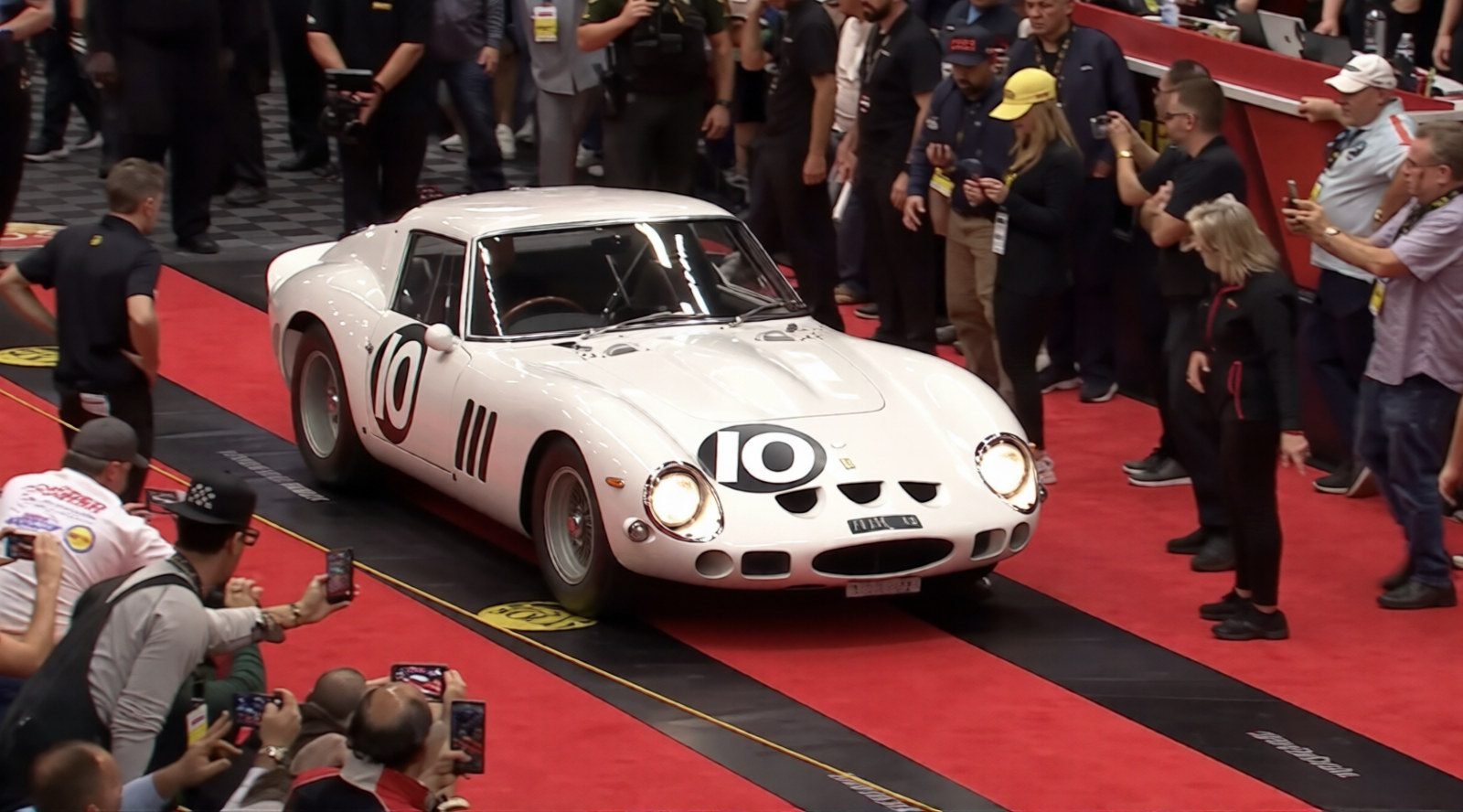
Every Ferrari 250 GTO carries a chassis number that collectors can recite like scripture, but only one of the 36 built between 1962 and 1964 wears a color no other GTO has ever worn from the factory. Chassis 3729GT — nicknamed “Bianco Speciale,” or “Special White” — is the sole 250 GTO that left Maranello finished in white rather than the marque’s signature Rosso Corsa. That single detail, layered onto a genuine competition history and a rare unrestored condition, turned this particular car into one of the most talked-about Ferraris of the last several years, culminating in a headline sale at Mecum’s Kissimmee auction in January 2026.
An Englishman’s Special Order
The GTO’s white livery exists because of one man: John Coombs, a respected British race team owner and, notably, a Jaguar dealer by trade. In 1962, with Jaguar’s E-Type and Ferrari’s 250 GT SWB already trading blows on British circuits, Coombs placed an order with Ferrari for the newest weapon in the GT wars — one of the freshly homologated 250 GTOs. Rather than take delivery in the factory’s usual red, Coombs specified a white paint scheme, a request Ferrari accommodated as a one-off. Some accounts describe the exact shade as a pearlescent white more closely associated with Jaguar’s own color palette, a detail that has only added to the car’s mythology given Coombs’ day job.
The chassis itself was completed on May 7, 1962, and immediately sent to Carrozzeria Scaglietti for its aluminum coachwork — the same hand-formed bodywork process that gave every 250 GTO its sculpted, one-off character despite shared underlying dimensions. A Certificate of Origin and Modena registration were issued on July 13, 1962, and two weeks later, on July 28, Coombs took delivery of his distinctive white GTO in England.
A Racing Career Among Legends
Coombs had no intention of parking the car. Bianco Speciale made its competition debut on August 6, 1962, at Brands Hatch in the Peco Trophy, entered by John Coombs Racing. Behind the wheel was Roy Salvadori, the 1959 Le Mans-winning co-driver alongside Carroll Shelby. Facing five other GTOs on Brands Hatch’s demanding layout, Salvadori brought the white car home second overall, beaten only by fellow GTO driver Mike Parkes.
Two weeks later, the car’s most celebrated outing arrived at the RAC Tourist Trophy at Goodwood — a round of the FIA International Championship for GT Manufacturers, and part of Ferrari’s push to keep Jaguar at bay. This time Coombs handed the car to Graham Hill, who would go on to win the Formula 1 World Championship that same year and again in 1968, later adding the Indianapolis 500 in 1966 and the 24 Hours of Le Mans in 1972 — making him the only driver in motorsport history to complete what’s known as the Triple Crown. Hill drove 3729GT to a second-place finish at Goodwood, one of the results that helped Ferrari secure the GT Manufacturers’ title for 1962.
The car’s competition career continued into 1963, when it scored a GT class victory at the Guards Trophy at Brands Hatch with driver — and future owner — Jack Sears at the wheel. Over its factory-supported career, Bianco Speciale contested roughly nine international races between 1962 and 1964, with other notable names, including American driver Richie Ginther, also getting behind the wheel at various points. Compared to some of its 35 siblings, 3729GT saw relatively modest use in period, something later owners and historians have speculated may be connected to its unusual color making it feel more like a personal statement piece than a pure works tool.
A Colorful, Quiet Second Life
After its factory-era racing wound down, the GTO passed through a short chain of noteworthy British hands. Jack Sears, who had piloted the car to its class win, acquired it outright and owned it from 1970 until 1999 — a remarkably long single-owner stretch for any GTO. Earlier in its life, ownership had also passed briefly through Robert Perry to John Pearce, and later to well-known collector Neil Corner. At some point after its factory racing days, the original 3.0-liter V12 was removed from the car; period records suggest it was subsequently fitted into privateer driver Chris Lawrence’s Cooper Formula 1 chassis for the 1965 season, a year in which the GTO’s reliable, competitively powerful V12 made an attractive alternative to the Coventry Climax engines then in wide use.
Somewhere along the way — accounts point to the 1970s — the car was repainted red, erasing its signature look for a time. It would take a later owner, American collector Jon Shirley, to return the car to its original Bianco Speciale finish, a restoration of livery rather than a full mechanical rebuild. Notably, despite passing through several caretakers over six decades, the car has never undergone a full nut-and-bolt restoration. Instead, it has been maintained, repaired, and refinished as needed, preserving an unusually high proportion of original fabric — including period racing details like its hood louvers and cockpit air hose. For collectors who prize originality above pristine presentation, that distinction matters enormously; a GTO that has been carefully kept rather than completely rebuilt is treated as a meaningfully different, and often more desirable, object than one restored to as-new condition.
Adding a layer of modern pop-culture recognition, a Ferrari 250 GTO modeled on 3729GT has appeared in the Gran Turismo video game franchise, featured by name in Gran Turismo 6 and represented, if not always chassis-specifically labeled, in Gran Turismo Sport and Gran Turismo 7 — introducing several generations of racing game fans to a chassis number most of them will never see in person.
Headlining Kissimmee 2026
In late 2025, Mecum Auctions announced that Bianco Speciale would headline its January 2026 Kissimmee sale — traditionally the season-opening event for the collector car calendar and, at more than 4,000 lots, the largest collector car auction in the world. The car’s rarity within a rarity — one of only 36 250 GTOs, and the only one ever finished in white, plus one of just eight built in right-hand drive — fueled speculation that it could challenge or even surpass the standing GTO auction record of $51,705,000, set by chassis 3765 at RM Sotheby’s in November 2023.
When the car crossed the block on the auction’s marquee Saturday in January 2026, bidding opened ambitiously at $50 million before gradually working down and rebuilding momentum, eventually climbing through the $30 million range before settling. After roughly ten minutes of bidding, the hammer fell at $35 million, rising to $38.5 million once the buyer’s premium was included. The winning bid came from David Lee, a California-based collector well known for an extensive Ferrari collection dominated by red and yellow examples — making this stark white one-off a striking outlier in his garage. Lee, who had reportedly expressed interest in the car as far back as the previous year’s Monterey auctions, ultimately secured it via live video bidding rather than in person.
The $38.5 million result made Bianco Speciale the most valuable car Mecum has ever sold at auction, though it fell short of both the pre-sale speculation and the all-time GTO benchmark set in 2023. Even so, the sale placed it among the handful of most expensive cars ever sold publicly, a fitting outcome for a car whose entire identity has always rested on being the only one of its kind.