Few names in the automotive world carry the weight of the Rolls-Royce Phantom. For a hundred years, it has functioned less as a mere car than as a moving statement — a benchmark against which every other claim to automotive luxury has quietly been measured, and, more often than not, found wanting.
A Name Born in 1925
The Phantom made its debut in 1925, and has remained a defining symbol of luxury, craftsmanship, and engineering mastery ever since. From its earliest days, the car was conceived as something closer to a private commission than a mass-market product. Its early roots placed it as the vehicle of choice for royalty and statesmen, a reputation that shaped the car’s identity long before it evolved into its modern incarnation as Rolls-Royce’s contemporary flagship of opulence.
That opening chapter also produced the car’s most enduring emblem. The Spirit of Ecstasy figurine was presented to Rolls-Royce in February 1911 by sculptor Charles Sykes, modeled in part on a young woman named Eleanor Thornton. Notably, company co-founder Henry Royce was reportedly never fully convinced by the ornament, arguing that it impaired the driver’s view and rarely allowing himself to be seen driving a car fitted with it — a small irony given that the figure would go on to become one of the most recognized emblems in the automotive world.
From Coachbuilt Chassis to the Goodwood Era
For much of the twentieth century, the Phantom evolved much as its wealthy clientele did — quietly, in stages, and largely out of public view. The Phantom II generation, introduced in 1929 and produced through 1936, was powered by a 7.7-litre inline-six engine, with Rolls-Royce supplying a fully functioning chassis to independent coachbuilders who then designed and fitted the body — a practice typical of the era’s ultra-luxury cars, in which the manufacturer built the mechanical foundation and left the aesthetics to specialist artisans.
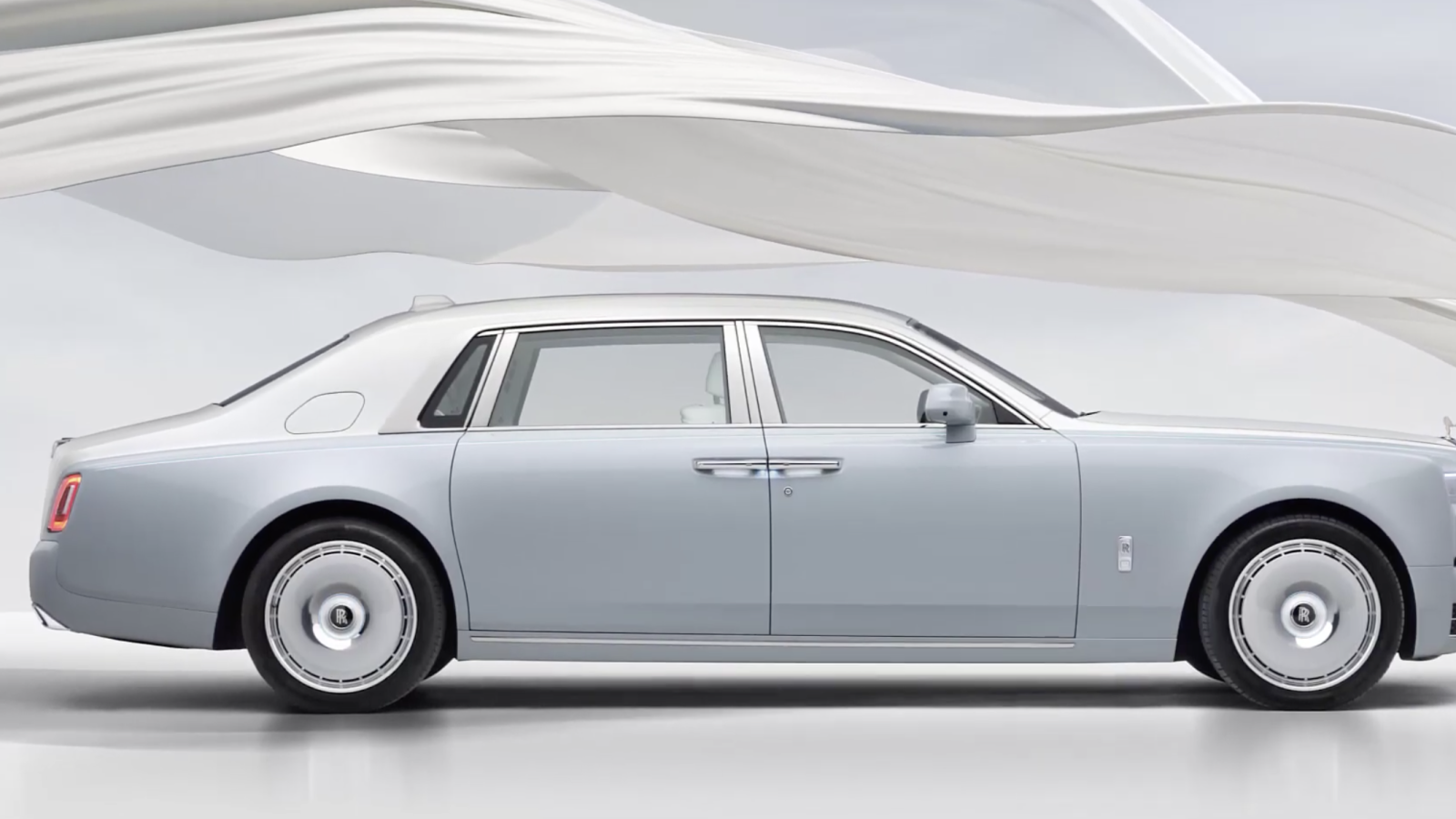
The modern Phantom era began in the 2000s, after Rolls-Royce came under BMW ownership and the marque was rehomed at its now-famous Goodwood, England headquarters. The current, second-generation Phantom of the Goodwood era launched to the world in 2017, following a predecessor generation produced from 2003 to 2017. That Phantom VIII uses an all-aluminum spaceframe architecture, making the car both lighter and stiffer than its predecessor, and is powered by a 6.75-litre twin-turbocharged V12 engine.
Much of the development work behind that generation focused on something almost impossible to quantify: ride quality. Rolls-Royce engineers extensively tested the Phantom VIII’s so-called “Magic Carpet Ride” suspension system, driving prototypes over cobblestone streets and unpaved tracks specifically to fine-tune a sensation of near-total isolation from the road beneath the car.
A Mid-Life Refresh, Deliberately Understated
The Phantom received a mid-life update known as the Series II, and true to Rolls-Royce’s institutional caution about changing a car that already represents the pinnacle of what the company can achieve, the revisions were kept deliberately small — subtle enough that even close observers of the 2017 original might struggle to spot the exterior changes at a glance. The more noticeable shifts came inside the cabin: Series II cars gained an onboard 4G Wi-Fi hotspot, the full suite of BMW Group’s connected music and media streaming options, and Rolls-Royce’s Connected networked software, which pairs with the marque’s Whispers smartphone app to let owners send destinations to the satellite navigation remotely or check on the car’s location and status from afar.
Today’s Phantom lineup starts at a genuinely eye-watering price point even before a single bespoke option is added. The current model year Phantom carries a base MSRP of $527,750 in the United States, rising to $607,750 for the extended-wheelbase version, both powered by a 6.8-litre twin-turbocharged V12 producing 571 horsepower and 664 pound-feet of torque, capable of a 0-to-60 mph time of roughly 5.3 seconds despite a curb weight north of six tons. In the UK, the Series II update alone added roughly £33,000 to the car’s starting price, pushing the entry sticker just below £410,000.
The Art of Bespoke
What ultimately separates the Phantom from every other luxury sedan on the road isn’t horsepower or top speed — Rolls-Royce has never particularly competed on either — but the sheer degree to which each car can be individually reimagined for its owner. The company’s Bespoke Collective treats every commission as an opportunity for genuine artistry rather than simple options-list customization, a philosophy taken to its furthest extreme in the recent Phantom Centenary Private Collection, produced to mark the model’s hundredth anniversary.
That commemorative edition centers on the Anthology Gallery, a sculptural installation of 50 interlaced aluminium fins inscribed with words celebrating a century of the Phantom’s story, subtly illuminated so its meaning shifts with every change in the viewer’s perspective. Rolls-Royce’s designers spent years researching the Phantom’s influential owners, its engineers, and the journeys that shaped its reputation, distilling that research into 77 hand-sketched motifs woven throughout the car as woodwork, embroidery, marquetry, and metal sculpture.
The car’s signature Starlight Headliner — the constellation of tiny fibre-optic lights built into the roof lining of contemporary Phantoms — received its own tribute treatment for the anniversary model, using 440,000 individual stitches to recreate scenes from Phantom’s history, including a depiction of the mulberry tree under which company co-founder Henry Royce was once photographed at his garden in West Wittering, deep in discussion with colleagues about Phantom design. Even the car’s oldest symbol received a tribute of its own: the Centenary edition’s Spirit of Ecstasy figurine is cast in solid gold, hallmarked and enamelled, based directly on the 1925 casting that graced the very first Phantom. Only 25 examples of the Centenary edition were built, each one representing its own chapter in a legacy that stretches back a full century.
A Value That Holds
Unlike most luxury goods, a Phantom’s value has historically proven unusually resistant to the passage of time. Despite its considerable running costs, a new Phantom is forecast to retain around 58 percent of its value after three years of ownership — a remarkably strong figure in an industry where most vehicles shed the majority of their worth within that same window. On the used market, Phantom VIII models produced between 2018 and the present day have traded anywhere from roughly $185,000 to as high as $417,000 for a well-specified extended-wheelbase example, with an average sale price in the region of $296,000.
More Than a Car
A century after its debut, the Phantom occupies a strange position in the automotive landscape: a product built to almost willfully ignore the industry trends around it, engineered instead around a singular, unchanging brief — to be, as the marque’s own long-standing internal ambition has always put it, the best car in the world. Whether or not that claim can ever be objectively settled, the Phantom’s enduring hold on the very top of the luxury market suggests that, for a certain kind of buyer, the argument was won a long time ago.