listen to the article
There is a certain audacity to taking one of the most landlocked symbols of luxury—the gilded lobby, the afternoon tea salon, the concierge who remembers your name—and setting it adrift on the open ocean. Yet that is precisely what The Ritz-Carlton did in the summer of 2017, when it announced it would build not a cruise line, but a yacht collection.
The idea was conceived by Douglas Prothero, a Canadian maritime executive with the backing of Oaktree Capital Management, and it came with serious money behind it: a three-way ownership split among Oaktree, the Scheinberg family’s Mohari Hospitality, and the government of Singapore. The plan was ambitious from the outset—three custom-built superyachts, each one a floating Ritz-Carlton resort where every guest would sleep in a suite with a private terrace.
A Shipyard in Ruins: The Evrima Saga
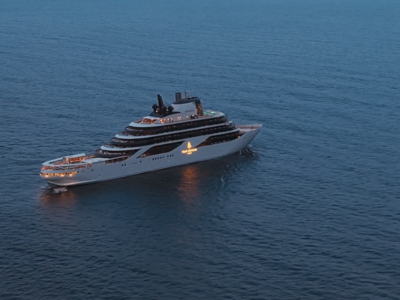
Reality, as it often does, had other plans. The first ship, Evrima, was contracted to a Spanish shipyard, Hijos de J. Barreras in Vigo, that had built ferries and container vessels but never a passenger cruise ship. Construction faltered, the yard collapsed financially, and the half-finished hull had to be towed across Spain to Astander in Santander for completion. Then the pandemic arrived, swallowing 116 planned voyages and pushing Evrima’s maiden sailing to October 2022—more than three years late than planned. By the time she finally cut through Mediterranean waters, she had become the most expensive lesson in the company’s brief history, a 190-meter, 298-guest proof of concept that proved the idea was sound but the execution brutal.
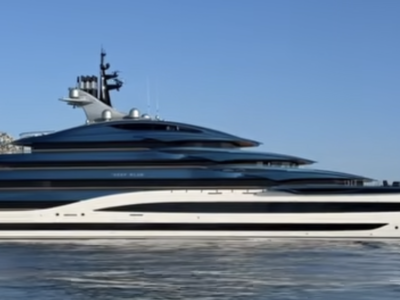
The company turned to the renowned Chantiers de l’Atlantique in Saint-Nazaire, France, and ordered two larger, LNG-powered sisters: Ilma and Luminara. Delivered in 2024 and 2025 respectively, they represent a significant evolution. Ilma stretches 241 meters and carries 448 guests across 224 suites; Luminara, the current flagship, accommodates 452 guests in 226 suites. Together, they have given the Yacht Collection a global footprint their smaller predecessor could only dream of. Ilma now dominates the Mediterranean in summer and the Caribbean in winter, while Luminara has pushed the brand into entirely new territory—first with an inaugural Asia-Pacific season threading through Singapore, Thailand, and Vietnam, and then with a groundbreaking summer 2026 deployment to Alaska.
Life Aboard: Where “Anti-Cruise” Meets Ultra-Luxury
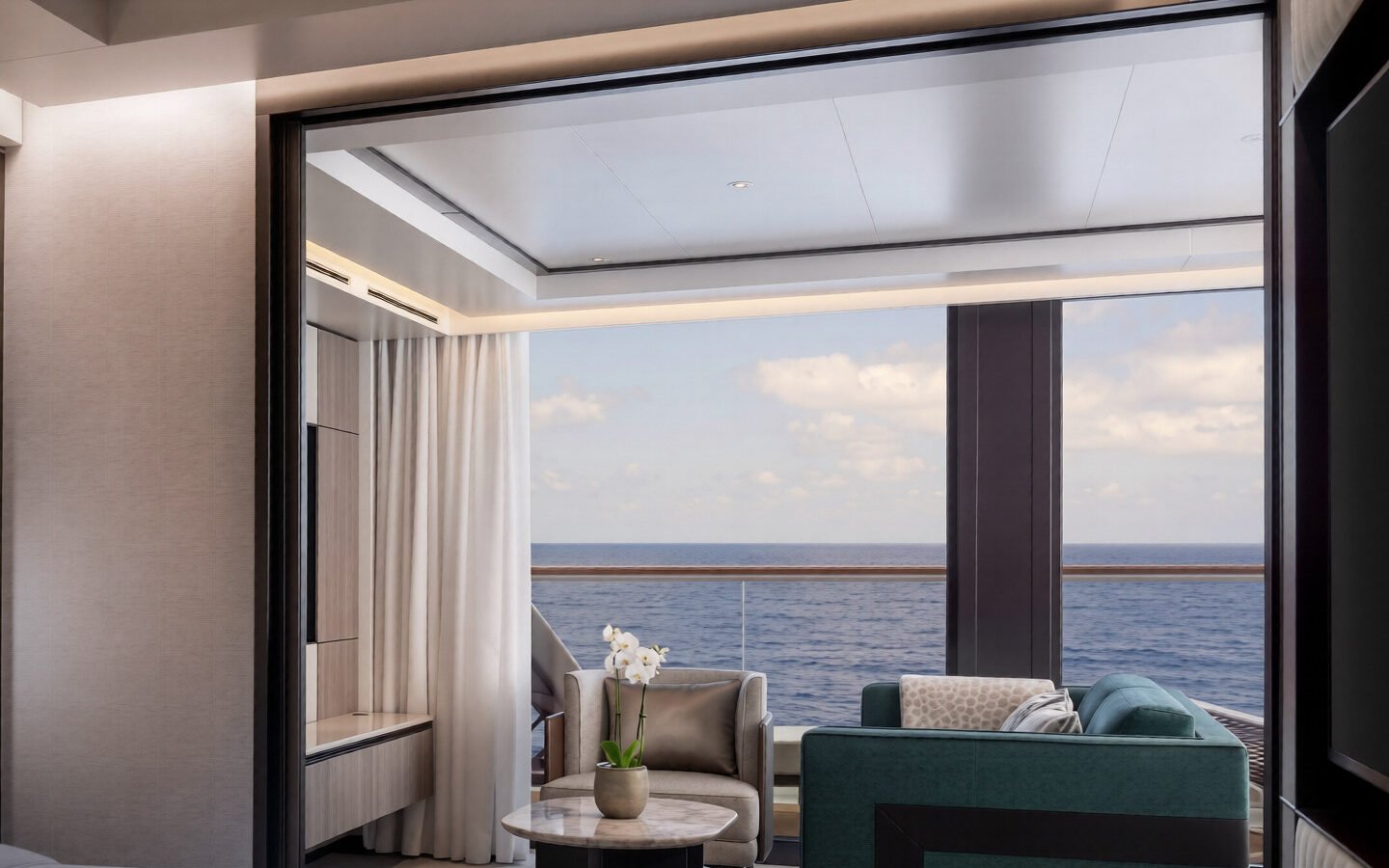
What distinguishes these vessels is not merely their size but their philosophy. The Ritz-Carlton Yacht Collection has been described, accurately, as “anti-cruise.” There are no fixed seating times, no stampedes toward the dining room, no scramble for deck chairs. The crew-to-guest ratio approaches one to one. Every fare is all-inclusive—meals, beverages, gratuities, WiFi, 24-hour in-suite dining, and a personal butler are bundled into the price, which ranges from roughly $3,700 per person for a short Caribbean hop to $28,400 for a 14-night journey through Southeast Asia. Even the entry-level Terrace Suites open onto private balconies; the upper-tier accommodations on Ilma and Luminara sprawl to 1,076 square feet, complete with wraparound terraces and outdoor Jacuzzis.
The culinary program operates at a level rare even among luxury lines. James Beard Award winners and Michelin-starred chefs shape the menus. On Luminara, Seta by Fabio Trabocchi serves an eight-course Italian tasting menu; Beach House by Michael Mina weaves the chef’s Egyptian heritage into Middle Eastern and Mediterranean flavors. For those seeking the apex, S.E.A.—a restaurant by a three-Michelin-starred chef—commands a supplement of $245 to $285 per person, a splurge that feels almost reasonable when measured against the caliber of the kitchen. But perhaps the most telling onboard detail is the marina: a fold-out platform at the ship’s stern that drops directly into the sea, offering guests kayaks, paddleboards, Seabob scooters, and electric hydrofoil boards.
Then there is the art. Luminara carries approximately 700 pieces, 65 percent of them commissioned specifically for the ship, including works by David Hockney, Alexander Calder, Henri Matisse, and Andy Warhol. A seven-story suspended light sculpture dominates the atrium. Walking her corridors feels less like moving through a ship than through a contemporary museum that happens to float.
The Itinerary Map: From Tahiti to Tokyo
The fleet’s sailing schedule for 2026 and 2027 reflects this ambition. Evrima explores Northern Europe—sailing from London to Barcelona via Bordeaux and Lisbon, or tracing Iceland’s coast—and then pivots to Polynesia for the winter, offering seven-night Tahiti round-trips from approximately $10,000 per person. Ilma commands the Mediterranean’s glamour circuit, running seven-night voyages from Rome to Monte Carlo or Venice to Athens, with fares typically between $11,400 and $15,100, before repositioning to the Caribbean for the winter, where shorter five-night sailings out of San Juan drop the entry price to around $5,100.
Luminara’s calendar is the most geographically daring: after her Alaska debut in summer 2026, she crosses the Pacific for an 18-night repositioning cruise to Japan, then spends the winter threading through Hong Kong, Bangkok, Bali, and Singapore, where a 14-night voyage commands the fleet’s highest fare at $28,400. For 2027–2028, the brand has announced further expansion into Polynesia and deeper Asia-Pacific itineraries, signaling that the map will only grow more ambitious.
The Verdict: A New Category of Travel
The brand has already joined Marriott Bonvoy, allowing guests to earn and redeem points at sea—a bridge between hotel and cruise that its upcoming rivals have yet to build. All three yachts are available for full-ship private charter, a revenue stream that appeals to corporate groups and wealthy families alike. And the product itself, for those who have experienced it, delivers on the original promise: this is not cruising as the world has known it, but something closer to a private yacht charter with the infrastructure and service standards of a global luxury hotel.
For the traveler standing on a private terrace as the ship slips into a Croatian harbor too small for the giants, watching the marina platform descend toward turquoise water, the answer feels, at least for the moment, like yes.