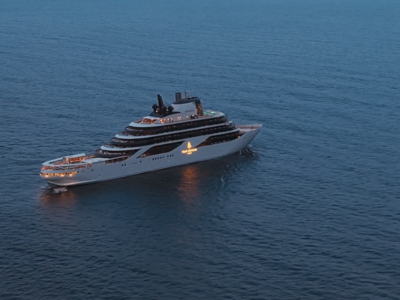
There are superyachts, and then there are cautionary tales. The 107.6-metre (353-foot) Luminosity, built by the Italian shipyard Benetti and delivered in 2020, is unusual on both counts. With a reported build cost north of $275 million and a design brief built almost entirely around glass, she was engineered to be one of the most technically ambitious hybrid yachts ever launched. But her real story isn’t really about engineering triumph—it’s about a yacht that has, by most accounts, never actually been to sea for anything other than her own sea trials.
Luminosity’s story begins with Kutayba Alghanim, a Kuwaiti billionaire businessman, who commissioned Benetti to build her under the project name Zoza. His brief was uncompromising on one point above all: glass, and lots of it, wrapping the superstructure in a way few yards had attempted at this scale. That ambition came at a cost—construction, which began around 2015, stretched on for years longer than planned. By the time she was ready for handover in 2020, Alghanim reportedly refused delivery, citing the very delays his own brief had helped cause. Benetti was left to formally deliver a 107-metre yacht with no owner waiting to take her.
She sat on the market for roughly two years before Russian fertilizer magnate Andrey Guryev, chairman of PhosAgro, purchased her in 2022 for a price reported to be around $190 million. The timing could not have been worse: within days or weeks of taking delivery in Montenegro, Guryev was added to international sanctions lists tied to Russia’s war in Ukraine. Luminosity has sat in Montenegro ever since—impounded in practice if not always in name, her crew reportedly unpaid for years, her teak decks and hull left to deteriorate from neglect. Guryev has publicly denied owning her. Neither he nor Alghanim is known to have ever set foot aboard. As of recent reporting, she remains for sale at roughly half her original asking price, with no buyer found.
A Glass-Wrapped Exterior
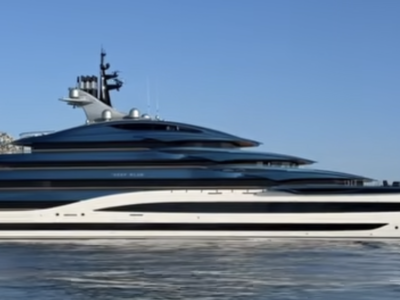
Her exterior, penned by Giorgio Cassetta of Cassetta Yacht Designers in collaboration with Reymond Langton Design, delivers on that original glass-obsessed brief: roughly 800 square metres of glazing wrap her superstructure, broken by crisp white banding that gives her hull a sense of dynamic forward lean even at anchor. It’s a striking, almost architectural profile—closer to a piece of habitable sculpture than a conventional displacement yacht—and it’s easy to see why the ambition behind it took years longer to execute than anyone planned.
An Ambitious Hybrid Heart
Whatever has happened to her since, Luminosity’s underlying engineering remains genuinely notable. She was among the first vessels over 100 metres to be built around a full diesel-electric hybrid system, developed by Azure Yacht Design & Naval Architecture. Six Caterpillar C32 generators, each producing around one megawatt, feed power through a management system to twin ABB Azipod propulsion units rated at roughly 2,200 kilowatts apiece. A very large lithium-polymer battery bank—reportedly around 36 tons of batteries providing several megawatt-hours of storage—allows her to run hotel systems, and even propel herself at low speed, silently and with zero emissions for extended periods at anchor.
Reported performance figures vary somewhat by source: top speed has been cited anywhere from about 16 to 19 knots, with cruising in the low-to-mid teens, and a widely repeated range of roughly 8,000 nautical miles at a 10-knot cruise. She carries retractable stabilizers by Rolls-Royce for comfort both underway and at rest. On paper, at least, this made her one of the greenest and quietest gigayachts built to that point—a genuine engineering milestone, even if she’s spent most of her life since delivery going nowhere at all.
The Interior
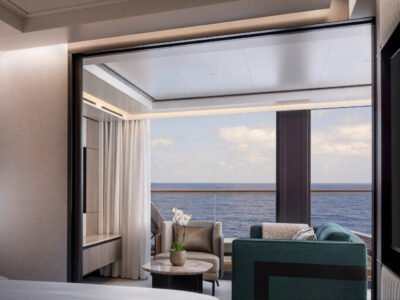
Inside, the design work was handled by Zaniz Interiors (also credited as Zaniz Jakubowski Design), an independent studio rather than an in-house arm of either owner’s business interests. With a gross tonnage of roughly 5,844–5,884—substantial, though not a record, and in fact only the second-largest yacht Benetti has ever built—she accommodates up to 27 guests across 12 suites, with a crew of 37.
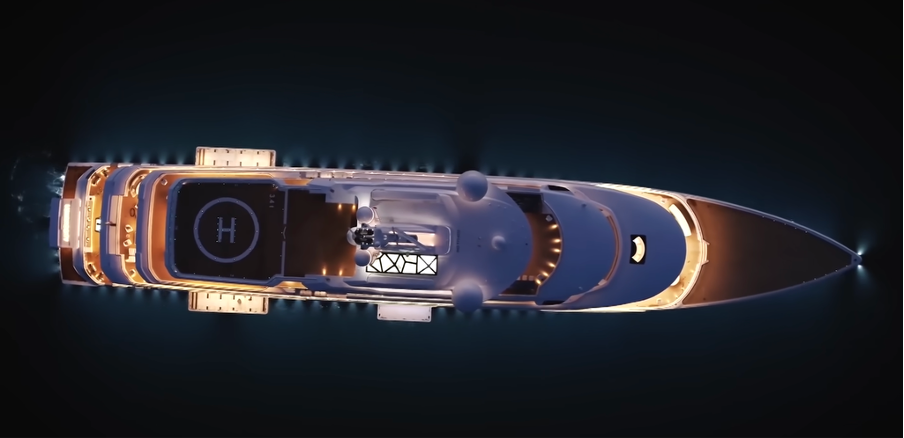
The glazing that defines her exterior floods the interior with light, and several standout spaces have been documented: a sea-level spa that opens via retractable side-shell doors to reveal a gym, a cold plunge pool held around 4°C, and a roughly 30-square-metre swimming pool whose floor reportedly raises to convert the space into a dance floor. A central stairwell lined with LED panels serves as a striking design centerpiece. On deck, she carries a helipad with a certified helideck. She’s also outfitted with serious long-range communications hardware—twin 3.5-metre satellite dishes and, by some accounts, roughly 500 kilometres of cable running through the vessel.
Some details occasionally repeated about Luminosity—a dedicated art-gallery concept, a hospital-grade medical center, a twelve-seat cinema, a named limousine tender, a helicopter hangar sized for a specific aircraft—aren’t corroborated by builder or brokerage documentation and should be treated as unverified rather than fact.
A Cautionary Tale, Not a Triumph
It’s tempting to tell Luminosity’s story as one of technological triumph—and in a narrow engineering sense, it is. But the fuller picture is stranger and considerably less flattering: a yacht built around one owner’s uncompromising glass obsession, refused by that same owner after years of delay, sold to a second owner who was sanctioned almost as soon as he took possession, and left to rust in a Montenegrin harbor ever since, unpaid crew and all. If Luminosity proves anything, it’s not that colossal volume and environmental innovation can coexist without compromise—it’s that even the most ambitious yacht in the world is only as good as the ownership story that follows her off the slipway.