listen to the audio of this article
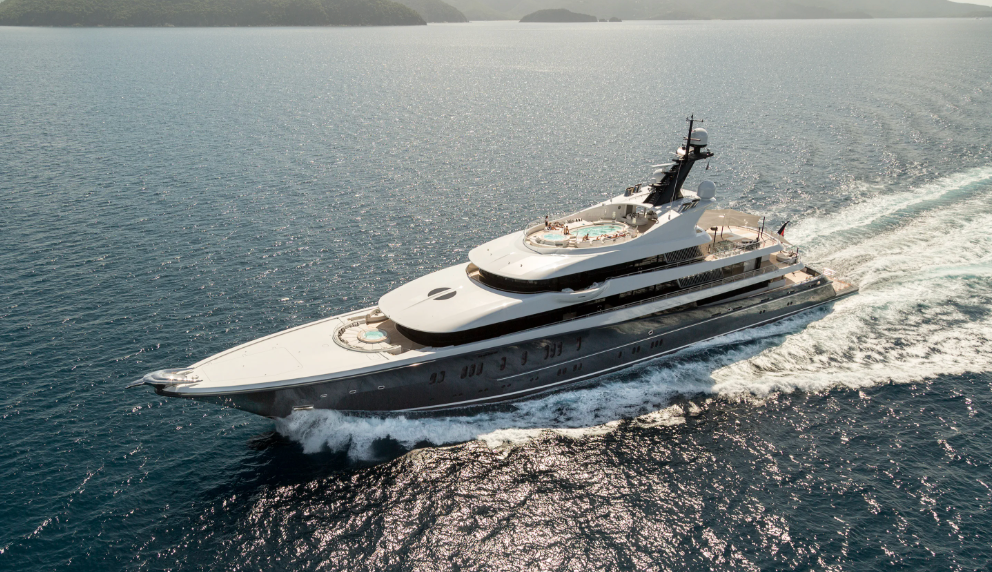
In the rarefied world of custom superyachts, where billionaires commission floating palaces to reflect their personal tastes, few vessels manage to be both a technical marvel and a genuine work of art. Phoenix 2, a roughly 295-foot (90-meter) leviathan delivered by the German shipyard Lürssen in 2010, is exactly that. She is not merely a successor to an older yacht but a deliberate, dramatic escalation of an existing relationship between owner, designer, and shipyard—a vessel built to carry forward a name, a bird, and a design language rooted in one of the twentieth century’s most glamorous architectural movements.
The Maker: Lürssen’s Legacy of Discretion and Might
To understand Phoenix 2, one must first understand her builder. Lürssen, a family-owned shipyard based in Bremen-Vegesack, has been building vessels since 1875. In the superyacht sphere, they are among the undisputed titans, responsible for delivering some of the world’s largest and most technically ambitious yachts, including the 180-meter Azzam and the 156-meter Dilbar.
Lürssen’s reputation is built on engineering excellence, exacting construction standards, and a fierce commitment to client confidentiality. They rarely build speculative yachts; instead, they forge long-term relationships with owners who return again and again for successive, ever-more-ambitious projects. Phoenix 2 is a quintessential example of exactly that pattern—a huge volume of 2,667 gross tons realized with a steel hull and aluminum superstructure, classed by Lloyd’s Register, and built to standards that place her construction quality closer to a small passenger vessel than a typical private pleasure craft.
Ownership History: A Polish Industrialist’s Second Act
The ownership story behind Phoenix 2 centers on Jan Kulczyk, at the time widely reported as Poland’s richest man and the founder of Kulczyk Investments, a holding company with interests spanning oil and gas, mining, brewing (including a major stake in SABMiller), and infrastructure. Kulczyk’s first superyacht, also built by Lürssen and also styled by British design studio Winch Design, was the original Phoenix—a roughly 60-to-61-meter vessel delivered in 2004. That first yacht was a success, and the collaboration between Kulczyk, designer Andrew Winch, brokerage and build-management firm Moran Yacht & Ship, and the Lürssen shipyard proved close enough that Kulczyk returned to the same team for a second, considerably larger project.
That second project became Phoenix 2, built under an internal project code and launched in April 2010. As her name suggests, she was conceived as a kind of squared, amplified version of the original—retaining the essence of what made the first Phoenix work while dramatically increasing her scale and ambition. The original Phoenix was later sold and now sails under a different name.
Jan Kulczyk died in 2015 following complications from heart surgery, at age 65, and Phoenix 2 passed into the ownership of his son, Sebastian Kulczyk, who continued the family’s association with the yacht for roughly a decade afterward. The vessel appears to have changed hands to an outside buyer more recently—reporting on her sale, brokered by Burgess on behalf of the buyer and jointly by Burgess and Cecil Wright on behalf of the seller, places the transaction around 2024, with an asking price reported at approximately €124,950,000. This kind of multi-generational, then eventual third-party ownership is entirely typical for a Lürssen build of this caliber: the asset is engineered to hold its value and desirability across decades, long outliving the circumstances of its first owner.
Exterior Design: An Art Deco Homage to Manhattan
The exterior of Phoenix 2 is a masterclass in architectural homage, penned by the British design studio Winch Design under Andrew Winch. Rather than looking to nature or abstraction, Winch and his client looked directly to a place and an era: the skyline of 1920s and 1930s New York City, and the Art Deco design language that defined it.
The yacht’s most singular, unmistakable feature is a 5.7-meter stainless-steel phoenix figurehead rising from her bow—a sculptural bird that both names the vessel and visually echoes the eagle sculptures mounted on the Chrysler Building, one of Manhattan’s most celebrated Art Deco landmarks. It’s a bold, almost theatrical touch, more evocative of a 1930s ocean liner’s decorative confidence than the understated, minimalist lines common on many contemporary superyachts.
The broader profile favors elegant, streamlined, arrowhead-like lines, articulated by more than 100 meters of uniquely shaped and polished stainless-steel handrails that run across her decks—a detail Lürssen and Winch Design have both highlighted as a signature element of the build. The superstructure carries a dark hull and more streamlined, sleek massing than her predecessor, giving the 90-meter vessel a lower, more purposeful stance on the water than the original, more traditionally profiled and white-hulled Phoenix.
Interior Design: An Art Deco Time Capsule
If the figurehead announces Phoenix 2’s identity from the bow, the interior confirms it below decks. Also designed entirely by Winch Design, the interior draws on the imaginative use of fabrics and furnishings associated with 1930s New York, creating what visitors and journalists alike have described as a space with the timeless, glamorous atmosphere of the Jazz Age—closer in spirit to The Great Gatsby than to a minimalist modern yacht interior.
Signature details include cherry-red velvet flooring, a gold-gilded grand piano, and thick, dark curtains in some social spaces reminiscent of a 1920s speakeasy—design choices that, in the words of one journalist who toured the yacht, “might make other designers recoil” but that Winch embraced fully and consistently. A full-beam owner’s suite, arranged as a duplex apartment with unrivaled, undisturbed sea views, occupies part of the main deck, connected by a private staircase to additional space above, with a private foredeck and spa pool offering the owner further seclusion from guest areas. Six further guest cabins (with total guest capacity reported variably at 12 to 14 across different points in her service life, likely reflecting configuration changes over multiple refits) are proportioned with the same generous volume that defines the rest of the yacht.
Standout Features
1. The Sundeck and Wellness Spaces
Phoenix 2’s sundeck centers on a swimming pool of roughly seven to 7.5 meters with a separate spa pool, alongside a flexible seating area capable of shifting between dining space, cinema, and even a teppanyaki dining setup. A dedicated wellness deck houses a full gymnasium, spa treatment room, and massage table with views over the helideck, while other decks house a hammam, sauna, and beauty salon—an unusually complete wellness program for a yacht of her generation.
2. Conventional, Confidently Engineered Propulsion
Contrary to some reporting, Phoenix 2 does not use a diesel-electric drivetrain. She’s propelled by twin conventional MTU diesel engines (reported around 2,670 to 2,680 hp each) driving twin screws directly, a proven and reliable configuration for a yacht of this displacement, supplemented by separate diesel generator sets that supply hotel and house power independently of propulsion. This setup gives her a top speed of around 18 knots and a cruising speed of roughly 14 knots, with reported range figures varying by source from approximately 4,500 up to 6,000 nautical miles at a 12-knot cruise—still more than sufficient for genuine ocean crossings, if not quite the exotic hybrid-electric pioneer some accounts have claimed.
3. The Owner’s Duplex Apartment
The full-beam owner’s apartment, spanning part of the main deck and connected to a private observation lounge and office above by its own dedicated staircase, offers uninterrupted sea views from nearly every angle and a level of privacy and seclusion unusual even among yachts of Phoenix 2’s size—a space clearly designed less as a simple bedroom suite and more as a self-contained private residence within the larger vessel.
4. Tenders, Toys, and a Fully Equipped Helideck
Phoenix 2 carries an extensive selection of water toys and tenders, deployed via concealed storage and hydraulic systems that keep the working decks visually clean when not in use. The foredeck converts into a helideck, rounding out a yacht built as much for genuine long-range exploration and hosting as for at-anchor entertaining.
Conclusion: The Art of an Enduring Design
Phoenix 2 is now a teenager of the seas, having passed through a refit in 2019 and, reportedly, a change of ownership around 2024—yet she has aged with a grace that few of her contemporaries can match. Reviewers who have toured her recently note that she still carries an air of timelessness that belies her construction date, a credit to both the rigor of her ongoing maintenance and the confidence of her original design brief.
More than her technical specifications, Phoenix 2’s real legacy is the story of a returning client and a design team given the freedom to go further the second time around: to take an idea that worked at 60 meters and reimagine it, bolder and more theatrical, at 90. She is a reminder that a superyacht’s most compelling feature isn’t always its newest technology—sometimes it’s the confidence to commit fully to a singular, unapologetically glamorous idea, carry a phoenix on the bow, and build an entire ship around the promise of that name.
There is also something quietly instructive in how thoroughly Phoenix 2’s real story diverges from the more fashionable, on-trend narrative that sometimes gets attached to celebrated yachts after the fact. She was never marketed, at launch or since, as an exercise in biomimicry or minimalist naturalism; she was, from her very first sketches, an unabashed exercise in nostalgia—an owner and a designer choosing to look backward, to the confident glamour of Jazz Age Manhattan, rather than forward toward whatever aesthetic happened to be dominant in superyacht design circles in 2010. That choice has arguably aged better than many of her more overtly futuristic contemporaries, precisely because it was never chasing a trend to begin with. Art Deco does not go out of fashion in the way that a particular decade’s idea of “futuristic” inevitably does; a decade after Phoenix 2’s cherry velvet floors and gilded piano were installed, they read not as dated but as deliberately, confidently timeless.
That same logic extends to her engineering. Rather than gambling on an unproven, exotic propulsion architecture, Lürssen and her owner chose a conventional, thoroughly proven twin-screw diesel configuration—the kind of decision that rarely generates headlines, but that has kept Phoenix 2 reliably cruising, largely without drama, for well over a decade. In an industry that increasingly prizes novelty for its own sake, there’s a case to be made that Phoenix 2’s real achievement was recognizing, at both the level of design and of engineering, exactly which battles were worth fighting—and which were better left to more experimental yachts still finding their footing.