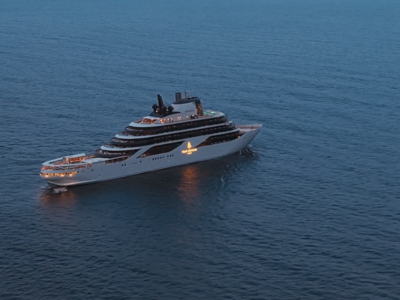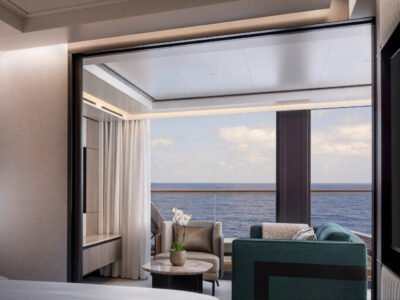
You are floating in a five-star hotel suite. The lights are dimmed to a warm amber, the air is chilled to exactly your preference, and your favorite playlist is emanating from invisible speakers. You walk to the floor-to-ceiling glass wall, draw the curtain, and see dolphins, slicing through the phosphorescent wake, seemingly unaware of your presence—because your 140-foot yacht is running on batteries alone, making almost no noise at all.
This isn’t a distant green-tech fantasy from a shipyard’s R&D lab. This is Seawolf X, the genre-defying catamaran from Italian shipyard Rossinavi, and she is currently asking €36,900,000 on the brokerage market. Delivered in 2024 and lightly used in charter service since, she’s now available for the first time as a resale—a detail that matters, because it means this is a yacht that has already proven itself at sea rather than a rendering waiting to become reality.
The Rossinavi DNA: Stealth-Wealth Italian Style
Rossinavi, the family-run shipyard from Viareggio, has spent the last decade cultivating a reputation for design collaborations well outside the usual yacht-industry playbook, working at various points with studios including Pininfarina—best known for shaping some of the most celebrated Ferraris and Maseratis in automotive history—and veteran yacht designer Fulvio De Simoni to create vessels that look more like architectural concept sketches than sea-faring craft.
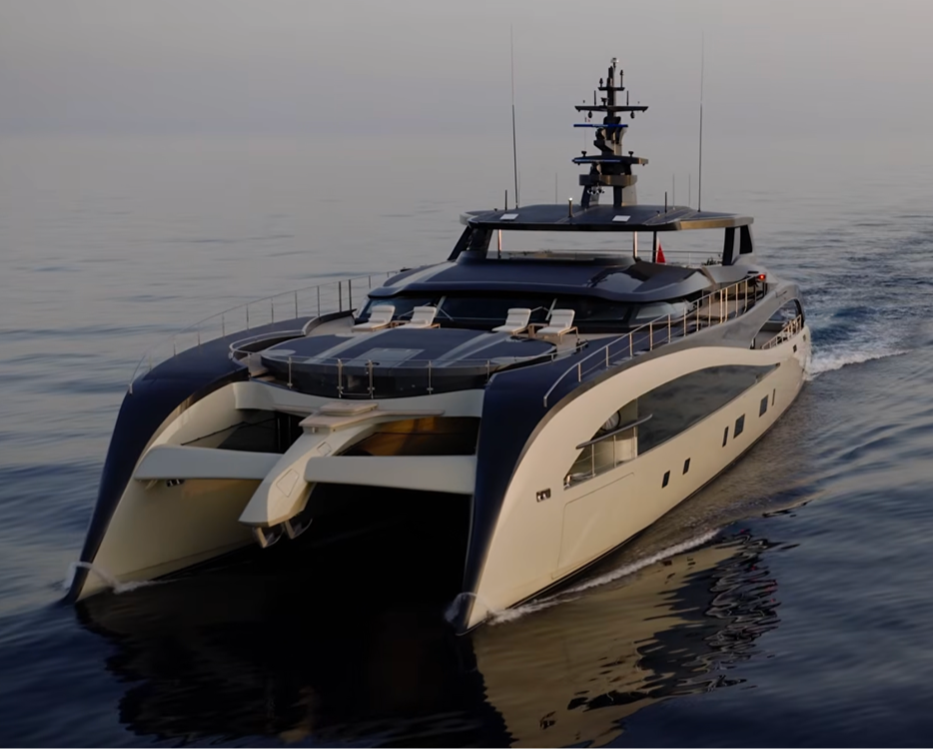
Seawolf X is, in a real sense, the logical, electrified extension of that approach—and a genuine first for the yard. She is Rossinavi’s first-ever multihull, and the first collaboration between the shipyard and De Simoni since the 49.1-meter motoryacht Aurora in 2017. As a catamaran, she immediately signals an owner who values space, stability, and efficiency over the traditional monohull superyacht profile. A multihull is the thinking person’s yacht—it offers considerably more deck space than a monohull of comparable length while sipping fuel rather than guzzling it. At roughly 42.8 meters (140 feet) with a beam in the neighborhood of 13.6 to 13.75 meters depending on the measurement point, Seawolf X has the footprint and social space of a much larger vessel.
The Propulsion: Performance Without Penance
Let’s get into the engine room, because that’s where the €36.9 million starts to look like an investment in future-proofing rather than simple extravagance.
Seawolf X runs on a hybrid-electric propulsion system built around roughly 1.5 megawatts of battery storage. That’s enough capacity to power more than 24 hours of what the yard calls silent anchor mode—air conditioning, galley, entertainment systems, and the rest of the yacht’s hotel load—without a generator ever kicking on, and to allow for genuinely vibration-free cruising under electric power alone at coastal speeds.
When a longer passage is required, the diesel engines do engage, working primarily to extend range rather than to drive the props directly. The net effect, according to Rossinavi, is a reduction in fuel consumption of up to 75 percent compared with a conventional diesel-only yacht of similar volume—a substantial figure, even if it falls short of some of the more dramatic claims that have circulated around the yacht. Worth noting, too: this is not a yacht built for speed. Top speed sits around 11.6 to 12 knots, with a cruising speed closer to 10—entirely in keeping with a vessel engineered around efficiency and silence rather than outright pace.
For the executive whose board is pushing an ESG mandate, or simply for an owner who prefers the sound of water over the drone of a generator, the appeal is straightforward, even if the numbers are more modest than the boldest marketing language sometimes suggests.
The Exterior: A Blade of Light
The exterior design, credited to Fulvio De Simoni Yacht Design, avoids the aggressive, angular styling common on much of the current superyacht market. Instead, Seawolf X is defined by a low, sleek profile that trades the towering silhouette of a traditional superyacht for something considerably more athletic—a look brokers and reviewers have repeatedly compared to a sports car or high-speed ferry rather than a conventional pleasure craft.
The superstructure integrates solar panels directly into the design, quietly trickle-charging the battery banks even while underway or at anchor, part of a broader philosophy that treats solar power, battery storage, and onboard automation as core engineering choices rather than decorative add-ons. The yacht’s naval architecture was developed by Rossi Engineering Design & Services, and the finished vessel has already picked up recognition within the industry, including a Judges’ Commendation at the 2025 World Superyacht Awards and a catamaran-category honor at the Robb Report’s own awards that same year.
The Interior: Sun, Sea, and a New York Sensibility
Step inside, and the aesthetic is a considered departure from the high-gloss mahogany often associated with traditional Italian yacht interiors. Rather than a De Simoni-designed cabin, the interior is the work of Meyer Davis, the New York-based design firm, whose co-founder Will Meyer has described the brief as an opportunity “to create something truly different—a catamaran that is elegantly designed but grounded in sustainability,” with the studio leaning into natural materials and refined, understated details.
Brokers describe the resulting look as carrying a “subtle New York influence” while drawing inspiration from “sun, sea, and sand”—a warm, materials-forward sensibility built around natural textures rather than any single imported design language. The main saloon spans the full beam of the yacht in an open-plan layout, and the overall palette favors light, natural tones over ornamentation, letting the yacht’s volume and light do most of the work.
The full-beam master suite, at roughly 70 square meters, occupies the privileged main-deck forward position and is among the largest of its kind in this size class, offering wide, uninterrupted views out over the water—one of the genuine standout features of the layout, and one of the few claims in earlier reporting on this yacht that holds up exactly as described.
The Toys and the Guest Experience
Seawolf X accommodates up to 12 guests across five cabins—a master suite plus four further doubles, some convertible to twins—supported by a crew of seven. She carries the expected complement of water toys and tender storage for a yacht in this class, along with a beach club and jacuzzi arrangement on the upper deck that reinforces the yacht’s broader emphasis on low-key, close-to-the-water living rather than tiered, ostentatious entertaining spaces.
The Bottom Line: An Appointment with the Present, Not Just the Future
At €36.9 million, Seawolf X sits in a genuinely competitive bracket of 40-to-50-meter yachts, both new builds and recent brokerage listings. But comparing her on price alone misses the point. This isn’t simply a vehicle for island-hopping; it’s one of relatively few production-ready demonstrations that a large, comfortable, sociable yacht can also be a quiet, low-impact one—not through any single miracle technology, but through a fairly straightforward combination of battery storage, solar integration, and a hull form chosen for efficiency over drama.
She is, in other words, for the owner who values how little fuel gets burned as much as how much, and who is drawn to a design story that’s genuinely interesting even without the embellishments: a first-of-its-kind multihull for a storied Italian yard, an interior shaped by a well-regarded New York studio rather than an invented Japanese theme, and a real, already-seasoned yacht rather than a rendering waiting to become one.
A Shipyard Built on Reinvention
Rossinavi’s own history helps explain why a project like Seawolf X makes sense coming from this particular yard. The company traces back to a small carpentry and mechanics workshop founded by brothers Claudio and Paride Rossi in the 1970s, evolving over subsequent decades into a full custom shipyard capable of competing with far larger, more established names in the ultra-luxury segment. Along the way, the yard built a reputation less for volume than for willingness to experiment: automotive-inspired collaborations with Pininfarina on projects like the 2017 Aurea concept and the 2019 Super Sport 65, architectural partnerships with firms including Zaha Hadid Architects on more recent concept work, and a standing sustainability initiative the yard calls BluE, aimed at bringing solar power, battery storage, and reduced-emission propulsion into the heart of its production line rather than treating them as optional add-ons for environmentally minded clients.
Seawolf X sits squarely within that BluE philosophy, but it also represents something genuinely new for the yard: its first catamaran, built in partnership with a naval architecture firm, Rossi Engineering Design & Services, with no direct lineage to Rossinavi’s earlier monohull output. That combination—an established Italian custom-yacht builder taking on a multihull platform for the first time, specifically to chase efficiency and quiet rather than raw speed or interior volume—is part of what has made the finished yacht a genuine talking point in the brokerage world, distinct from the more familiar formula of stretching or restyling an existing hull design.
The Broader Case for Eco-Conscious Superyachts
Seawolf X also arrives at a moment when the ultra-luxury yacht market is grappling, unevenly, with its own environmental footprint. Large yachts remain among the least fuel-efficient forms of private transportation per passenger mile, and shipyards across the industry have spent the past several years rolling out hybrid propulsion packages, solar integration, and lower-emission builds in response to both regulatory pressure and a genuine shift in buyer expectations, particularly among younger owners and family offices increasingly attentive to ESG considerations.
What distinguishes Seawolf X within that broader trend isn’t any single breakthrough technology—hybrid-electric propulsion, solar-assisted charging, and extended silent-running capability all exist elsewhere in the market, on yachts from other builders experimenting with similar systems at various scales. Rather, it’s the combination of all of that engineering with a hull form, the catamaran, that inherently rewards it: more deck and interior volume per meter of waterline, a naturally more efficient hull shape at low-to-moderate speeds, and enough stability to make a large, glass-heavy, low-profile superstructure genuinely comfortable rather than merely striking to look at. Seawolf X isn’t the fastest, largest, or most technologically singular yacht on the market. It may, however, be one of the more coherent arguments yet built for what a genuinely low-impact superyacht could look like at this size, without asking an owner to sacrifice the space, service, or social life that a yacht like this exists to provide in the first place.