listen to the audio of this article
When “Business Jet” Isn’t a Big Enough Word
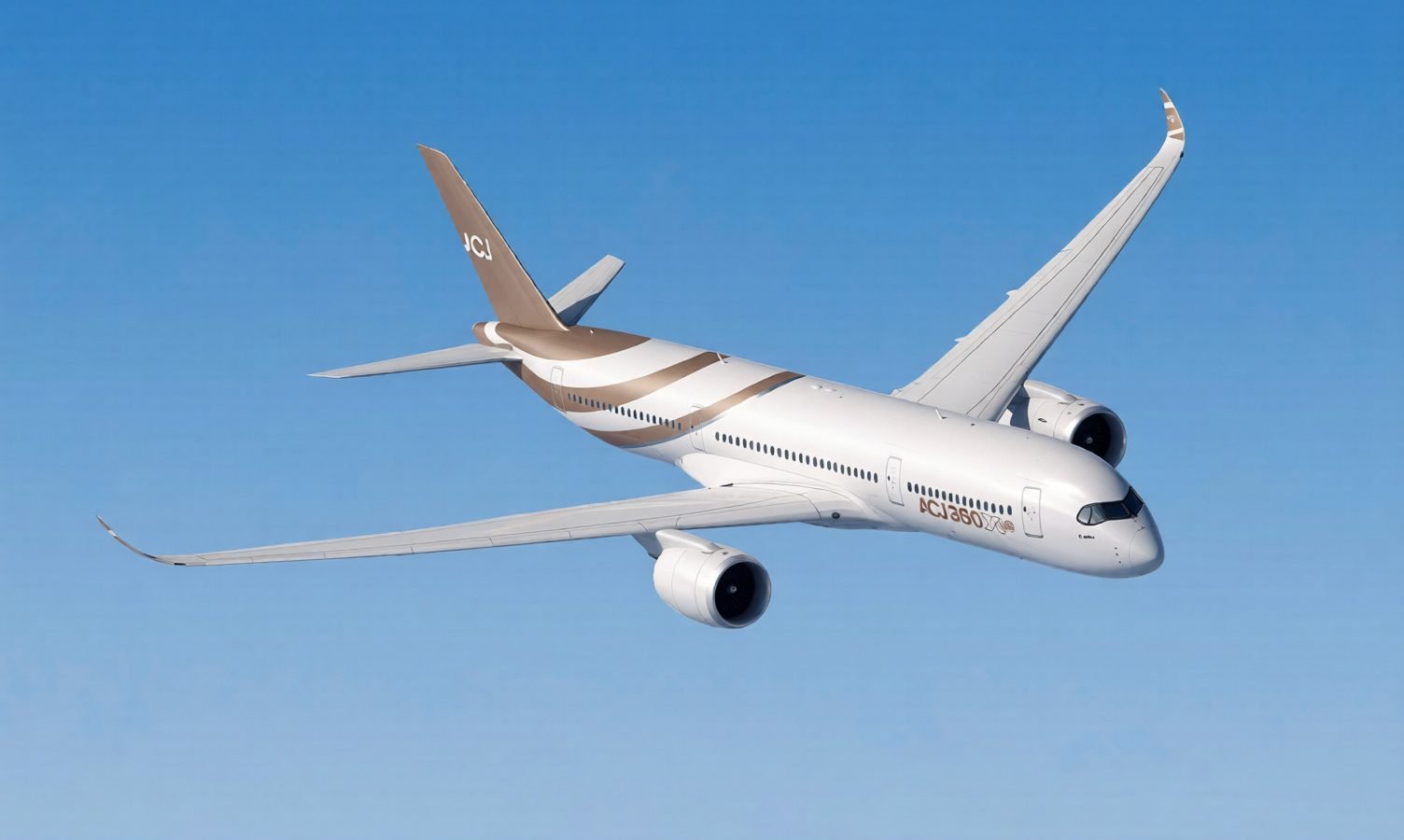
There’s a moment every private aviation buyer eventually reaches: the point where even the largest purpose-built business jet starts to feel small. For those clients — heads of state, sovereign wealth funds, the handful of individuals whose net worth is measured in the tens of billions — Airbus built something that doesn’t compete with traditional bizjets so much as it makes the entire category look modest by comparison. It’s called the ACJ350, reported cost $317 million, and it is, quite simply, a widebody airliner reimagined as a private residence that happens to fly at 41,000 feet.
From Troubled Airliner to Flagship Flying Palace
The ACJ350’s story begins with its parent aircraft, the Airbus A350 XWB — “XWB” standing for Extra Wide Body. The commercial A350 was itself a hard-won achievement: after nearly five years of delays, a significant mid-program redesign, and a development budget that ballooned to nearly $15 billion, Airbus finally delivered the first production A350 to Qatar Airways in December 2014. It went on to become one of the most commercially successful widebody programs in aviation history, racking up more than 780 orders from over 40 carriers.
Airbus Corporate Jets launched the VIP conversion program for the aircraft in May 2016, branding it the ACJ350. Rather than adapt the standard A350-900, Airbus based its corporate jet on the A350-900ULR — the “Ultra Long Range” variant originally developed for airline routes like Singapore Airlines’ marathon nonstop flights to New York and Los Angeles. That decision alone tells you everything about what kind of aircraft the ACJ350 was designed to be: not merely spacious, but capable of connecting almost any two points on Earth without stopping to refuel.
A Government, Not a Billionaire, Got There First
For an aircraft so strongly associated with private wealth, it’s a fitting twist that the ACJ350’s first customer wasn’t a business tycoon at all — it was a country. In 2019, the German government placed a firm order for three A350-900s to replace the aging pair of Airbus A340s that had spent two decades ferrying chancellors and cabinet officials around the world, jets that had become notorious for breakdowns serious enough to strand German officials at their destinations or force them onto commercial flights.
The three aircraft — registered 10+01, 10+02, and 10+03, and christened Konrad Adenauer, Theodor Heuss, and Kurt Schumacher after former German chancellors — began entering service in 2020, with full VIP cabin outfitting completed by Lufthansa Technik’s Hamburg completion center through 2022 and 2023. The total investment was substantial even before the interiors were considered: roughly €640 million ($714 million) for the three baseline aircraft, plus an estimated €288 million ($321 million) for cabin outfitting and another €229 million ($255 million) for onboard defense systems — underscoring that an ACJ350 is never really a single line-item purchase, but an entire program.
The Numbers That Redefine “Spacious”
Strip away the diplomatic history and the raw specifications of the ACJ350 are still staggering. The aircraft comes in two cabin lengths, corresponding to the underlying A350 airframe variants. The ACJ350 XWB-900 offers roughly 2,910 to 3,000 square feet of usable cabin floor space, while the longer XWB-1000 stretches that to an extraordinary 3,315 square feet — more than 1,000 square feet larger than the average American house, packed into a single aircraft cabin measuring 18 feet 5 inches across at its widest point.
Typically configured for around 25 VIP passengers — a fraction of the 300-plus economy seats a standard airline A350 carries — the ACJ350 uses that freed-up volume for amenities no conventional business jet has room for: dedicated wellness zones with gyms and spa facilities, private bedroom suites, full conference rooms, and living areas that owners routinely describe not as a cabin but as a flying house. Because the interior is entirely bespoke, no two ACJ350s look alike; completion centers have delivered everything from minimalist, gallery-white interiors to opulent, gold-accented state rooms depending on each client’s taste.
Range That Erases the Map
Powered by two Rolls-Royce Trent XWB engines — among the most efficient large aero-engines ever certified, delivering roughly 25% lower fuel burn and CO2 emissions than the generation of engines they replaced — the ACJ350 offers a maximum range of approximately 11,100 nautical miles (20,550 km), with some sources citing figures as high as 12,400 miles depending on payload and configuration. In practical terms, that’s enough to fly nonstop between London and Auckland, Beijing and Toronto, or Buenos Aires and Jeddah — city pairs that would require a fuel stop on almost any other aircraft, private or commercial.
That range translates to roughly 20 hours of airborne endurance, meaning the ACJ350 can, in a single hop, connect virtually any two cities on the planet. Despite its size, Airbus also engineered the aircraft to access a surprising number of shorter runways, giving operators more flexibility to reach less conventional or more remote destinations than the jet’s widebody proportions might suggest.
Nature-Inspired Engineering Underneath the Luxury
Behind the marble bathrooms and private cinemas sits genuine aerospace innovation. Airbus has repeatedly pointed to the ACJ350’s adaptive wing technology — a design explicitly inspired by the way birds subtly reshape their wings in flight — which morphs the aircraft’s wing shape while airborne to optimize wing loading, reduce drag, and lower fuel consumption across different phases of flight. Combined with an airframe built from more than 70% advanced materials, including carbon-fiber composites, titanium, and modern aluminum alloys, the ACJ350 is lighter and more efficient than its size would suggest — a genuine engineering achievement wrapped inside an extraordinary display of wealth.
The composite fuselage also delivers a passenger-comfort benefit that’s easy to overlook: because carbon-fiber structures tolerate higher cabin pressure than traditional aluminum airframes, the ACJ350 can maintain a lower cabin altitude — around 6,000 feet, compared to the 8,000 feet typical of older aircraft — along with higher cabin humidity. On a 20-hour flight, that difference is the reason passengers reportedly arrive noticeably less fatigued than they would on an older-generation long-haul aircraft.
A Price Tag to Match the Ambition
Even by the standards of ultra-high-net-worth aviation, the ACJ350’s price is extraordinary. A standard airline-configuration A350 has historically listed at roughly $254 million to $308 million depending on variant, before any cabin work begins. Once a bespoke VIP interior, communications suite, and completion work are added, fully finished ACJ350s have been reported to cost as much as $317 million — figures that place it not merely at the top of the private jet market, but among the most expensive single aircraft ever built for private use, government or otherwise.
The Aircraft as Statement
More than any specification sheet can convey, the ACJ350 exists because, for a small number of governments and individuals, no conventional business jet — however large, however well-equipped — is simply big enough. It represents Airbus’s answer to a question few manufacturers are ever asked: what happens when you remove almost every constraint on cabin space, range, and budget, and simply build the best flying environment physically possible on top of a proven, extraordinarily capable commercial airframe?
The answer, it turns out, is less an airplane than a private world with wings — one capable of carrying a head of state, a royal family, or a handful of the world’s wealthiest individuals nonstop to virtually anywhere on Earth, in a cabin larger than most people’s homes. Whether viewed as an engineering marvel, a diplomatic tool, or the ultimate expression of aviation excess, the ACJ350 occupies a category almost entirely its own.