listen to the audio of this article:
There is a particular kind of mystery that only extreme wealth can buy, and the 445-foot megayacht Crescent is one of its finest specimens. She is, by gross tonnage, one of the ten largest privately owned yachts on Earth — a 9,034-GT leviathan built by the German shipyard Lürssen, styled by two of the industry’s most sought-after names, and reportedly worth $600 million. And yet, for a vessel of such staggering scale, almost nobody outside a small circle of owners, captains, and Spanish port authorities has ever set foot on her, let alone photographed her interior. The Crescent superyacht is less a yacht than a rumor with a hull number.
From Project Thunder to Crescent: The Build at Lürssen
Every serious superyacht begins life under a codename, and Crescent’s was Thunder — a fitting placeholder for a vessel that would eventually stretch 135.61 meters, or 444.9 feet, stem to stern. Construction started at Lürssen’s yard near Rendsburg, Germany, in early 2015, and the yacht was launched on April 3, 2017, before undergoing sea trials that yachting photographers still talk about. She was formally delivered to her owners in August 2018, at which point Thunder quietly became Crescent, and the vessel disappeared into the private, guarded world its owner apparently intended for it.
Her numbers alone place her among the largest yachts in the world. She carries a 21-meter beam and a 5.2-meter draught, powered by twin MTU 20V 4000 M73L diesel engines that push her to a top speed of roughly 20 knots. Depending on configuration, she can accommodate between 18 and 36 guests, all tended to by a crew that can run into the fifties. She is built on a steel hull with an aluminum superstructure and teak-laid decks, classed to Lloyd’s Register standards, and flagged in the Cayman Islands under the ownership of a company called Black Dragon Minerals — a corporate structure as opaque as the yacht herself.
Espen Øino’s Striking Exterior Design
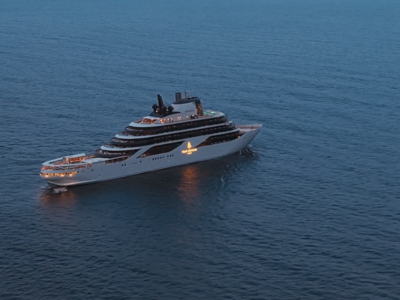
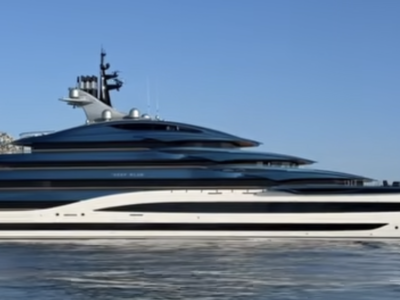
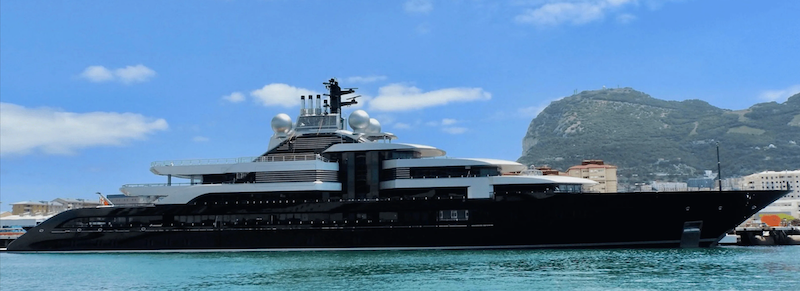
The exterior design belongs to Espen Øino, the Norwegian naval architect whose portfolio includes some of the most photographed yachts afloat, and whose signature on the Lürssen Crescent yacht is unmistakable. The yacht wears a striking black hull beneath a silver superstructure — a palette that reads almost aggressive on the water, more stealth vessel than pleasure craft, and one that photographers have noted creates an unusual, almost liquid-metal interplay of light across her flanks at sunrise and sunset.
Three broad deck windows sit just forward of the wing stations, flooding the interior with natural light and giving guests panoramic sightlines out across the sea — a detail Øino has used elsewhere in his work, but rarely at this scale. Up top, Crescent carries two helipads, one of which folds into a retractable hangar so the deck can return to a clean, uncluttered profile the moment a helicopter departs. Aft, there is a glass-bottomed pool, a feature that has become something of a status marker among the very largest yachts, casting shifting light down through the decks below rather than merely sitting atop them.
The Interior No One Has Photographed
Here is where the Crescent superyacht becomes genuinely strange, even by the secretive standards of the superyacht world. Her interior was designed by François Zuretti, the French designer whose Nice-based studio built a career on bespoke, old-world luxury for yachts, private jets, and residences. Zuretti is also responsible for the interiors of the equally shadowy Scheherazade, a comparably enormous Lürssen vessel whose ownership has been tied by various reports to figures close to the Kremlin.
By every account, Crescent’s centerpiece is a soaring, multi-story glass atrium — some descriptions put it at two levels, others at three — that yachting writers have compared to a crystal cathedral, connecting her decks via elevator and pouring daylight down through the heart of the ship. Beyond that atrium, the known feature list reads like a checklist of megayacht excess. She reportedly holds a full movie theater, a fully equipped gymnasium, a spa and beauty salon, a beach club, and what has been described as a huge master suite. Zero-speed stabilizers keep the ride smooth even at anchor.
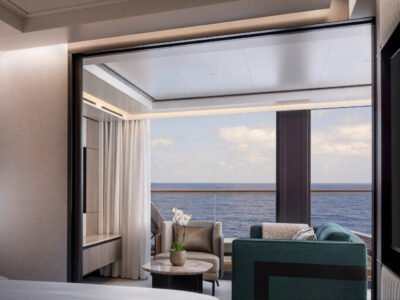
And that is essentially where public knowledge ends. Despite years of international attention, not a single verified interior photograph of Crescent has ever surfaced. Compare that to almost any other yacht in her size class — vessels whose sun decks and formal dining rooms circulate endlessly through yachting magazines and brokerage listings — and Crescent’s total visual silence starts to look less like privacy and more like design. Whoever commissioned her went to considerable lengths to make sure the world would only ever see the outside.
Why Crescent Remains the World’s Most Private Megayacht
There is a certain dark elegance to how thoroughly Crescent has resisted the fate of every other yacht of her caliber. She has never been chartered. She has never been listed for sale. Her interior has never leaked into a brokerage brochure or a paparazzi long-lens shot. Even her most public moment — a years-long international detention involving two governments’ law enforcement agencies — has managed to disclose almost nothing concrete.
What remains is a set of facts that read more like specifications for a legend than a boat: 445 feet of steel and aluminum, a crystal atrium nobody has photographed, a black-and-silver hull built to be seen from a distance and not much closer, and an owner whose identity is, officially, still unconfirmed. In an industry built almost entirely on visibility — on being seen at the right marina, chartered by the right celebrity, photographed from the right helicopter — the 445-foot yacht has thrived by doing the opposite. She may be one of the largest yachts ever built. She is almost certainly the most private.
For now, she remains in limbo at MB92 shipyard in Barcelona, a $600 million question mark. Whether she will ever sail again under her original ownership, be sold to a new buyer, or be absorbed into some form of state asset forfeiture remains unknown. What is certain is that the Project Thunder yacht — born in a German shipyard, styled by two masters of maritime design, and swallowed by geopolitics — has become something far more enduring than a mere vessel. She is a symbol of what extreme wealth can build, and what the modern state can, however slowly, challenge.