For more than six decades, one name has stood above all others in the world of long-distance bluewater cruising: Amel. Founded in 1965 by visionary French engineer Henri Amel, Chantiers Amel has built over 2,000 ocean-going sailboats that have circumnavigated the globe, crossed the Pacific, and weathered the fiercest storms the world’s oceans can deliver. What makes Amel yachts so special is not just their unmistakable silhouette or their legendary build quality—it is a philosophy born from one man’s refusal to accept that serious cruising should ever be uncomfortable, unsafe, or beyond the reach of a couple sailing alone.
The Origins of a Bluewater Legend
Henri Amel was not a typical boatbuilder. He did not come from a shipbuilding dynasty, nor did he inherit a yard. Born in 1913, Amel was a passionate sailor, a wartime Resistance fighter, and an engineer who began building boats in his Paris workshop at the age of 50. He had never run a business before. What he did have was an unshakable conviction: that the perfect ocean-going yacht must be robust, comfortable, and easy to manoeuvre—qualities that remain the cornerstone of every Amel built today.
Amel’s journey to founding Chantiers Amel in La Rochelle was shaped by World War II. During the conflict, he observed the Allied naval forces using polyester resin to construct floating caissons—a material innovation he would later pioneer in yacht construction. After the war, he continued building in Lyon before establishing his own yard in La Rochelle in 1964, taking over a failing workshop called ARPIN. The early models—the Copain, Pampero, Super Mistral Sport, and Euros 39—were built using his own fibreglass cloth and a revolutionary lamination technique that bonded the hull, deck, and interior bulkheads into a single, watertight structure.
Disaster struck on 3 February 1968, when a fire destroyed the ARPIN workshops completely. Undeterred, Henri Amel rebuilt in Périgny, La Rochelle’s newest industrial estate, inaugurating the new facility in January 1969. Every Amel yacht built since then—including the current Amel 50 and Amel 60—has emerged from that same Périgny yard.
The Henri Amel Philosophy: Safety First, Comfort Always
What truly sets Amel apart from every other production yacht builder is the founder’s unwavering design philosophy. Henri Amel, who was partially blind for much of his career due to a war injury, designed boats not with his eyes but with his hands and his experience at sea. He believed that a cruising couple should be able to sail anywhere in the world without needing a professional crew.
This belief translated into innovations that were decades ahead of their time. Amel was the first production builder to fit electric furling sails and retractable bow thrusters as standard equipment. Every Amel was designed as a complete, turnkey package—what the company calls its “all-inclusive principle.” Owners did not choose options; they received everything needed for bluewater cruising, from the generator and watermaker down to the towels, bathrobes, and even a hairdryer.
The construction itself reflects this obsession with safety. Amel yachts feature bulkheads that are laminated—not glued—to the hull and deck, creating a monocoque structure of extraordinary stiffness and watertight integrity. “If you have a collision you can close the doors and still be perfectly secure,” explains the shipyard’s sales team. “You can stay floating and get back safely.”
The Golden Era: Maramu, Super Maramu, and the Ketch Legacy
For nearly four decades, Amel built almost exclusively ketch-rigged yachts—a configuration Henri Amel insisted was easier for a cruising couple to handle than a sloop. The Maramu (1978), Sharki (1979), Mango (1979), and later the legendary Super Maramu (1988) defined an era of bluewater cruising that remains unmatched.
The Super Maramu and its successor, the Super Maramu 2000, became the most successful models in Amel’s history. Voted Boat of the Year by Cruising World magazine in 2000, the Super Maramu 2000 combined classic ketch aesthetics with Henri Amel’s signature innovations: the hard-top doghouse with its offset wheel and armchair helmsman’s seat, solid stainless steel guardrails, and the unmistakable maroon rubbing strake.
These yachts were not just boats; they were statements of intent. They told the world that their owners were serious about sailing—not racing, not weekend coastal hopping, but going. To this day, used Amel Super Maramus command premium prices on the brokerage market, a testament to their enduring build quality and the cult-like following they inspire among bluewater sailors.
A New Chapter: The Amel 50 and Amel 60
In 2005, Henri Amel passed away at the age of 92, having worked at the yard until his final days. True to his character, he donated 12,000 of his 13,000 shares in the company to his employees, ensuring that Chantiers Amel would remain independent and true to its founding principles. From that point forward, new models would no longer bear the names of winds or islands—they would simply carry the name Amel.
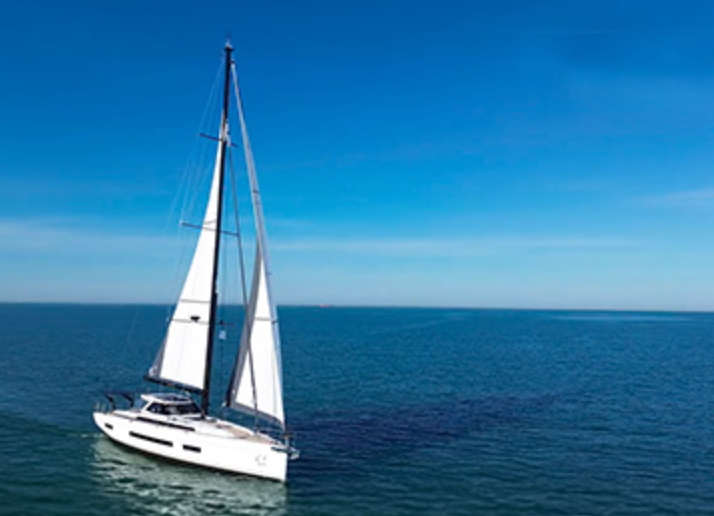
The transition to a new design language came with the appointment of renowned naval architects Jean Berret and Olivier Racoupeau, who brought modern sloop-rigged designs to the yard while preserving the DNA that makes an Amel unmistakable. The Amel 50, launched at the Cannes Yachting Festival in 2017, was a watershed moment: the first sloop-rigged Amel in over a decade, and the winner of the European Yacht of the Year award in the Luxury Cruiser category for 2018.
The Amel 60, unveiled in 2019 and also a European Yacht of the Year winner (2020), extended this modern design language to an 18-metre platform. Both models retain the signature centre cockpit protected by a rigid hard top, the vast aft owner’s cabin, the deep bilge for enhanced safety, and the comprehensive standard equipment list that has always defined the brand.
In 2026, Amel continues to evolve. The upcoming Amel 50.2, set to premiere at the Cannes Yachting Festival in September 2026, represents a thoughtful refinement of the original 50. The redesigned aft owner’s cabin offers greater privacy with an aft-facing bed, improved sound insulation, and a more homely interior concept featuring light oak and American walnut finishes. The galley has been enhanced for extended cruising with increased refrigeration capacity and larger work surfaces. Priced at approximately €1.15 million net, the 50.2 reaffirms Amel’s position at the intersection of luxury and practicality.
Why Amel Yachts Hold Their Value
Walk through any major boat show and you will see dozens of brands claiming to build bluewater cruisers. Yet few can match the resale value and global demand of a used Amel. The reasons are structural, not merely cosmetic.
First, build quality. Amel yachts are constructed using vacuum resin infusion with vinylester resin and PVC closed-cell foam sandwich construction—techniques that ensure exceptional strength-to-weight ratios and long-term hull integrity. The engine room is isolated and flood-resistant, with high-density sound insulation and full access via the cockpit floor. Every system is designed for redundancy and ease of maintenance at sea.
Second, the complete package. Unlike most builders who offer a base boat with an extensive options list, Amel delivers yachts that are genuinely ready to cross an ocean the day they leave La Rochelle. Standard equipment includes in-mast furling, electric winches, a generator, comprehensive navigation electronics, bow and stern thrusters, and a watermaker.
Third, after-sales support. Amel’s commissioning process is unique in the industry. Each new owner spends a full week at the La Rochelle yard with a dedicated Amel technician, learning every system aboard their yacht from “A to Z.” The yard maintains direct contact with owners for the life of the vessel, offering remote technical support that can diagnose and resolve problems even when the yacht is mid-ocean.
Sailing an Amel: The Owner Experience
To step aboard an Amel is to enter a world where every detail has been considered from the perspective of the person who will actually use it. The helming position, sheltered beneath the hard top, offers panoramic visibility and protection from the elements. The armchair seat, a Henri Amel invention now widely imitated, allows the helmsman to steer for hours in complete comfort. The centre cockpit layout keeps the crew safe and dry while providing easy access to all sail controls.
Below deck, the interiors reflect a distinctly French sense of art de vivre. Light-filled saloons, functional galleies with Corian work surfaces, and spacious cabins with ensuite facilities create an environment where long passages become pleasures rather ordeals. The Amel 50 and 60 offer three-cabin layouts with accommodation for six to eight, making them ideal for families or couples who occasionally entertain guests.
The Future of Chantiers Amel
Today, Chantiers Amel employs approximately 125 people at its La Rochelle-Périgny facility and produces around 20 yachts per year—a deliberately limited output that preserves the handcrafted quality that defines the brand. Under the leadership of Managing Director Emmanuel Poujeade, who joined the company in 2000 and took the helm in 2014, the yard has successfully navigated the transition from Henri Amel’s personal vision to a modern, employee-owned enterprise.
The future looks bright. With the Amel 50.2 launching in 2026 and the Amel 60 continuing to attract discerning buyers, the shipyard remains the benchmark against which all other bluewater cruisers are measured. In an era of mass production and disposable consumer goods, Amel stands as a rare exception: a builder that still believes a yacht should last a lifetime, carry its owners safely to the farthest corners of the earth, and bring them home again.
check out the Amel Yacht Youtube Channel