listen to the audio of this article
For Bernard Arnault, the chairman and chief executive of LVMH and the architect behind the world’s largest luxury empire, owning a superyacht was never a question of if, but of how extraordinary it could be. The answer came in 2015 with the delivery of Symphony, a 101.5-meter (333-foot) masterpiece that became the first Feadship ever to break the 100-meter barrier. Valued today at approximately $150 million, Symphony is not merely a vessel — it is a floating cathedral of everything Arnault has spent four decades perfecting: taste, craftsmanship, and an almost obsessive attention to detail.
The Maestro and His Empire
To understand Symphony, one must first understand its owner. Bernard Arnault is not a tech bro in a hoodie or a property magnate who struck gold on debt. Since 1989, he has presided over LVMH — a sprawling conglomerate of over 75 brands including Louis Vuitton, Christian Dior, Fendi, Tiffany & Co., and Moët & Chandon. His fortune is built not on algorithms or oil, but on the alchemy of turning leather, silk, and champagne into objects of global desire.
Arnault is famously private. Unlike Elon Musk or Jeff Bezos, he does not court the spotlight. In fact, he sold his Bombardier Global 7500 private jet in October 2022 precisely to avoid public flight tracking, underscoring a man who prefers his luxuries whispered about rather than broadcast. And yet, when it comes to Symphony, he has made no effort to hide her. She is his public masterpiece — a steel-and-aluminum symphony (quite literally) that announces his presence in harbors from Monaco to the French Riviera without him ever having to say a word. The name itself is a nod to Arnault’s well-documented passion for classical music, a refined touch that separates the old-world billionaire from the new-money crowd.
The Birth of a Record-Breaker
Symphony was built as Project 808 at the Royal Van Lent Shipyard in the Netherlands, part of the prestigious Feadship collective. When she was launched in January 2015 and delivered that May, she became the largest yacht ever built in the Netherlands and the first Feadship to surpass the 100-meter mark — a milestone that had eluded the storied shipyard since its founding in 1849.
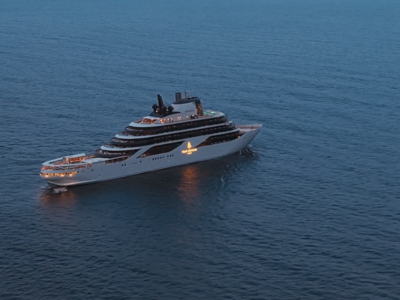
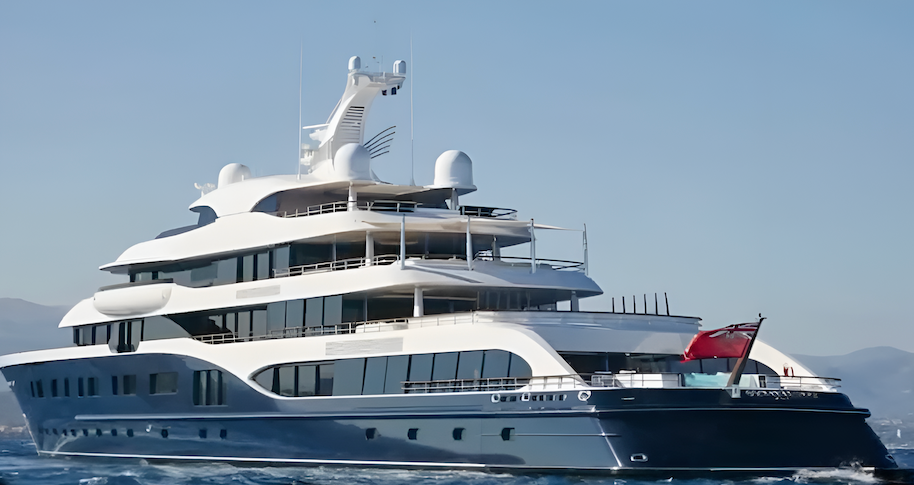
Her exterior was designed by the acclaimed British yacht designer Tim Heywood, whose brief was to create something timeless yet unmistakably modern. The result is a profile that balances classical yachting elegance with contemporary drama: a gently concave clipper bow finished in high-gloss Flag Blue evokes the golden age of ocean liners, while sculptural stainless-steel masts and wave-inspired motifs lend the vessel a sense of motion even when anchored. At night, sophisticated LED lighting illuminates the exterior staircases, turning Symphony into a lantern floating on the water.
But the exterior is only half the story. The interior was entrusted to two design titans: François Zuretti, who provided architectural warmth and clarity, and Peter Marino, the legendary architect behind flagship boutiques for Louis Vuitton, Christian Dior, and Chanel. Marino was given what the shipyard’s project manager called “free rein to create one of the most detail-rich and elaborate interiors ever seen on a superyacht.” The result is what they describe as a “summerhouse on the sea,” drawing inspiration from luxury residences in Bali, Thailand, and Africa.
Inside the Palace: A Deck-by-Deck Marvel
Symphony spans six decks with an internal volume of approximately 3,000 gross tonnes and a beam of 14.1 meters. She was also the first Feadship to comply with the Passenger Yacht Code (PYC), a stringent set of regulations that allows a vessel to carry up to 36 guests — far exceeding the traditional 12-guest limit on most private yachts. While PYC compliance technically permits 36 passengers, Symphony typically hosts around 20 guests, looked after by a crew of up to 38.
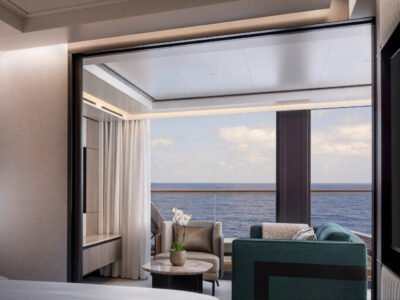
The owner’s deck — a private sanctuary occupying the entire upper deck — is the jewel in the crown. It features separate his-and-hers offices, dressing rooms, and bathrooms. The master bedroom offers a jaw-dropping 200-degree view of the sea, while a private terrace fitted with a spa pool and sunpads ensures Arnault can survey his floating kingdom in complete seclusion. A sauna and private study complete the owner’s quarters, creating a space that functions as both a corner office and a personal spa retreat.
For guests, the amenities are staggering. The main deck aft centers around a swimming pool with its own waterfall — a feature so theatrical it feels ripped from a Bond villain’s lair. Below the pool, on the lower deck, lies a beach club whose ceiling is the pool’s glass bottom, allowing light to cascade down like a liquid skylight. The bridge deck boasts an outdoor cinema, while the sun deck features a Jacuzzi, an observation lounge, and a bar.
Wellness is taken seriously aboard Symphony. The yacht carries a fully equipped gym, a beauty salon, a massage room, and a spa with steam room and sauna. A “pop-up” golf tee on the upper deck allows guests to hit biodegradable balls into the open sea — a feature Arnault also had on his previous yacht, Amadeus. Even the elevator is an experience: a glass lift shaft fitted with a giant interactive video wall that immerses passengers in either an aquarium or a cosmic outer-space scene as they move between decks.
The materials throughout are what one would expect from a man who sells $10,000 handbags for a living: bronze, satinwood, palm and banana leaf, bamboo, natural silk, textured leather, and hand-scraped French oak floors that invite guests to walk barefoot. Floor-to-ceiling windows start just 20 centimeters above the deck and stretch to the ceiling, ensuring uninterrupted sea views and flooding the saloons with natural light.
Engineering and Eco-Consciousness
For a vessel of her size — 101.5 meters long and weighing roughly 3,000 gross tonnes — Symphony is remarkably quiet. Arnault specifically requested that the yacht be as silent as possible, and Feadship’s engineers worked to isolate guest and owner spaces from engine vibrations, ensuring restful nights even when crossing open ocean.
She is powered by four MTU 16V4000M73 diesel engines, delivering a combined output of over 13,700 horsepower. Her top speed is 22 knots, with a comfortable cruising speed of 16 knots and a maximum range of approximately 5,000 to 5,500 nautical miles — enough to cross the Atlantic with fuel to spare. Advanced at-anchor stabilizers minimize rolling when moored, ensuring that champagne glasses remain steady even in choppy Mediterranean waters.
What sets Symphony apart from many billionaire yachts is her environmental consciousness. The yacht incorporates a hybrid propulsion system that integrates traditional engines with modern generators and a battery bank, reportedly reducing energy consumption by up to 30% compared to similarly sized vessels. In an era when luxury is increasingly judged by its carbon footprint, Symphony allows Arnault to maintain his green credentials without sacrificing an inch of opulence.
A Fleet, Not Just a Yacht
Symphony is not Arnault’s first dance with superyachts. Before Symphony, he owned Amadeus, a 70-meter converted research vessel that was rebuilt as a luxury yacht in 2007. Amadeus featured many of the same signatures — an owner’s suite spanning the entire upper deck, a golf tee, and interiors by François Zuretti. He sold Amadeus for an asking price of approximately €50 million, just as Symphony was being delivered, ensuring a seamless transition from one palace to the next.
Arnault’s interest in yachting extends far beyond personal pleasure. In 2008, LVMH made a decisive move into the maritime luxury sector, acquiring a controlling stake in British yacht manufacturer Princess Yachts for approximately €250 million. Later that same year, the group acquired Royal Van Lent — the very Feadship shipyard that would go on to build Symphony — in a deal analysts valued at around €400 million. These acquisitions gave Arnault direct control over two of the most respected names in yacht building, effectively allowing him to own not just the finest yacht on the water, but the factories that build them.
The Cost of Perfection
Owning a floating palace of this magnitude does not come cheap. Industry estimates place Symphony’s annual running costs at between $10 and $15 million. This covers everything from the salaries of her 38-person crew to maintenance, insurance, fuel, port fees, and the inevitable refits required to keep a vessel of this complexity in pristine condition. To put that in perspective, the yearly cost of operating Symphony could buy a respectable mansion in most American cities.
And yet, for a man whose net worth fluctuates by billions with the movement of LVMH’s stock price, these are rounding errors. Symphony is not an investment; it is a statement. It is the physical manifestation of a philosophy that has made Arnault the emperor of luxury: that true wealth is not about having the most, but about having the best.
Conclusion: The Quiet King of the Seas
Bernard Arnault will never tweet about Symphony. He will not post Instagram stories from its sun deck. He will not invite cameras aboard for a MTV Cribs-style tour. That is not his style. But when Symphony glides into Port Hercule during the Monaco Grand Prix — towering over lesser yachts, her glass-bottom pool glowing in the Mediterranean dusk, her silhouette unmistakable against the Côte d’Azur skyline — she does all the talking for him.
In a world where tech billionaires compete to launch themselves into space, Arnault has chosen to rule the seas. Symphony is not just a yacht; it is a floating Louvre, a mobile headquarters for the world’s most discerning tastemaker, and a reminder that in the hierarchy of luxury, Bernard Arnault remains the conductor of the orchestra.