The River and the Founders
In 1958, two men named Gianfranco Cecchi and Giuliano Pecchia opened a small boatyard in Limite sull’Arno, a village pressed against the river near Florence. Italy was still rebuilding. The Arno flowed past their shed with the indifferent patience of water that has seen empires rise and fall. They did not set out to build the world’s largest yachts. They set out to build boats that would last, shaped by the same Tuscan craft traditions that produced leatherworkers in Santa Croce and marble cutters in Carrara. The name they chose was simple: San Lorenzo, name after the nearby church. It sounded like a place, not a brand. That would turn out to be the point.
For the first two decades, the yard built wooden boats. Then, in 1972, a man named Giovanni Jannetti took over and moved the entire operation to Viareggio, the historic heart of Italian yacht building on the Tuscan coast. Viareggio was already a town of shipwrights, its streets lined with workshops where men in blue coats bent oak and teak by hand. Jannetti understood that the future was not in wood but in fiberglass, and in 1985 Sanlorenzo launched the SL57, its first GRP yacht. The transition was not merely material. It was philosophical. Wood demands forgiveness. Fiberglass demands precision. The yard chose precision.
The Man Who Said No to Scale
In 2005, Massimo Perotti bought the majority of Sanlorenzo. He was not a yacht builder by trade. He was an industrialist with a taste for restraint. Where other shipyard owners saw volume as the only metric of success, Perotti saw something else: the moment when a yacht stops being bespoke and starts being a product. He decided Sanlorenzo would never cross that line. A stock market listing in 2019, yes, but one that explicitly refused to let quarterly earnings dictate the build schedule.
Perotti’s philosophy was captured in a slogan that sounds like a riddle: “Nothing is like your Sanlorenzo. Not even another Sanlorenzo.” It is not a marketing line. It is a business model. Every yacht is made to measure. Every interior is a conversation between the owner, the yard, and a designer. The shipyard does not build stock. It builds commissions. The result is that Sanlorenzo has become the most prolific single-brand builder of yachts over twenty-four metres in the world, not by building more, but by building more carefully.
The SL Line: Thirty-Eight Years of Evolution
If Sanlorenzo has a spine, it is the SL line. Born in 1988, the range began as a family of planing flybridge motor yachts—fast, sleek, balanced, designed for owners who wanted performance without surrendering elegance. Over thirty-eight years, the line grew to twenty-two models. Seven remain in production today, ranging from the compact SL80A at just under twenty-four metres to the flagship SL120A stretching nearly thirty-seven.
The early SL yachts were symmetrical. Classic. Two side decks, port and starboard, running bow to stern like the aisles of a church. Then, in 2018, Sanlorenzo did something that yachting purists considered either brilliant or heretical. They built a boat that was deliberately lopsided.
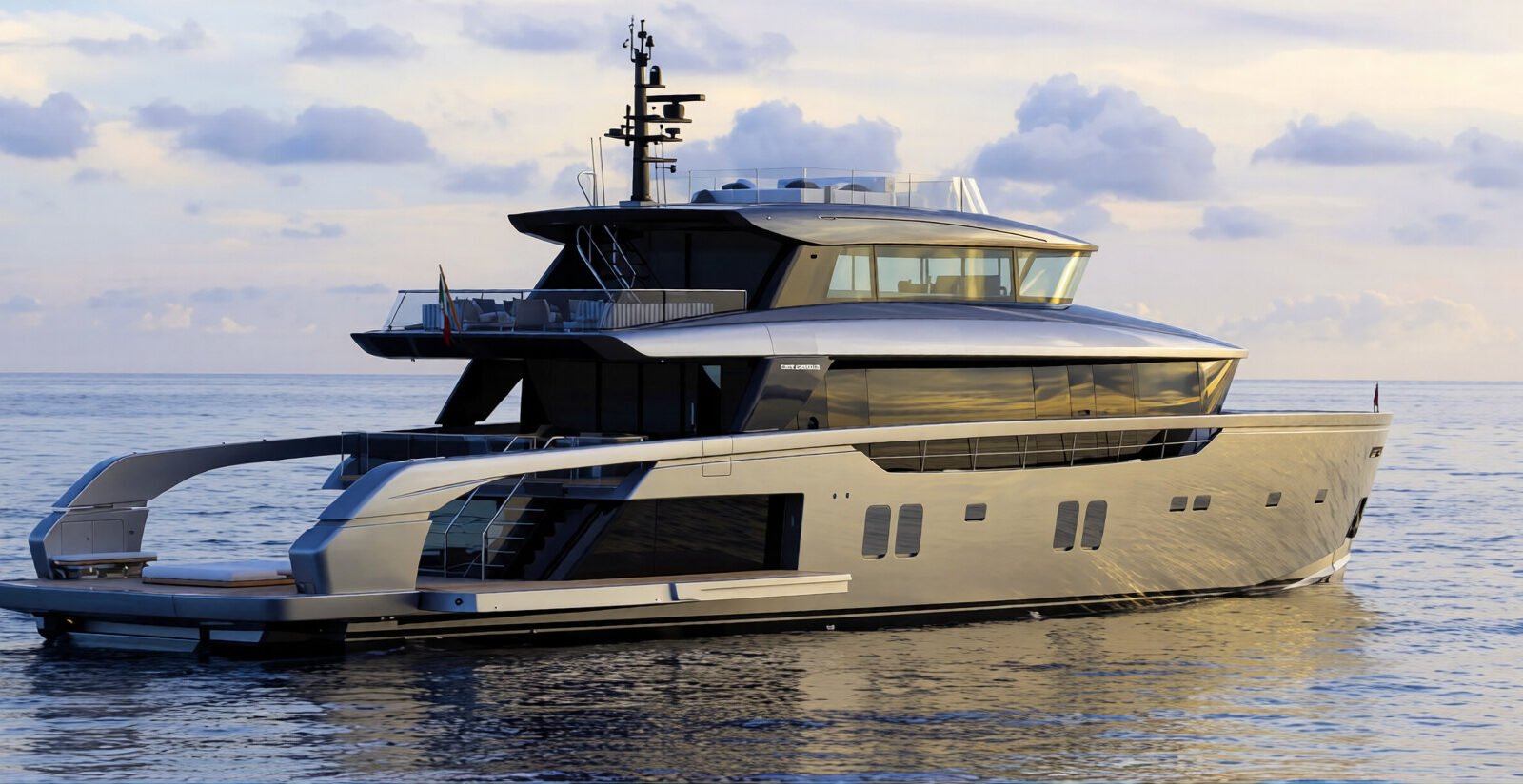
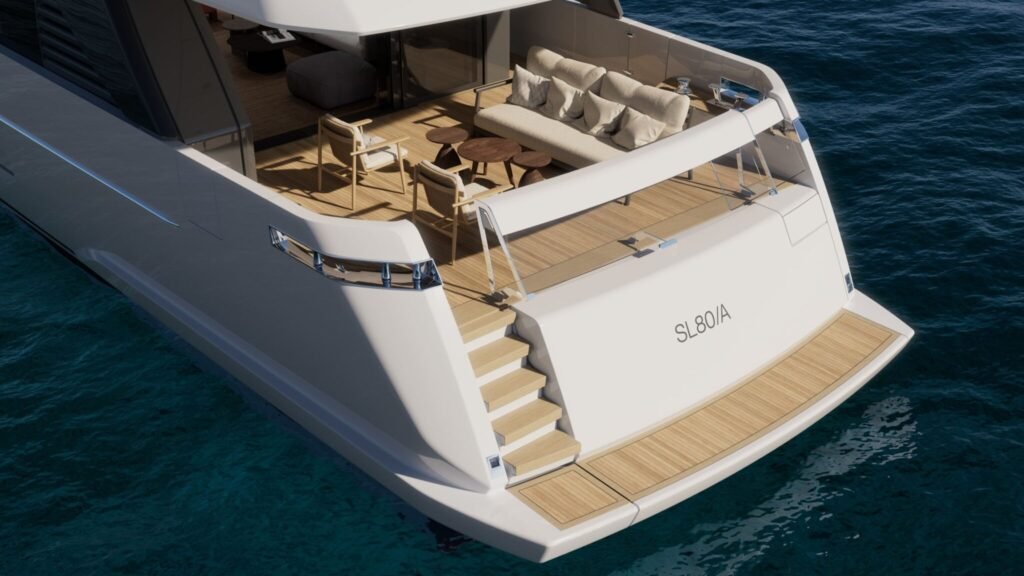
The idea came from Chris Bangle, the former BMW design chief who had already revolutionized automotive aesthetics. Bangle asked a simple question: why must a yacht be identical on both sides? Could one side be optimized for circulation while the other surrendered its walkway to interior space? Sanlorenzo patented the answer. They eliminated the port-side deck entirely, shifted the starboard walkway to a lateral passage across the roof of the superstructure, and reclaimed up to twenty percent more interior volume. The result was a full-beam main saloon on a yacht that, from the dock, still looked balanced—because the asymmetry was hidden in a careful play of glass and shadow.
The SL80A, the newest and smallest of the asymmetric family, is perhaps the purest expression of the idea. At 23.97 metres, it concentrates decades of design experience into a hull that can explore shallow bays and coastlines where larger yachts dare not go. Nine have already been sold. The first hulls are under construction. Tommaso Vincenzi, the company’s CEO, describes it not as a scaled-down version of something larger, but as a synthesis: “It is not a simplified version of a larger yacht, but a synthesis of the experience we have built over decades with the SL line.”
The Language of Materials
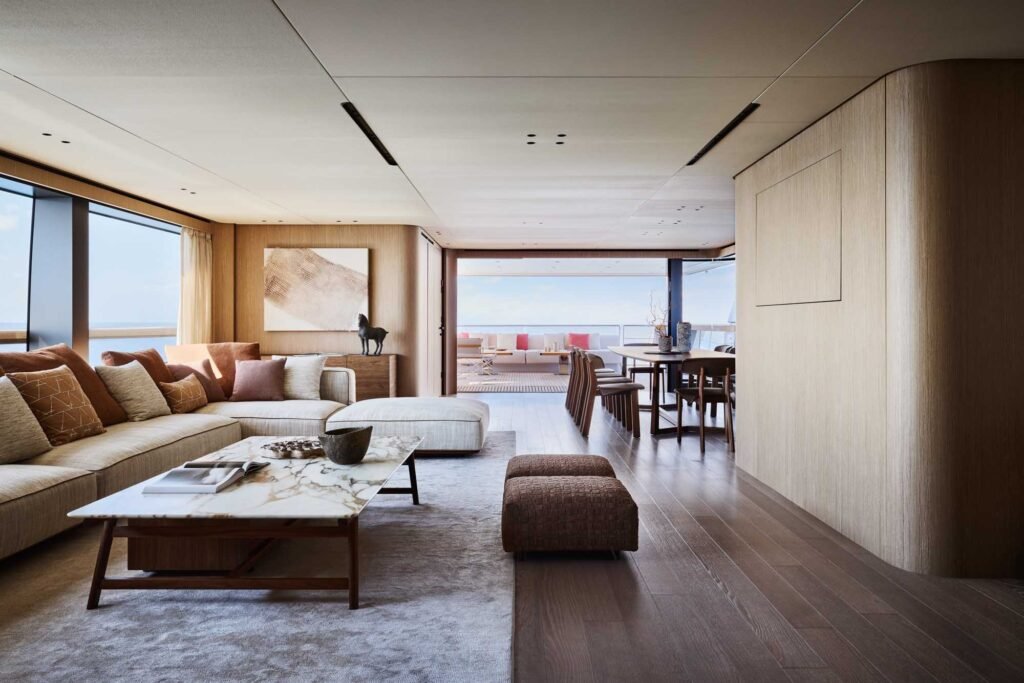
Walk through any Sanlorenzo interior and you will notice a recurring vocabulary. Thai walnut, warm and matte, speaking to the exterior teak in a whispered conversation across the threshold. Full-height glazing that turns the hull into a lantern. Floating staircases that seem to hover between decks. Lowered bulwarks amidships that flood the main saloon with light. Electrically operated sliding glass panels that disappear into the walls, so the boundary between inside and outside becomes theoretical.
The design is not minimal in the cold, Scandinavian sense. It is minimal in the Italian sense: every element earns its place, and the space between elements is as considered as the elements themselves. There is no gratuitous chrome. No marble chosen for its price rather than its grain. The materials are selected to age, to darken, to develop a patina that records the owner’s life on board. A Sanlorenzo interior is not a stage set. It is a residence that happens to move at sixteen knots.
The Leap: From Flybridge to 74Steel
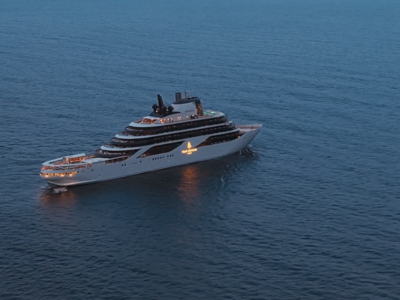
In 2016, Perotti opened the Superyacht division in La Spezia, and the yard began to think in steel. The result was the 74Steel series, and its first hull, delivered in 2026, was named Silver Fox.
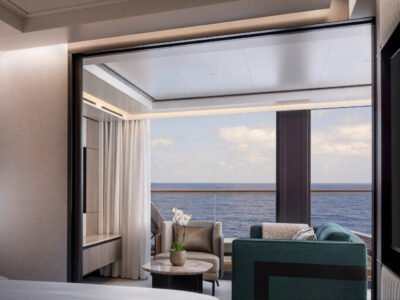
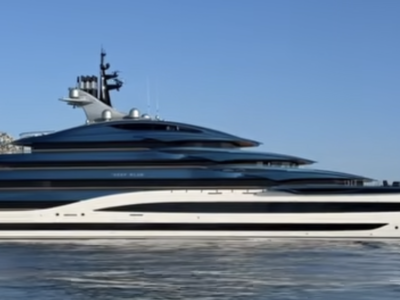
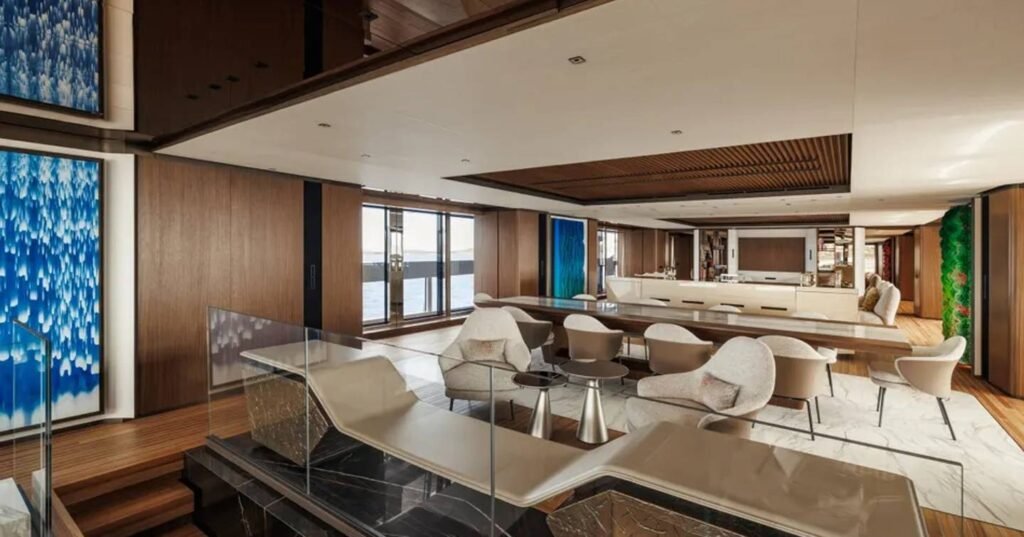
At 73.4 metres and 1,946 gross tonnes, Silver Fox is the largest yacht Sanlorenzo has ever built. It is not merely bigger. It is different in kind. The exterior lines, drawn by Zuccon International Project, possess what observers call “architectural calm”—a discipline of form that refuses to shout. The interior, by Francesco Paszkowski Design and Margherita Casprini, favours matte woods and sculpted furniture in a palette that whispers.
But the real story is below the waterline. Silver Fox is propelled by a diesel-electric system developed with Siemens Energy, using Schottel E-Pods that allow near-silent operation and roughly fifty percent lower fuel consumption than conventional setups. By rationalizing the engine rooms, Sanlorenzo freed interior volume that would normally be lost to machinery. The result is a beach club and wellness complex of approximately 290 square metres — more than the entire guest accommodation on some yachts of similar length. Within it: a gym, a hammam, a sauna, a cold plunge, a hair salon, and a family wellness room. Above, a glass-bottomed swimming pool filters natural light down through the water, so even the submerged spaces feel connected to the sky.
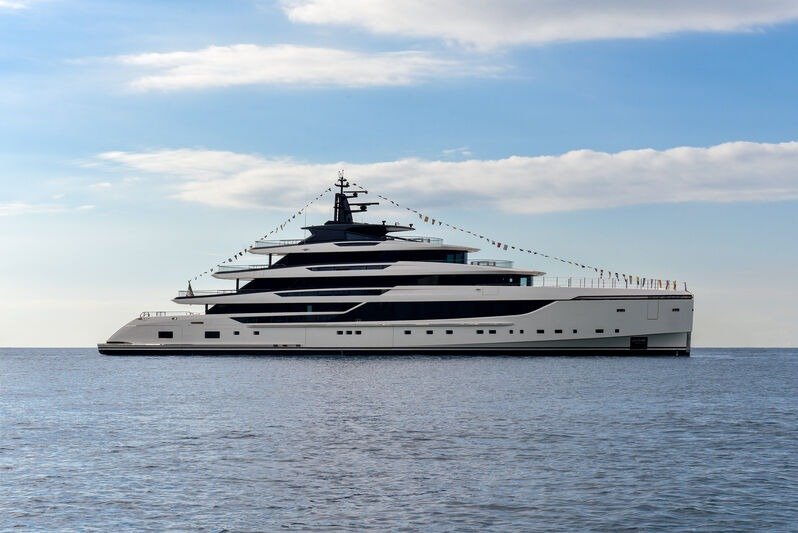
The owner’s deck alone spans 300 square metres—private, self-contained, with its own terrace, hot tub, office, and two spa-inspired bathrooms. There is a sports court on the bow for pickleball under floodlights. A touch-and-go helipad. Evogro hydroponic cabinets that let the chef harvest greens hours before plating. The yacht charters for roughly €900,000 per week, but the more telling detail is this: it was built not for a single owner’s whim, but as a statement of what Sanlorenzo could do when it stopped worrying about length and started thinking about volume, silence, and light.
The Numbers That Tell a Story
Since 1958, Sanlorenzo has delivered more than 830 yachts. The average length is a hundred feet. The average age of the fleet is just over ten years, meaning these are not museum pieces. They are living vessels, actively cruised, actively maintained, actively loved. The secondary market reflects this: used SL models start around $674,000, while newer builds command over $18 million. The average asking price sits near $7.2 million.
In 2026, the yard opened the year at Boot Düsseldorf with the new SD90 and reported 110 yachts in its order book. The new Heritage SHE series sold its first five units before the model had even made its public debut at Cannes.
There is a list of things Sanlorenzo does not do. It does not build stock yachts. It does not license its name to furniture lines or hotel chains. It does not chase the megayacht arms race beyond its own design vocabulary. It does not, despite its stock market listing, allow quarterly earnings to dictate the build schedule.
The result is a fleet of yachts that feel personal. An SL90A with its asymmetric saloon and thirty-two-knot top speed. An SD90 that rethinks space and insulation to reduce consumption. An SX88 with its open stern and loft-style interior. A 52Steel with a floodable tender garage that transforms into a beach club. And now, a 74Steel named Silver Fox that drifts through the Mediterranean on electric pods, its glass-bottomed pool casting shifting rectangles of light onto a wellness club below.
The Patina of Time
Four decades after the SL line began, Sanlorenzo remains what it was in 1958: a workshop by a river, staffed by people who believe that a boat should fit its owner the way a suit fits a body. The materials have changed—from oak and mahogany to Thai walnut and glass—but the intention has not. The yard still builds roughly fifty yachts a year. It still treats the space between things as carefully as the things themselves.
https://www.sanlorenzoyacht.com/en